23 October 2026, 14:38
Loading...
On the construction of a new nuclear unit at Dukovany in Czechia
Oldřich Sklenář
9 July 2020, 07:12
Summary:
- There are reasonable grounds to believe that the cost of the planned construction of EDU II will not be the stated CZK 160 billion, but significantly more. Based on existing experience with the construction of nuclear units, costs can be expected to rise during construction to around 2.2 to 2.4 times the original budget, in this case at least CZK 350 to 385 billion (a sum equivalent to up to ¼ of state budget expenditure in 2019).
- The project’s preparatory phase alone will cost tens of billions of Czech crowns, even if construction of the new unit does not ultimately go ahead.
- Even if construction begins, there is no guarantee that the project will be completed successfully.
- The timetable envisaging the commissioning of the new source in 2036 appears unrealistic. If this project is ever completed, it cannot be expected before the first half of the 2040s.
- According to an analysis by ČEPS, existing coal-fired power plants can be shut down without having to build a new nuclear unit.
Introduction
During the state of emergency, the Czech government approved, under a “secret” procedure, drafts of two agreements supporting the construction of new nuclear units in the Czech Republic. Approval of the third agreement is conditional on the adoption of the Act on Support for Nuclear Sources, which is to regulate the terms on which the state will purchase electricity from these sources. The bill’s sponsor, Minister of Industry and Trade Karel Havlíček (ANO), has managed to push through a significant shortening of the consultation procedure while also limiting the number of entities that can comment on the legislation.
Under the current draft of the aforementioned law, any financial losses from the construction and operation of new sources are to be passed on to end consumers, with reference to Act No. 165/2012 Coll. on supported energy sources. At present, it is not clear how any “nuclear surcharge” is to be determined, nor what its final amount will be. This will depend, among other things, on the total cost of constructing the new source.
In this context, the question naturally arises as to what the estimated cost of constructing the new unit at the Dukovany nuclear power plant (EDU II) is, and how this estimate may differ from actual costs.
The current price mentioned by ČEZ CEO Daniel Beneš in connection with EDU II is EUR 6 billion, which at the current exchange rate is approximately CZK 160 billion. The state is to contribute 70% to financing, with ČEZ to pay the remaining 30% (although ČEZ is itself 70% state-owned). Prime Minister Andrej Babiš (ANO) expects the supplier to be selected by the end of 2022, with work beginning in 2029 and being completed in 2036.
Overview of current projects
Some idea of the actual costs of constructing new nuclear units can be gained from an overview of nuclear power plants currently under construction, shown in the following table.
| Year construction began | Country | Name | Installed capacity | Original cost estimate | Current cost estimate | Converted to 1200 MW of installed capacity | Planned completion year (construction duration) |
| 2005 | Finland | Olkiluoto 3 | 1720 MW | EUR 3.2 billion | EUR 11 billion | CZK 206 billion | 2021 (16 years) |
| 2007 | France | Flamanville 3 | 1750 MW | EUR 3.3 billion | EUR 12.4 billion | CZK 228 billion | 2023 (16 years) |
| 2008 | Slovakia | Mochovce 3 & 4 | 942 MW | EUR 2.4 billion | EUR 5.67 billion | CZK 194 billion | 2020 (12 years) |
| 2013 | USA | Vogtle 3 & 4 | 2500 MW | USD 14 billion | USD 17.1 billion | CZK 195 billion | 2021-2022 (8-9 years) |
| 2018 | United Kingdom | Hinkley Point C | 3440 MW | GBP 19.6 billion | GBP 23.5 billion | CZK 240 billion | 2025 (7 years) |
The author deliberately lists only plants under construction in Central and Western Europe or the USA, primarily because conditions in the countries examined are comparable to those in the Czech Republic (unlike projects carried out, for example, in Asia). Moreover, verifiable data can be relatively easily found for these projects, unlike plants in other countries (for example, the Belarusian Astravets plant is reported to have a wide cost range of between USD 5 billion and USD 22 billion). The conversion to 1200 MW of installed capacity is related to the capacity specified in an earlier application for permission to site a new nuclear source.
The table shows, among other things, that current costs for capacity equivalent to EDU II are significantly higher than those stated by ČEZ. The average value for these five projects is approximately CZK 213 billion per 1200 MW of installed capacity, i.e. around one-third more than the estimate for EDU II. At the same time, it is important to realise that these figures are not final and may rise further over time.
It is also interesting to track how the originally estimated costs of these plants have developed compared with current figures. The overview shows that the older the project, the greater the increase in expected completion costs. For example, for the French Flamanville 3 nuclear power plant, whose construction began in 2007, the current estimate is almost four times higher than the originally expected amount. Costs at the UK’s Hinkley Point C have so far increased by only 20%, partly because it has been under construction for only two years and the phenomena described below have therefore not yet had time to emerge. On average, the original budget of the five projects examined has increased by 140%. If this figure were applied to ČEZ’s estimate for EDU II, the result would be more than CZK 385 billion.
The aforementioned cost growth is related, among other things, to delays beyond the originally set deadlines. The average planned construction period for these projects is now 12 years. If construction of EDU II began as planned in 2029, the new source would similarly not be commissioned until the 2040s.
It may rightly be argued that an estimate based on such a small sample is not sufficiently informative. Individual projects also differ greatly. In the case of Slovakia’s Mochovce 3 & 4 plant, this is essentially the completion of two units whose construction first began in 1987 and was then interrupted for more than 20 years. The VVER 440/213 reactors being built there will therefore most likely be the last completed examples of this type in the world. The Finnish Olkiluoto 3 project, meanwhile, is the first plant with an EPR reactor, developed as a joint French-German project. Each project thus has certain specific features affecting final costs. In the first case, these include problems linked to building on construction work carried out in the past or integrating safety standards tightened during completion following the accident at Fukushima in Japan. In the second case, they include difficulties in implementing new technologies and failures in managing subcontractors.
Historical experience
In addition to the overview of current projects, a comparison conducted in 2014 by a team led by Professor Benjamin K. Sovacool, who works at universities in Aarhus, Denmark, Sussex, England, and Vermont, USA, can be used. The study entitled An International Comparative Assessment of Construction Cost Overruns for Electricity Infrastructure covered 401 power plant and transmission line construction projects carried out in 57 countries (mainly in Europe and the USA) between 1936 and 2014. Nuclear power plants were represented by a sample of 180 completed reactors. The study primarily focused on cost overruns during construction, with projects divided by energy source into hydro, nuclear, thermal (fossil fuel-fired), solar (photovoltaic and solar thermal) and wind power plants, plus the aforementioned transmission lines as an integral part of energy infrastructure. Chart 1 shows the result of this comparison.
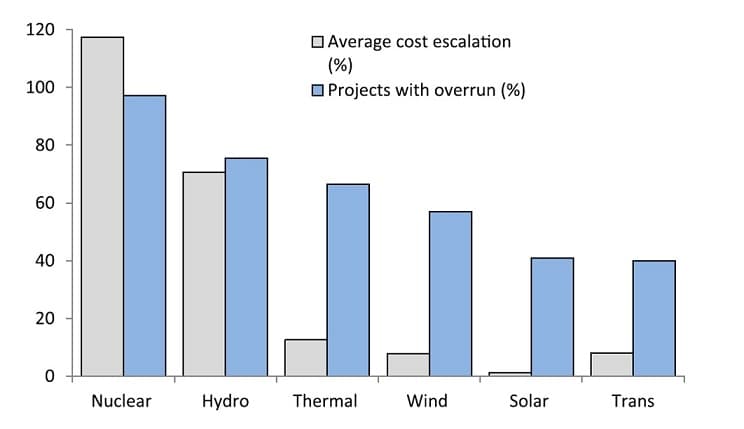
As is clear from the chart, the highest cost increase was recorded for nuclear power plants, averaging 117%, or more than double the original budgets. By comparison, solar power plants recorded just 1.3%. The nuclear power plant category also showed the highest share of projects with budget overruns – the problem affected 175 of the 180 cases examined.
If the identified figures were applied to EDU II, estimated costs would come to nearly CZK 350 billion.
Another paper by the same authors, entitled Construction Cost Overruns and Electricity Infrastructure: An Unavoidable Risk?, addresses, among other things, project delays during construction. According to this source, nuclear power plants experienced an average delay of 64% compared with the original schedule; see Chart 2. Again, applied to EDU II, construction would take not 7 but 11.5 years.
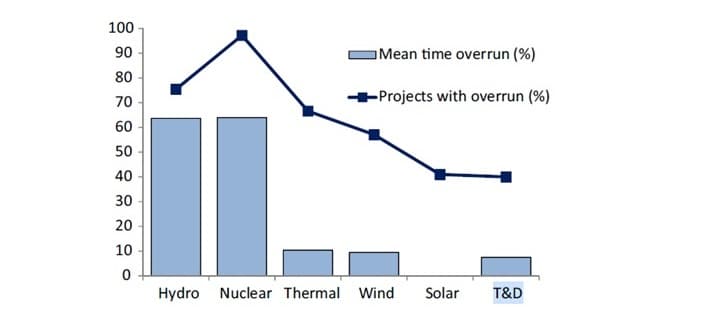
The study further examines the enormous budget increase (averaging the aforementioned 117%) compared with the relatively smaller time delay (averaging 64%). According to the authors, this is because growing delays at nuclear power plants create pressure to complete projects more quickly, accompanied by higher wage costs and shorter delivery times.
According to the authors of the study, other reasons for exceeding original costs may include:
- The impact of tightening safety measures in connection with accidents (referred to in the original as “regulatory ratcheting”): if a nuclear accident occurs somewhere in the world during the construction of a nuclear power plant (for example, the accidents at Three Mile Island, Chernobyl or Fukushima), it means significantly tighter safety measures and related standards for the entire sector. This consequently entails changes to the existing design, adversely affecting final costs.
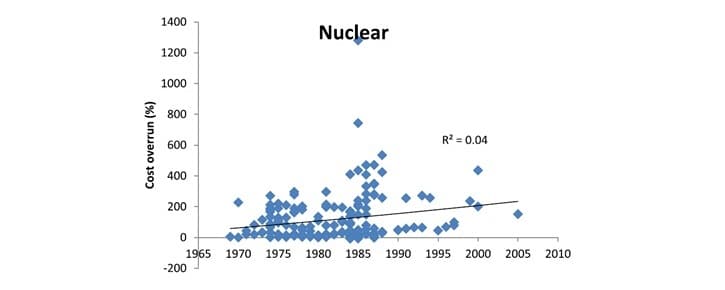
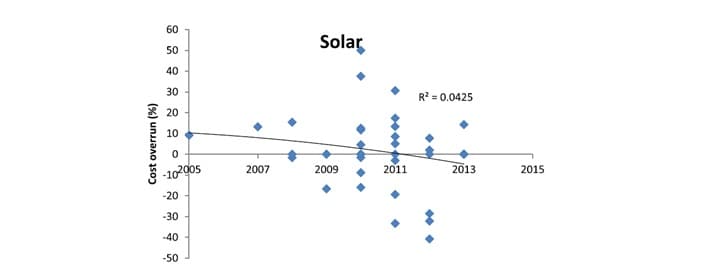
- The impact of a negative learning curve, a situation in which, rather than project implementation costs falling with each additional project due to growing experience, the opposite occurs. According to Lena Christiansson of the International Institute for Applied Systems Analysis, based in Vienna, large projects consisting of large construction units generally display a lower learning effect than projects that are based on using a greater number of standardised parts. The occurrence of this phenomenon at nuclear power plants is confirmed by another Sovacool study entitled “Risk, Innovation, Electricity Infrastructure and Construction Cost Overruns: Testing Six Hypotheses”. One of the hypotheses examined tracks the presence of a learning curve in individual energy infrastructure projects (the project sample used corresponds to the studies cited above). In the case of nuclear power plants, it was found that the later the year in which the project was completed, the greater the overrun of originally planned costs; see Chart 3a. Conversely, solar power plant projects, which typically consist of a larger number of identical parts, showed the opposite phenomenon – the later the year in which the project was completed, the lower its final costs; see Chart 3b.
- The impact of the lack of a standardised design in nuclear power plant construction. The effects of this phenomenon are closely related to the reference to standardised parts in the previous point. While essentially every nuclear power plant project is site-specific and (for several reasons) uses custom-made components, photovoltaic plants, for example, combine large numbers of standardised parts that can be produced to the same design and in large series.
- The impact of political support – this thesis assumes that nuclear power was supported in some countries not for its economic advantage but for other, often political, reasons. The authors cite the example of the USA, where nuclear energy became an object of rivalry with the Soviet Union, and France, where it was intended to contribute to reconstructing national identity and re-establishing the country as a global power. In both cases, economic aspects played a secondary role.
The study Why are Megaprojects, Including Nuclear Power Plants, Delivered Overbudget and Late? Reasons and Remedies by Giorgio Locatelli of the University of Leeds identifies the complexity of nuclear power plants as one cause of their disproportionate budget increases. It should be noted here that nuclear power plants rank among the most complex technical works created by humankind. Their construction and subsequent operation require the combination of many entirely different disciplines. In addition to nuclear engineering itself, these include, for example, civil and electrical engineering, information technology, mechanical and materials engineering, as well as geology, psychology, cybersecurity and others.
A further layer of complexity in nuclear projects is their organisation, which is subject to strict and largely specific regulation. This brings certain undesirable effects, including further increases in supply-chain costs compared with non-nuclear projects.
Failed projects
Even if construction of a new nuclear unit begins, there is no guarantee that it will be completed or commissioned. This experience can be observed, among other places, in most countries neighbouring the Czech Republic.
The first such case occurred in Austria, where in 1978 a narrow majority of voters in a nationwide referendum voted against commissioning the fully completed Zwentendorf nuclear power plant. Behind this referendum was, among other things, a political battle for the office of chancellor at the time, whose holder tied his continuation in office to its outcome. Total construction costs, including subsequent maintenance and later decommissioning, reached approximately ATS 14 billion.
A referendum also definitively ended the Polish Żarnowiec nuclear power plant project. Construction began in 1982 and was suspended seven years later by a decision of the Polish prime minister. In the subsequent vote in Gdańsk Voivodeship, more than 86% of voters opposed completing the plant – the public still vividly remembered events connected with the accident at Chernobyl in Ukraine. However, substantial financial resources had already been spent before work was halted, as several dozen buildings had been erected at the plant site. The building for the first of the two planned reactor units was 40% complete. Overall, approximately 84% of the original budget was spent on construction of the plant and subsequent related costs.
At the Greifswald plant, located in the territory of the former East Germany, a total of 6 of the planned 8 reactors were built. However, the fifth reactor operated for only a few weeks, while the sixth – although fully completed – was never commissioned.
The shutdown, or failure to commission an already completed reactor, was related to the decision of the government of reunified Germany, which made continued operation conditional on meeting Western safety standards. Retrofitting the existing units was, however, assessed as economically unviable. The former East German Stendal plant suffered the same fate. Its first unit was 85% complete and its second 15% complete.
Looking at the situation in the United States, more than 160 nuclear reactor construction projects have been cancelled there since the last century, with construction work having begun on more than 40 of them.
The most recent of these cases is the project to build 2 units at the Virgil C. Summer plant. Construction, which began in 2013, was plagued by constant delays and budget increases. These problems ultimately contributed to the bankruptcy of the supplier company (which had previously, among other things, bid for completion of the Temelín nuclear power plant), while the project’s majority owner soon afterwards decided to terminate the entire project over fears of further delays and cost increases. Around USD 9 billion had meanwhile been spent (more than CZK 200 billion). Total costs of completing the plant were estimated at approximately USD 23 billion (more than CZK 500 billion).
Conclusion
Based on the facts set out in the preceding chapters, there are reasonable grounds to believe that the cost of the planned construction of EDU II will not be the stated CZK 160 billion, but significantly more. Based on existing experience with the construction of nuclear units, costs can be expected to rise during construction to around 2.2 to 2.4 times the original budget, in this case at least CZK 350 to 385 billion (a sum equivalent to up to ¼ of state budget expenditure in 2019). However, this still refers to so-called overnight costs, i.e. costs excluding interest rates and related financing expenses.
The project’s preparatory phase alone will cost tens of billions of Czech crowns, even if construction of the new unit does not ultimately go ahead.
Even if construction begins, there is no guarantee that the project will be completed successfully. It may be interrupted or halted entirely for political, safety or financial reasons, for example.
The timetable envisaging the commissioning of the new source in 2036 appears unrealistic. If this project is completed at all, it cannot be expected before the first half of the 2040s.
In view of the above facts, it is appropriate to ask whether construction of EDU II is absolutely necessary, particularly given the planned end of coal-fired power generation. According to data from an independent analysis by ČEPS, the Czech transmission system operator, this scenario is possible. After the existing Dukovany nuclear power plant is shut down in 2035-2037 and coal-fired generation is subsequently phased out by 2040, electricity generation would be based primarily on renewable energy sources, especially photovoltaic plants (15.3 GW of installed capacity) and wind power plants (4.7 GW). Grid stability would in this case be ensured, among other things, by gas-fired power plants (4.8 GW) and battery storage (812 MW).
About the author:
The author studied, among other subjects, Energy and Process Engineering at Brno University of Technology. As a designer, he previously worked, for example, on projects to remediate uranium mining at Stráž pod Ralskem and to complete the Mochovce nuclear power plant. He now works as a manager in the development and manufacture of electrical machines. He also works as an analyst for the Fakta o klimatu organisation.
Translation disclaimer
This article is a machine translation of the Czech original and has not yet been fully reviewed. In case of any doubt, please refer to the Czech version.
Sdílejte článek prostřednictvím:
Topics:Opinion
You might also like
23 October 2026, 11:01
23 October 2026, 06:34