On the redistribution of refugees and electricity in Czechia
Amid the media clamour surrounding the peak of the refugee crisis, an inconspicuous report published on the website of the Czech transmission system operator went largely unnoticed.
The linked report presents the position of the European Agency for the Cooperation of Energy Regulators (ACER), according to which the exclusion of the common German-Austrian bidding zone from the coordinated system for calculating cross-border electricity transmission capacity in Central and Eastern Europe (CEE) breached EU rules and must be ended (see ACER Opinion 09-2015).
If there happen to be any readers who have followed my energy blogs for a long time, they may recall an article from January 2011 entitled “Even green electricity needs wires”. At the time, I wrote that with “the current very dynamic development of renewables in Germany, it is only a matter of a relatively short time before the weakest link in the chain becomes fully exposed and begins constraining the entire renewable energy system – namely, grid transmission capacity”. Even then, transmission system operators were grappling with technical problems caused by the transmission of large volumes of power from northern German wind farms to the southern parts of the country. Since the politically and economically supported construction of new renewable energy sources (particularly wind and photovoltaic plants) is progressing substantially faster than the construction of new grids and the refurbishment of older ones – which, incidentally, reliably brings negative political approval ratings – the problem of insufficient transmission grid capacity continues to worsen.
Broader technical context of the ACER decision
As their output gradually increased, German green electricity producers logically sought the most economically advantageous outlet for generation surpluses that arose under favourable weather conditions. The solution was obvious: electricity temporarily surplus in Germany could be stored in pumped-storage plants in Austria or exported to the Balkans, which has long faced an electricity generation deficit. The simplest way to achieve this was to create a common German-Austrian electricity trading zone, effectively allowing unrestricted cross-border trade. With the proviso that this new “Magna Germania” was, by decision of its founders, excluded from the system for calculating cross-border electricity transmission capacity in the CEE region…und fertig.
This is a typical example of a clash between political or environmental visions and the related economic concepts, on one hand, and technical reality on the other. Put simply, German and Austrian electricity traders currently face no restrictions and trade like mad. That is hardly surprising: in the case of weather-driven overproduction from renewables, electricity can be bought for a pittance or even at a negative price. For example, on 2 January 2015, the electricity price on the German EEX exchange was negative at -46,97 €/MWh(!). In other words, weather-dependent electricity generation from renewables, with off-market financing through the renewable energy levy and mandatory purchases by grid operators – regardless of the current condition of operating grids and the market situation – distorts the market price of electricity so much that it occasionally turns the market into a Christmas giveaway.
The consequence is clear. Sources with higher generation costs are shut down and their output is replaced by imports. There is, however, one problem. Transmission lines between Germany and Austria have technically constrained transmission capacity. Yet situations are becoming increasingly frequent in which agreed cross-border trades substantially exceed the lines’ current transmission capacity. What does this mean? Electricity that does not flow directly through Germany into Austria passes through the grids of neighbouring countries – primarily the Czech Republic and Poland. These loop flows must then be “absorbed” by neighbouring operators, albeit at the cost of economically expensive measures within their grids. Another aspect is that, due to the above-described impact on surrounding countries, German-Austrian electricity trading de facto restricts opportunities for cross-border trade in the CEE region.
Complicated situation in CEE grids at the turn of the year
Critical situations over periods of several weeks were recorded especially at the start of the year, as shown by the graph below, taken from a ČEPS document.
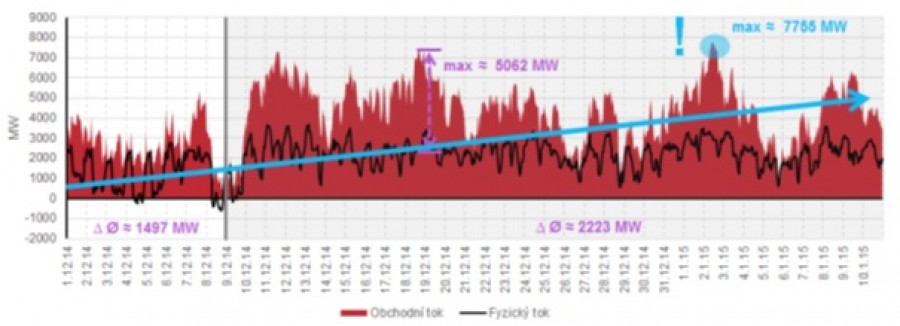
The graph shows that scheduled commercial exchanges from Germany to Austria rose to a historic record of 7 755 MW, specifically during the aforementioned 2 January 2015, when the electricity price reached its maximum negative level. Yet at that time, only around 3 100 MW was physically flowing across the border profile, less than half of the scheduled commercial exchange, with the remainder flowing “the long way around” through neighbouring grids. It should be noted that this actual physical electricity flow had already been influenced by corrective technical measures taken by grid operators. The largest difference between the commercial exchange and the physical flow, amounting to 5 062 MW, was recorded on 18 December 2014. The blue line in the graph shows the gradual increase in the difference between commercial and physical flows in the critical period after 9 December, which averaged 730 MW (> 50 %).
What happens if…
I have tried, in a highly condensed form, to outline the technical reasons that led ACER to recognise a causal link between the unified German-Austrian trading zone and difficulties in the transmission systems of surrounding countries, and to conclude that the process of allocating transmission capacity at the German-Austrian border must be managed within the CEE region. As for the timeline for corrective action, ACER calls on the region’s transmission system operators and regulatory authorities to commit within four months to adopting this procedure “according to a realistic but ambitious timetable with specific steps”.
The question naturally arises as to what will happen if the German or Austrian side challenges ACER’s position or approaches implementation, let us say, “the European way” – that is, very laxly. Regarding this possible development, it can be said that ACER’s position is merely a certain “bonus” for Central European grid operators. For example, following the complicated situation at the turn of 2011/2012, Czech national operator ČEPS decided as early as 2013 to install a phase-shifting transformer (PST) on the border with German operator 50Hertz, specifically at the Hradec u Kadaně substation, in order to ensure the technical ability to actively manage active power flows at the German border and keep them within safe technical limits. The PST is scheduled to be commissioned at the end of 2016. Polish operator PSE has adopted the same technical solution by installing PSTs.
On refugees and electricity…
If I laboriously attempt to find an analogy between the current refugee crisis and the power sector, then while the Visegrád Four countries were outvoted on the redistribution of refugees and mandatory quotas, European bodies have sided with us on the “automatic redistribution” of electricity from weather-driven renewable overproduction in Germany.
Large energy companies will remain in the game
From the perspective of the ongoing energy transition (Energiewende), the ACER decision is merely a minor complication that will not jeopardise progress towards the stated objective. However, in effect it will push German political elites one small step closer to having to bite the bullet. By this I mean clearly setting out certain conclusions and conditions for the further successful advancement of the energy transition to a public subjected to environmental media messaging. A substantial part of the public without technical education has so far believed that the energy transition is primarily about individual households installing photovoltaic panels on their roofs, storing surplus electricity in batteries, using cogeneration units, heat pumps and so on, while all conceivable achievements of modern energy systems are integrated within smart electricity grids. This is undoubtedly true, but it describes only one shade of future reality. Other shades include, for example, the construction of large industrial wind farms in the northern part of the country and in coastal waters (standard units of around 400 MW), and the construction of thousands of kilometres of ultra-high-voltage direct-current transmission lines, which will undoubtedly have a significant impact on the property rights of hundreds of thousands of landowners and profoundly affect the landscape. Put simply, Germany is an advanced industrial country and the energy transition will inevitably reach an “industrial scale” in the broader sense of the term; after all, nearly 80 000 MW of installed wind and photovoltaic capacity undoubtedly confirms that scale. This is linked to another aspect that has not yet received much media coverage – the gigantic scale of the transformation will inevitably lead to the ever-greater involvement of large energy companies in the entire process, rather than to their gradual break-up and disappearance, as many left-wing and environmentally minded advocates of the energy transition would surely wish.
(Republished with the author’s permission from nejedly.blog.idnes.cz, where it was published on 27. 9. 2015)
Petr Nejedlý
Lead photo source: www.ceps.cz
Translation disclaimer
This article is a machine translation of the Czech original and has not yet been fully reviewed. In case of any doubt, please refer to the Czech version.