
23 October 2026, 14:38
Loading...
Oppenheimer – the film and reality
Vladimír Wagner
2 March 2024, 08:04
Christopher Nolan’s film Oppenheimer has thirteen Oscar nominations. It is an excellent film depicting the golden age of nuclear physics, the birth of quantum physics, the development of the atomic bomb during World War II and its political consequences. It is certainly interesting to compare its portrayal of this key period in the history of human civilisation with reality.
The 96th Academy Awards ceremony will take place on 10 March 2024. Christopher Nolan’s Oppenheimer has 13 nominations this year. The film depicts key events in the life of Robert Oppenheimer, one of the most important nuclear physicists of the golden age, who was among the founders of quantum physics and helped drive its development. He was the scientific director of the US Manhattan Project to develop nuclear weapons and the key figure who enabled its rapid completion before the end of World War II and its use to defeat Japan.
Oppenheimer himself was one of the most prominent and fascinating figures in American, and thus international, science and politics. At the same time, he was a key actor who influenced both the course of atomic bomb development and its use against the Japanese cities of Hiroshima and Nagasaki, an event that remains highly controversial. Assessments of it are therefore highly subjective and varied. Nuclear weapons probably accelerated Japan’s defeat, but they also ensured a very long period of peace in Europe during the Cold War and in the decades following its end. Nuclear weapons are again an extremely topical issue at a time when a number of Russian politicians, including Dmitry Medvedev and Vladimir Putin, threaten to use them.
A film is not a documentary
.As I stressed when comparing the Chernobyl series with reality, a film is not a documentary. It must describe reality, including scientific and technical reality, in a way that is clear to people unfamiliar with the subject and without the relevant knowledge. This inevitably requires appropriate simplifications. Some phenomena cannot be portrayed realistically; instead, the film must focus on clarity and comprehensibility for a lay audience. A good film is also about people, expressing the feelings and subjective views of its particular protagonists.
And Christopher Nolan’s film is truly excellent. Its screenplay is based on the book by Kai Bird and Martin J. Sherwin, “American Prometheus: The Triumph and Tragedy of J. Robert Oppenheimer”. It should be stressed that the film follows the book very closely. It portrays Robert Oppenheimer’s fate: his rise, peak and fall, followed ultimately by a degree of vindication. As in his previous films, Nolan plays with time, and the film itself has multiple temporal layers in which different timelines overlap. Everything is set in the context of the clash between Robert Oppenheimer and politician Lewis Strauss. This is shown through the Senate committee hearing on Lewis Strauss’s appointment as Secretary of Commerce in 1959 and Robert Oppenheimer’s 1954 security-clearance hearing.
Against the backdrop of the hearings, testimony and recollections portray Robert Oppenheimer’s path to physics and its pinnacle, as well as the implementation and context of the Manhattan nuclear weapons project. Not only to make the interwoven narratives easier to follow, scenes from Lewis Strauss’s perspective are shot in black and white, while those from Robert Oppenheimer’s perspective are in colour. The film therefore has three main thematic layers. The first may be called “Robert Oppenheimer and his path to quantum physics”, the second “Robert Oppenheimer and the Manhattan Project”, and the third “Robert Oppenheimer and Lewis Strauss”.
Before attempting to analyse them, let us recall some important aspects of viewing the film. Natural and technical laws apply regardless of how we view them or whether we like them. There is only one set of them; we can only discover and use them. Political and historical perspectives are different. They are largely subjective, and it is usually impossible to decide which is more correct. Different people simply hold different views. A film then selects a particular subjective perspective; in this case, it is the liberal outlook of Oppenheimer and most scientists. This differs considerably from the outlook of conservative politicians. That, too, is a theme of the conflict portrayed in the film, to which we will return later.
Another problem is that many historical events are described differently by different witnesses. A film portrayal must choose one of their accounts. For other events, we have no testimony and must infer their course. As mentioned, the screenplay is based on “American Prometheus”. The book also discusses a number of events from different perspectives, and Christopher Nolan had to choose one of them. This applies, for example, to the story of the poisoned apple, which we will address later.
As with the Chernobyl series, Oppenheimer involved an enormous and, in my view, very successful effort to make its details and atmosphere authentic. Interiors, exteriors, equipment, clothing and technical details were recreated very precisely from photographs and film footage. This is clearly evident when comparing the various buildings and structures at Los Alamos in the film with historical photographs. The actors were also selected to resemble as closely as possible the historical figures they portrayed. In this respect, the film is, in my opinion, flawless. An equally enormous effort was made to depict the first nuclear weapons test as faithfully as possible. Let us now look at the individual layers in greater detail.
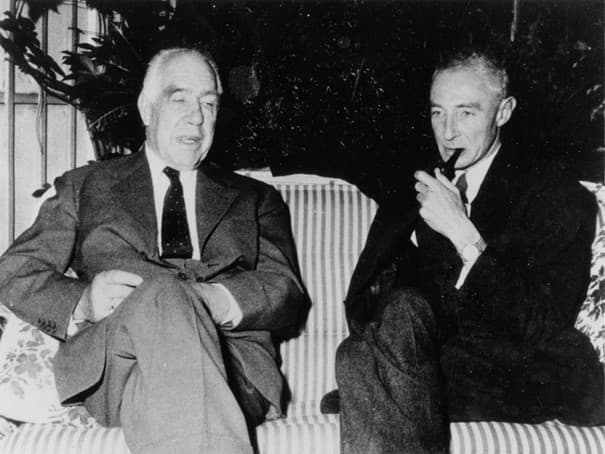
Niels Bohr and Robert Oppenheimer (source: Niels Bohr Archive, AIP Emilio Segrè Visual Archives).
Robert Oppenheimer and his path to quantum physics
The era of nuclear physics began in 1896, when Henri Becquerel discovered radioactivity. Physicists and chemists thus began exploring the extremely small-scale world. Phenomena at the microscopic level cannot be described without new physical theories: special relativity and quantum physics. These began developing at the start of the twentieth century.
The first half of the twentieth century can be described as the golden age of quantum physics, to which Robert Oppenheimer also contributed. He was born into a relatively secular Jewish family in New York; his parents were emigrants from Germany. His brother Frank also became a physicist, partly thanks to him, and worked with him on the Manhattan Project. He was interested in science and art alike. During his studies at Harvard University, he focused on chemistry and physics, although many other fields attracted him. After graduating from Harvard, he went to Cambridge.
Unfortunately, Cambridge was not an entirely good choice. He wanted to focus on theoretical physics, but was required to take a laboratory course focused on experiments. His supervisor was Robert Blackett, an outstanding experimental physicist who used cloud chambers to study cosmic rays. He received the Nobel Prize after the war for this work. Oppenheimer, however, was not a good experimentalist and lacked manual dexterity. Yet he was required to undertake tasks involving experimental equipment. He did not excel at solving them; quite the opposite. This was very stressful for him, and he was extremely angry with Blackett, leaving him with unhappy memories of Cambridge. His mental health problems also emerged during this period.
The poisoned-apple story dates from this period. In the film, he poisons Robert Blackett’s apple while Niels Bohr is visiting, and only at the last moment prevents Bohr from eating it. Whether the incident actually occurred in this way is questionable. The book on which the screenplay is based discusses a number of possibilities. One is even that it never happened at all. It is known mainly from accounts by colleagues who heard the story from Oppenheimer. It is therefore possible that he merely contemplated such an act and gradually created a legend. In any case, it is not known whether or how the event occurred. What is certain, however, is that it did not happen as depicted in the film. The apple incident, if it existed, took place sometime in autumn 1925, whereas Niels Bohr’s Cambridge visit, which strongly influenced Oppenheimer, did not occur until 1926.
Robert Oppenheimer was an outstanding theorist. His subsequent stay in Göttingen was therefore exactly what he needed. Göttingen was then a centre of theoretical physics, and his supervisor there was Max Born, one of the founders of quantum physics. It was there that his talent fully emerged. He wrote a number of publications, the best known concerning the Born-Oppenheimer approximation. This is based on the possibility of separating the motion of atomic nuclei and electrons in a molecule, since atomic nuclei are many orders of magnitude heavier than electrons, and thus describing the quantum dynamics of molecules. He also completed his doctorate there.
He then undertook several postdoctoral stays, visiting Caltech in California and several places in Europe, including Leiden and Zurich. There he met a number of young physicists and gained valuable contacts that proved useful during the Manhattan Project. He also began looking for a place where he could teach and form his own group focused on quantum physics. He eventually chose a professorship at the University of California, Berkeley. The main reason was that it had no theoretical group focused on quantum physics and he could create one as he wished. Another enormous advantage was that the outstanding experimentalist Ernest Lawrence also worked at the university. Lawrence is known as the creator of the cyclotron, the best-known type of particle accelerator. The intensive cooperation between theorist and experimentalist was useful not only for the Manhattan Project. It was also where Oppenheimer tested his organisational abilities and gained many students and supporters.
He worked very closely on astrophysical topics with Richard C. Tolman, Hartland Snyder and Robert Serber. His interest in astrophysics culminated in a series of articles on the stability of neutron stars and their collapse into black holes. When a star exhausts its fuel, it ceases to resist gravitational attraction and begins to collapse.
In white dwarfs, collapse is prevented by the resulting degenerate fermion gas composed of electrons. As the mass of a star’s final stage grows, gravitational pressure rises further. So does the kinetic energy of the electrons in the degenerate fermion gas. Since electrons are very light, they soon become relativistic and subsequently ultrarelativistic. At a certain stellar mass, the fermion gas can no longer resist gravity. The star begins to collapse again. This limiting mass is known as the Chandrasekhar limit.
Further collapse creates a new form of matter: electrons and protons combine into neutrons, forming a neutron star. Like electrons, neutrons are fermions, producing a degenerate neutron fermion gas that resists further collapse. Nuclear matter composed of neutrons forms. Neutrons are very heavy compared with electrons. Even at higher kinetic energy, they therefore remain non-relativistic particles. However, as the dying star’s mass increases further, even the neutron fermion gas can no longer resist further gravitational collapse.
Using the description of a degenerate fermion gas and classical Newtonian gravity makes it possible to determine the relationship between the mass and radius of a white dwarf, and similarly of a neutron star. It can also determine the aforementioned Chandrasekhar limit for the maximum mass of a white dwarf. The limit for neutron-star collapse was determined by Oppenheimer and his colleagues. It is now called the Tolman-Oppenheimer-Volkoff (TOV) limit. Calculations for an ultrarelativistic degenerate electron gas in a white dwarf and a non-relativistic degenerate neutron gas are fine examples of the ultrarelativistic and non-relativistic limits of a degenerate fermion gas. I therefore liked to use them in tutorials on the fundamentals of nuclear astrophysics. It should be stressed that the precision of the TOV limit is limited. Besides neutron matter, a neutron star may contain hyperon or quark matter. At the same time, the gravitational field begins to reach intensities at which the inaccuracies of Newtonian gravity become apparent.
If a neutron star collapses, we no longer know of any form of matter capable of preventing further collapse. To describe this process, however, Newtonian theory is no longer sufficient and we must turn to general relativity. Yet even there, nothing stops the collapse and a singularity results. This does not mean that matter collapses into a point, but only that the collapse produces conditions our current physical theories cannot describe. In any case, the matter of the collapsing star passes below the horizon and a black hole forms. This unstoppable collapse of a neutron star and the formation of a black hole was described precisely by the article by Robert Oppenheimer and Hartland Snyder, published on 1 September 1939 in Physical Review. World War II began that day, and the same issue also carried an article describing the properties of uranium fission, heralding the path to nuclear weapons. The excellent article on the necessity and existence of black holes was thus overshadowed by other events.
Robert Oppenheimer and the Manhattan Project
After Walther Bothe and Herbert Becker discovered neutral radiation produced by bombarding beryllium with alpha particles, and James Chadwick proved in 1932 that these were neutral particles with roughly the mass of a proton, several key findings existed that made it possible to build a nuclear energy source. The first was the discovery of uranium fission by neutrons and determination of the energy released. The second was the finding that fission releases not only energy but also several neutrons that can trigger further fission. A fission chain reaction can therefore be achieved. The third was understanding the difference between uranium-238 and uranium-235 and the possibilities for using them in fission.
The discoveries of fission and its key properties came just before and at the start of World War II. In December 1938, German physicists Otto Hahn and Fritz Strassmann published their discovery that barium was produced when uranium was irradiated with neutrons. This was explained as uranium fission using the liquid-drop model. The following year, Lise Meitner, who had to flee Germany because of her Jewish origin, used the nuclear liquid-drop model to calculate the considerable energy released in this fission.
Niels Bohr prompted a highly intensive debate in the physics community on the existence and properties of uranium fission, and the already mentioned article by Niels Bohr and John Wheeler on the fission mechanism of uranium was published on 1 September 1939. It was preceded in August of the same year, in the same journal, by an article by H.L. Anderson, Enrico Fermi and Leo Szilard on neutron production during fission. This was crucial information, pointing to the possibility of a fission chain reaction and a route to obtaining nuclear energy.
The importance of information on neutron production during fission is illustrated by an interesting episode from Czech scientific circles. On 14 October 1942, the journal Vesmír published František Běhounek’s article “The illusion of atomic machines”. It is a very fine overview of knowledge of nuclear structure and nuclear physics, fully consistent with current understanding. Yet it states that even for fission energy, the ratio between energy gained and energy invested to obtain it using an atomic machine was highly unfavourable. It was clear, he wrote, that this problem would be solved in the distant future, but atomic machines for producing energy could not be expected soon. The article appeared about two months before Enrico Fermi started the first nuclear reactor, Chicago Pile-1—an atomic machine producing energy.
Why was one of the greatest Czech nuclear physicists mistaken? Precisely because he lacked the information that neutrons are released during fission. Since Czechia was already occupied at the time and Czech universities had been closed in November 1939, information about this discovery and new findings had not reached him. He therefore assumed that neutrons would be produced using beams of charged protons or alpha particles accelerated in an accelerator and reacting with beryllium. This is a process with enormous energy losses. The discovery of neutron release during fission and the possibility of a fission chain reaction was the crucial missing piece that enabled the use of nuclear energy. I wrote about this article in greater detail for Vesmír magazine.
As early as 1939, it was clear that the Germans, who had made the key discoveries, also possessed the information needed in principle to build nuclear weapons. A number of physicists, especially those of Jewish origin who had fled Germany, feared Hitler might acquire such a weapon. Leo Szilard therefore wrote a letter intended to convince US President Franklin Delano Roosevelt that an atomic bomb could be built and that the Germans were working on such a project. He had Albert Einstein sign it, and it was delivered to the president in October 1939. It was one of the main impulses leading to the Manhattan Project.
A key project in the drive towards the bomb was building and starting a controlled fission chain reaction and reactor. The first such facility, Chicago Pile-1, began operation on 2 December 1942, two months after the aforementioned article by František Běhounek appeared. The reactor was built by a team led by Enrico Fermi. Its youngest member, and the team’s only woman, was Leona Woods Marshall, who prepared Geiger-Müller counters.
Let us consider what must be ensured for an atomic bomb to work. A supercritical quantity of fissile material must be prepared, divided into two subcritical parts. The supercritical mass must be assembled sufficiently quickly; it cannot be done manually, and an appropriate detonator is needed. The fission chain reaction must be initiated without a moderator. The supercritical mass must be maintained long enough for a sufficient amount of fissile material to burn.
Potential fissile material must have an odd number of neutrons. Uranium-235, which accounts for around 0.7% of natural uranium, can be used. Its advantage is that it occurs naturally. Its disadvantage is that it must be separated from uranium-238, which cannot be done chemically. The other option is plutonium-239. Its disadvantage is that it does not occur naturally and must be produced in reactors. Its advantage is that it can be separated chemically.
Developing a nuclear weapon and carrying out all the necessary steps requires an enormous volume of experimental data as well as theoretical and technological progress. It was therefore necessary to concentrate large numbers of top scientists, engineers and workers.
It also required someone to bring together all those needed and organise the necessary effort. Two people undertook this task within the Manhattan Project. Lieutenant General Leslie Groves Jr., a West Point graduate and engineering officer with considerable organisational experience, became military commander. Before the Manhattan Project, he oversaw construction of the Pentagon. He had exceptional organisational abilities. He chose Robert Oppenheimer as scientific director. ¨
They were very different characters, but their cooperation proved extremely successful. General Groves did not regret his choice. He commented on it: “Everyone criticised me, saying that only a Nobel laureate, or at least an older man, would have enough authority to manage so many prima donnas. But I insisted on Oppenheimer, and the results proved me right. What he accomplished, nobody else could have done.”
The Manhattan Project had three main sites. Los Alamos in New Mexico, where the nuclear weapon was developed, assembled and ultimately tested. Its director was Robert Oppenheimer, who selected this particular location. This site is the main subject of the film. Oak Ridge in Tennessee focused on uranium enrichment. Hanford in Washington focused on producing plutonium in reactors and separating it. There were also many others, such as Chalk River in Canada. At its peak, around 125 thousand people were involved in the project. Around half a million workers passed through it over the project’s duration between 1942 and 1945.
Oppenheimer succeeded in assembling an extensive team of top scientists. It included established older physicists, but also many young people who would become the elite of the second half of the twentieth century and win Nobel Prizes. A number of them had only just left university when they joined the Manhattan Project. One was Richard Feynman, my favourite, whose view of quantum physics most closely aligns with mine. The pranks with which he tormented Los Alamos security personnel while working on the Manhattan Project, described in his books, are first-rate.
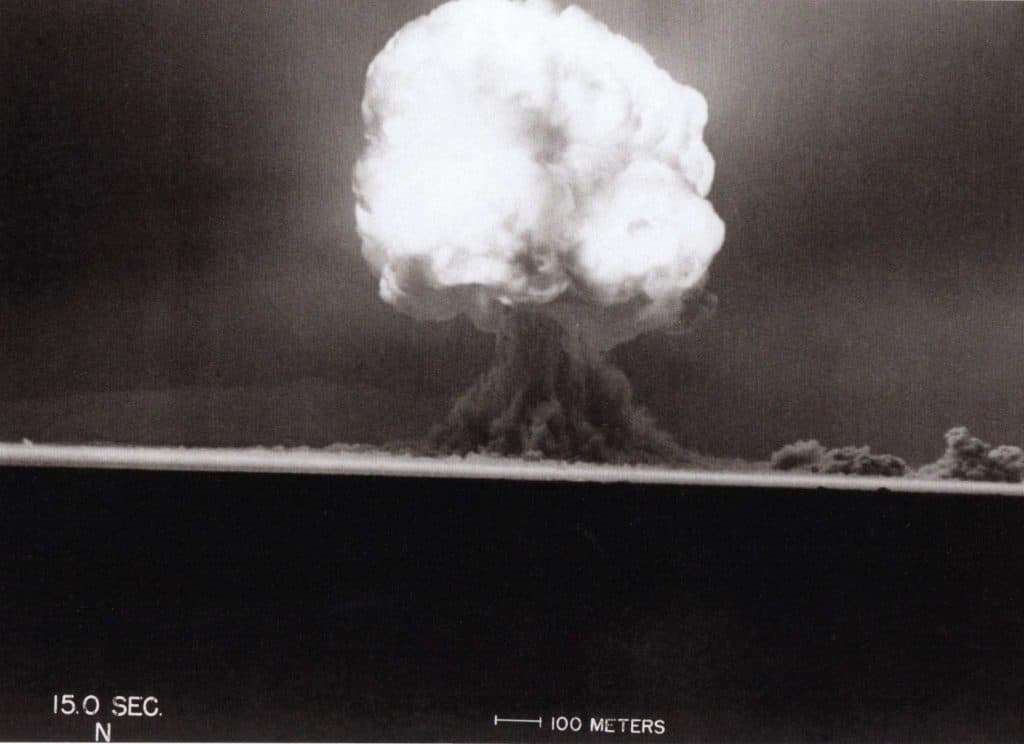
The work on developing the bomb and its first test is the key and most fascinating part of Nolan’s film. This is where he seeks the greatest possible fidelity even in detail, as well as maximum plausibility and understanding for a lay viewer. In my opinion, he truly succeeded. The depiction of the detonation of the implosion-initiated plutonium bomb Gadget in the Trinity test, which is also the film’s climax, is genuinely dramatic and apt. Kenneth Bainbridge was in charge; in the event of a failed detonation, he was the person who would have had to go to the tower first and inspect what had failed. The storm ended just in time. The test was thus carried out in the Jornada del Muerto desert on 16 July 1945 and had 425 participants, mainly scientists, technicians and soldiers. Both Oppenheimer brothers were present. Given the large number of physicists who briefly appear in the film’s portrayal of the test, their characterisation is necessarily sometimes more schematic and relies on symbols associated with them. For my favourite Richard Feynman, these include bongo drums.
The bets scientists placed among themselves on the outcome of the nuclear explosion again mention the possibility of igniting a chain of thermonuclear fusion reactions in the atmosphere. This issue runs through the entire film. It concerned the possibility that the extremely high temperatures produced by an atomic bomb explosion could start a chain reaction between pairs of nitrogen nuclei, releasing vast amounts of energy. Edward Teller, Emil Konopinski and Cloyd Marvin calculated the probabilities of the relevant reactions and showed that, even on the basis of knowledge at the time, the probability of such a reaction was extremely close to zero. At that time, there was not yet the experience with safety studies involving extremely small probabilities that has since accumulated, for example through the use of nuclear power. The military in particular therefore demanded proof of zero probability.
Discussions were also intense among scientists associated with the Manhattan Project about whether to use nuclear weapons against Japanese cities. After Adolf Hitler’s defeat, many of them favoured a warning in the form of an internationally public test in an uninhabited location. However, it should be remembered that the bloodiest clashes for the United States had taken place in the Pacific and the Japanese were even more fanatical than the German fascists. America genuinely feared enormous losses should an invasion of the Japanese islands become necessary.
Robert Oppenheimer himself ultimately supported the necessity of dropping the bomb on a Japanese city. On 6 August 1945, the Little Boy uranium bomb was dropped on the Japanese city of Hiroshima. Like the massive aerial bombing of Tokyo, it claimed around one hundred thousand victims. The psychological difference in the impact of these attacks was that Hiroshima involved one aircraft and one bomb, while the Tokyo bombing involved a massive raid by many aircraft. Japan did not surrender after the first attack; it was compelled to do so only after the Fat Man plutonium bomb was dropped on Nagasaki on 9 August 1945. It was fortunate that the Japanese did not know the Americans then had no further atomic bomb, nor the necessary enriched uranium or plutonium. World War II finally ended. But the world faced the question of how to deal with the risk of a nuclear arms race.
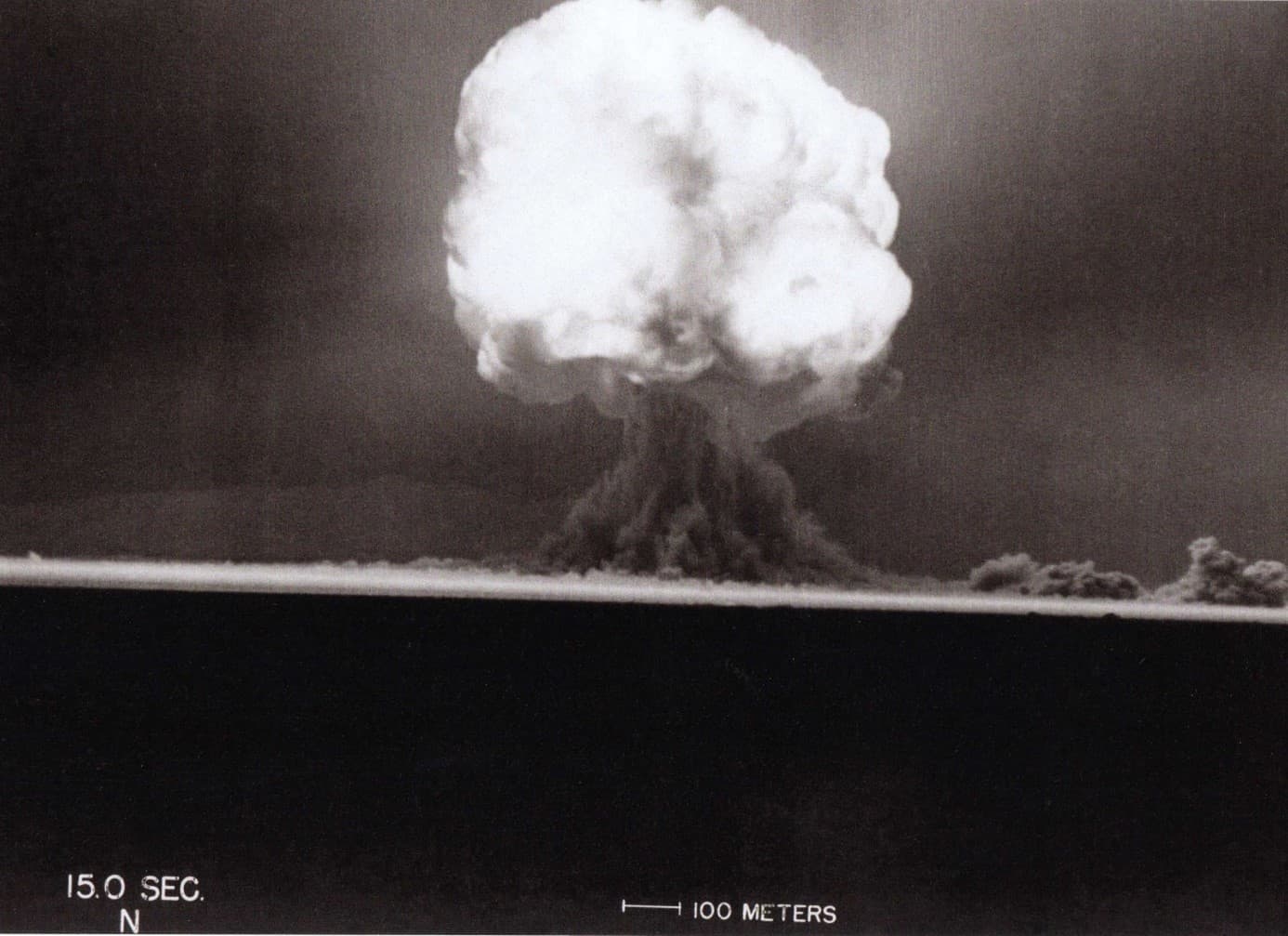
Nuclear bomb explosion during the Trinity test (source: Atomic Heritage Foundation).
Robert Oppenheimer and Lewis Strauss
Robert Oppenheimer and Niels Bohr, among others, were aware of this risk. They sensed that a world with nuclear weapons would differ from the world before them. They believed one of two possibilities would occur: either nuclear weapons would make major war impossible, or civilisation would be destroyed. We know that reality proved much more complex. Possession of nuclear weapons by the US and USSR ensured a long period without military conflicts in Europe during the Cold War.
Both considered how to avoid a nuclear arms race. Their idea was for the US to be as open as possible in this respect, not develop thermonuclear weapons, and create an international organisation that would control nuclear non-proliferation while allowing the peaceful use of nuclear energy by all states complying with non-proliferation obligations. They hoped that with a transparent US proposal and negotiations, an agreement of this kind could be reached with the Soviet Union.
A number of politicians and some scientists did not believe such an agreement was possible and insisted on developing an arsenal of fission nuclear bombs as quickly as possible, as well as thermonuclear weapons. Thanks to his successful leadership of the Manhattan Project, Robert Oppenheimer became very well known and sought to use this popularity to influence politicians in line with his view of the need to control nuclear armament. This brought him into conflict with a number of influential people, some of whom were prepared to use any means to neutralise him.
They included Lewis Strauss, first a member and then, from 1953, chairman of the Atomic Energy Commission. After the war, nuclear weapons development was to be transferred to civilian administration, and work was also needed on the peaceful use of nuclear energy. The Atomic Energy Commission was established for this purpose and had five members.
As a member and later chairman of this body, Lewis Strauss met and worked with Robert Oppenheimer. His priorities were keeping nuclear weapons development secret from the Soviet Union and maintaining the US lead in this field; developing thermonuclear weapons; and independently monitoring nuclear weapons development and possible tests in the Soviet Union. It is clear that Lewis Strauss and Robert Oppenheimer were bound to clash in their views.
On thermonuclear weapons development, Edward Teller sided with Strauss against Oppenheimer. Lewis Strauss had acquaintances in the US Air Force and, for that reason as well as others, advocated a project for a specially equipped aircraft that would detect any Soviet nuclear test by collecting air samples in the upper atmosphere and determining their radioactivity. Both Oppenheimer and Teller opposed this project.
Lewis Strauss was a conservative Republican, while Oppenheimer was a left-wing liberal. They were political opposites, and there were also a number of personal antipathies between them. When Lewis Strauss became chairman of the Atomic Energy Commission in 1953, he made it a condition that Oppenheimer’s security clearance be revoked and that his influence over nuclear weapons development be removed.
The main reason he gave for this demand was Oppenheimer’s pre-war contacts with American communists. These contacts did indeed exist: both of Oppenheimer’s fateful women, Jean Tatlock and Kitty Oppenheimer, were communists, as were some of his friends. A hearing was therefore held in 1954, at which Robert Oppenheimer’s security clearance was assessed under new, stricter rules. Although most witnesses called spoke in Oppenheimer’s favour, Teller was an exception, and Oppenheimer was stripped of his clearance. General Groves conceded that under the new criteria he would not have granted Oppenheimer a security clearance. However, he also noted that he could not have granted one to the overwhelming majority of the leading scientists without whom the Manhattan Project could not have been carried out.
Frank Oppenheimer’s fate is interesting; he paid an even higher price for the campaign against his brother. While Robert Oppenheimer was excluded from nuclear weapons work but could lecture and conduct physics research, his brother was not allowed to teach even at secondary school. Only in 1957 did he begin teaching physics again, at a Colorado secondary school, and later at a university, where he also joined particle physics research. Gradually, however, he focused more on popularising and teaching science and physics. Inspired by new modern methods gaining ground in Europe, he established a new type of museum in the US: the Exploratorium in San Francisco. His work in this field was an enormous benefit to the United States and the world.
Not only Oppenheimer but many of his scientific colleagues were outraged by Lewis Strauss’s campaign. And in 1959, they repaid him. President Dwight D. Eisenhower nominated him for Secretary of Commerce. His appointment required Senate approval, which he did not receive after a hearing. This was largely due to the appearance of David L. Hill, who had participated in Chicago Pile-1 as a young man and spoke in the Senate on behalf of scientists.
It should be stressed that in portraying Lewis Strauss as an unequivocally negative character, Christopher Nolan adopted the subjective view of events held by the liberal intellectual milieu to which he undoubtedly belongs. That view is closer to me too, but I would not dare claim it is the most correct one.
I can imagine a film that would portray Lewis Strauss just as truthfully as an entirely positive figure. He was an important American philanthropist who did much good for the United States. For example, the special aircraft for monitoring radioactivity in the atmosphere, whose implementation he eventually pushed through despite Oppenheimer’s opposition, made it possible to detect the Soviet Union’s first atomic bomb test, conducted on 29 August 1949. Thus, it was the US that announced the first Soviet nuclear weapons test, just as the West was first to announce the Chernobyl accident. He also worked very intensively to develop nuclear power. He was the author of a statement frequently misused by anti-nuclear activists against nuclear energy. He said nuclear electricity would be so cheap that installing electricity meters would not be worthwhile. To understand his statement, one must know the context, which anti-nuclear activists ignore. The fact remains that Lewis Strauss greatly helped the development of nuclear power not only in the United States.
As I wrote at the beginning, a film is not a documentary. It portrays a particular subjective view of the world and history—a view that encourages thought, and perhaps also encourages viewers to try to see and understand other subjective perspectives. From my subjective perspective, Christopher Nolan’s Oppenheimer is an excellent film. I first saw it at the IMAX Flora cinema in 70 mm, and it is truly a fantastic spectacle. Its interesting details and historical references certainly make it worth seeing more than once.
Conclusion – how should we live with nuclear weapons?
Robert Oppenheimer and the other scientists involved in developing nuclear weapons encountered a fundamental question: “How should our civilisation live with nuclear weapons?” We face this problem today as well. Treaties banning nuclear weapons tests have been negotiated and concluded. Methods have been created to control the proliferation of nuclear technologies and materials needed to produce nuclear weapons. As already mentioned, parity between Western and Soviet nuclear arsenals ensured a long period of peace in Europe during the Cold War.
Today, however, the urgency of the problem is again heightened by Russia brandishing its nuclear arsenal and by Iran’s efforts, along with those of some other states, to acquire nuclear weapons. This is why it is very useful to recall how we acquired nuclear weapons and how their creators considered solutions to the issues associated with the risks of their use. I therefore recommend not only watching the film but also reading “American Prometheus”, the book that provided the basis for the screenplay. It examines in great detail the scientists’ reflections and discussions on this subject.
I gave a very detailed analysis of the differences between Oppenheimer and reality for Café Nobel in Děčín in January 2024.
For the same organisation, this time in Teplice, I gave a lecture years ago on the Chernobyl series and reality.
Translation disclaimer
This article is a machine translation of the Czech original and has not yet been fully reviewed. In case of any doubt, please refer to the Czech version.
Sdílejte článek prostřednictvím:
Topics:Opinion
You might also like


23 October 2026, 11:01


23 October 2026, 06:34