23 October 2026, 14:38
Loading...
Past successes, current problems and the open future of French nuclear power
Vladimír Wagner
7 April 2023, 13:35
Following developments in the energy sector in recent years, France has returned to expanding nuclear power. Several other European countries, including Czechia, likewise want to use nuclear generation to build a low-emission energy mix. It is therefore certainly useful to examine France’s experience and plans in greater detail.
Thanks to its nuclear fleet, France has had a low-emission power sector for several decades. At the same time, it is the only European Union country that covers all components of the nuclear industry. It builds nuclear reactors, produces their fuel and also recycles spent fuel. After hesitation in previous years, plans to reduce the share of nuclear generation in the energy mix and the closure of existing nuclear units, France has returned to the path of nuclear power development and expansion following the experience of recent winters.
Czechia, like several other countries, is now also more decisively pursuing a nuclear-renewables mix. It is therefore particularly interesting for us to look more closely at France’s experience and plans in nuclear power. I recently had the opportunity to attend a very good seminar on this subject by Jan Barták of consultancy NucAdvisor. Drawing also on his presentation, I decided to provide a brief introduction to the topic.
The beginnings of French nuclear power
France began developing nuclear power alongside other countries in the 1950s. As one of the great powers, it developed this field in parallel with its nuclear weapons capability. France initially focused on gas-cooled, graphite-moderated reactors. In the second half of the 1950s and in the 1960s, it built nine such reactors, which were similar to the British Magnox reactors. Construction began between 1956 and 1959 on the two gas-cooled, graphite-moderated Chinon A1 and A2 reactors, with capacities of 70 MWe and 180 MWe, and the three Marcoule G1, G2 and G3 reactors, with capacities of 2 MWe, 39 MWe and 40 MWe. Some of these reactors were also used to produce plutonium for French nuclear weapons. The last of these reactors, Bugey 1, started up in 1972. Some of them supplied electricity for a relatively short period. Chinon A1 operated for only two years, although it was commissioned in 1963 and permanently shut down in 1973. Most, however, generated electricity for between fifteen and twenty years. Bugey 1 operated for the longest period, supplying electricity for around 23 years. The last of these reactors, the aforementioned Bugey 1, was shut down in 1994.
By 1973, one heavy-water gas-cooled reactor, EI 4 (Monts D´Arree), and the first light-water pressurised-water reactor, Chooz A, with a capacity of around 300 MWe, had also been built. The sodium-cooled fast reactor Phénix also started up in 1973. The larger sodium-cooled fast reactor Superphénix followed on from this experience in the 1980s. It was a period of exploring options and selecting the most promising reactor model for the next phase of power sector development.
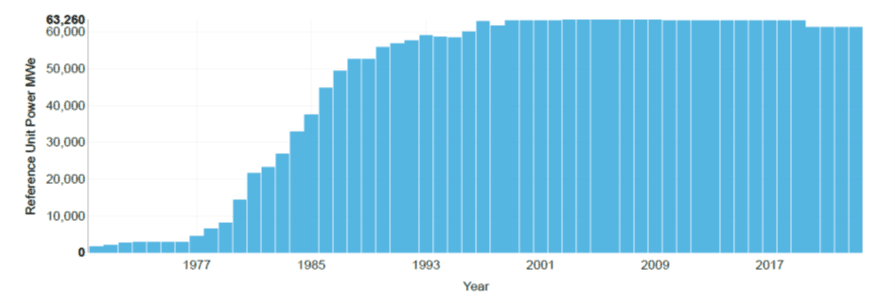
Development of total French nuclear generating capacity. The transition from fossil-fuel power generation to the current mix is clearly visible (source: WNA).
Achieving a low-emission power sector
France ultimately decided to focus on pressurised-water reactors. Their development was based on the US concept of Westinghouse, which was fully adapted by Framatome (Franco-American Atomic Constructions). The programme’s success was based on accumulated experience with this reactor model, which had proven itself in the US. France also benefited from building a uranium enrichment plant and fuel production facilities needed for light-water reactors.
The first-stage plan was to build an initial series of thirteen reactors with capacities of 900 MWe. The first of these, Fessenheim 1, started up and began supplying electricity to the grid in April 1977. In total, 34 three-loop pressurised-water reactors with capacities of around 900 MWe were eventually built. France’s decision to base its power sector on nuclear generation was strongly influenced by the first oil crisis in 1973 and confirmed by the second oil shock in 1979. Nuclear power was to help France reduce its dependence on imported fossil fuels.
Construction of larger units with capacities of around 1,300 MWe began in 1979. A total of 20 were ultimately built. Construction proceeded extremely quickly in the 1970s and 1980s: seven units began supplying electricity to the grid in 1980 alone, followed by eight a year later. The third record year was 1986, when five units were connected. Almost the entire French nuclear reactor fleet, which can provide more than 70 % of French electricity generation, was built in less than twenty years.
Intensive construction continued in the 1990s, when four units of the most advanced N4 type, with capacities of around 1,500 MWe, entered operation between 1996 and 1999. The Civaux and Chooz B plants each have two of these newest reactors.
At the turn of the 1980s and 1990s, the gas-cooled, graphite-moderated reactors described above were being closed, but they had relatively small capacities and were easily replaced by newly completed pressurised-water reactors. From the end of the 1990s until 2020, France therefore operated 58 reactors with total capacity of 63 GWe, which supplied more than 70 % of French electricity generation in a given year and in some years approached almost 80 %.
Most plants are located on the coast or on major rivers. Cooling towers were therefore not built at them. This means that on exceptionally hot summer days and when water is scarce, some reactors must reduce output or even shut down. However, such events are exceptional, while electricity consumption in France is much lower in summer than in winter. The need to reduce output in summer is therefore not usually critical.
The high share of nuclear generation led to its use not only for baseload but also for grid balancing. The French therefore have experience showing that this genuinely works. Hydropower also makes a significant contribution to grid balancing, but the French grid could not operate without the flexibility of nuclear reactors. Thanks to its extensive nuclear fleet, France was for a long time Europe’s largest electricity exporter. Italy in particular, which has instead abandoned nuclear power, is heavily dependent on it. High production of cheap electricity also led to the use of electric heating in France. A positive consequence of such heating is its environmental cleanliness. A potential problem is that every one-degree fall in temperature in winter results in a significant increase in electricity consumption.
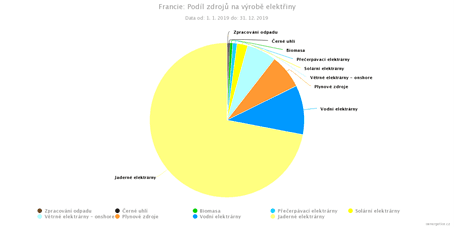
The share of individual sources in French electricity generation in 2019, the last year unaffected by the COVID-19 pandemic. Nuclear sources generated 72.0 % of electricity and low-emission sources generated 92.2 % in total (source: Energostat on oEnergetice).
The green anti-nuclear activists’ campaign
The successful deployment of nuclear power had dramatic effects in improving environmental conditions. Since the beginning of the 1990s, the combination of nuclear and renewable sources has ensured a low-emission power sector in France with minimal use of fossil fuels. It also dramatically reduced the use of fossil fuels in heat generation. Unfortunately, these positive aspects did not gain much traction in public awareness. By contrast, the campaigns of green anti-nuclear activists received a very strong response. They succeeded in ending the development of sodium-cooled fast reactors. As a concession to their Green coalition partners, the Socialists closed the Superphénix reactor.
Green activists gradually fought nuclear power with increasing intensity. It is worth recalling that Germany also planned, in response to the oil crises, to switch to nuclear power to reduce dependence on fossil fuels. As in France, Siemens developed and built a number of pressurised-water reactors there, distinguished by their high quality and reliability. In Germany, however, the green activists’ campaign was even more intense and successful. It ultimately succeeded in pushing through a phase-out of nuclear power and the early shutdown of all nuclear reactors. The last ones will be shut down in April this year. The campaign in Germany was a major factor in the closure in 2022, after more than forty years of successful operation, of the two oldest pressurised-water reactors at Fessenheim. The plant lies in the immediate vicinity of the German border.
In France, green activists did not succeed in securing a rapid nuclear phase-out as they did in Germany. That was not realistic. However, they succeeded in halting construction of new capacity. New units could replace only those being shut down. A reduction in the share of electricity generated by nuclear sources to below 50 % was also enshrined in law. It is now known that these pressurised-water units have the potential to operate for at least sixty years if properly maintained. The current French reactor fleet can therefore last for more than another twenty years. However, they will then be shut down at the same pace at which they were commissioned. Finding a solution to replace them is a key issue for the French power sector.
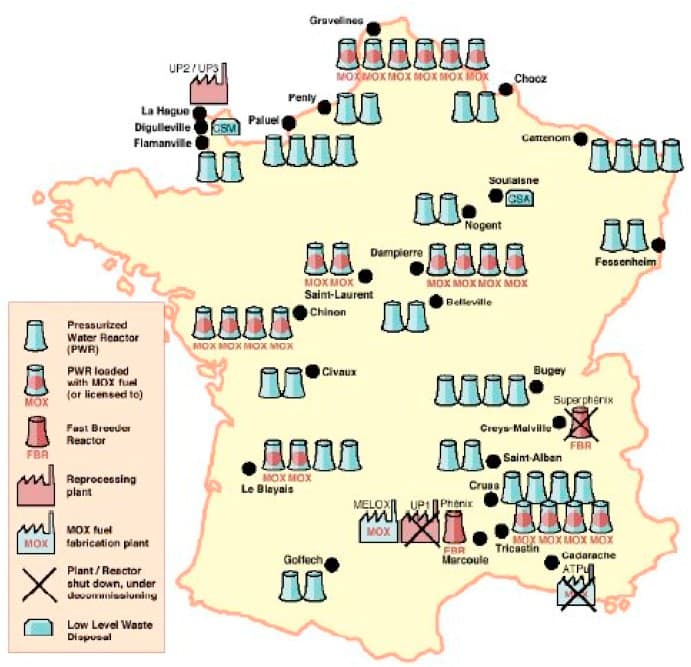
Overview of the locations of individual nuclear facilities in France. The two units at Fessenheim are now also shut down. (Source: Carlos E. Velasquez et al, Assessment of the French nuclear energy system – A case study, Energy Strategy Reviews, vol 30, July 2020, 100513)
The beginning of the Generation III reactor era
At the turn of the 1980s and 1990s, France’s Framatome and Germany’s Siemens agreed to develop the European Generation III EPR (European Pressurised Reactor). The plan was to build on the French N4 type and the German Konvoi design and develop a reactor with output scalable up to 1,650 MWe. The intention was to use the best elements of both types and license the new reactor with the nuclear safety authorities of both countries. As mentioned, Germany decided to phase out nuclear power as a result of the green activists’ campaign and withdrew from development of the EPR reactor. Siemens’ complete exit from the EPR project took place in 2009. The unfinished project thus passed entirely to AREVA, which was created through the merger of Framatome and Cogema (fuel cycle) and Technicatome (nuclear propulsion systems). AREVA NP was responsible for developing the EPR reactor.
The original idea of creating a new reactor by combining the best of the French and German concepts was very good. However, Siemens’ withdrawal from the project became a major problem. The French nuclear safety authority had to deal during licensing with concepts it was encountering for the first time, while French experts were also working with elements they had not previously used. This too led to delays and difficulties in developing the EPR reactor.
The first EPR project was the third unit at Finland’s Olkiluoto nuclear power plant. It was the first tender for the implementation of a Generation III reactor project in the European Union. In 2003, there was strong interest in securing this contract, which would give the winning company an advantage in winning further orders. A need to build a larger number of units was anticipated not only in Europe. Areva NP hoped that any losses on the first project would be fully offset by subsequent projects expected in the near future. It therefore offered a fixed price, and a very low one at that. The project was incomplete at the time, yet completion within 48 months was promised. This was despite the Finnish nuclear safety authority’s well-known strictness. The subsequent complications that meant this reactor is only now entering operation are well known.
In 2004, preparations were approved for construction of a second reactor of this type in France, Flamanville 3. It was to be followed by Penly 3 and then by construction of replacements for existing units in the 2020s. In the end, only construction of Flamanville 3 got under way. Everything else was cancelled as a result of the aforementioned growing pressure from anti-nuclear movements and an overall loss of vision and strategy for the French power sector. A number of problems also emerged here, including poorly executed welds that had to be redone. It will therefore only begin operating next year. The latest delay is due to the need to ensure a long-term, well-controlled cooling process for the newly repaired welds.
Two EPR units were built at the Taishan nuclear power plant in China. The project began in 2008, with construction of the first unit starting in autumn 2009 and the second in the first half of 2010. They were connected to the grid in 2018 and 2019, becoming the first EPR reactors in operation. A very positive factor here was that nuclear units had been built continuously in China, meaning an experienced workforce was available. China generally has extensive experience in delivering major infrastructure projects at present.
Sources of the problems that arose
Both the development and implementation of the reactor project were strongly affected by the long break in nuclear unit construction, not only in France. Also crucial was an underestimation of the complexity and difficulty of the project, which combined French and German approaches. EDF and the French nuclear regulator had to deal with entirely new approaches arising from the German concept. The demands of the Generation III reactor project were likewise underestimated, as they resulted from efforts to substantially increase its safety, economics and reduce operating requirements.
When working on the project and trying to make better offers than competitors, engineering teams underestimated the financial and time requirements. The quality of project management was also problematic. An extreme anti-nuclear campaign and the rather negative attitude of the public and media, which used every real and imagined problem to fight new nuclear projects, reduced efforts towards transparency.
When concreting of the nuclear island at Olkiluoto 3 began, only around 40 % of the detailed design work had been completed. This resulted in a relatively frequent need for rework. The situation was further worsened by a shortage of skilled and experienced workers, whether construction workers, technicians or welders. France and Europe as a whole suffered a fundamental loss of expertise in the required fields. This was also why not only many welds had to be redone.
The response to the Fukushima I accident also required many changes. During the long construction period, some rules and requirements for components changed, including for parts of the reactor pressure vessel. Some parts manufactured in advance then remained in storage for a long time as construction was substantially prolonged, and in some cases continuity with the supplier that had made them was disrupted. Together with the numerous necessary reworks that resulted in contracts being rewritten, this significantly complicated the operation of supply chains.
Another source of problems was that, apart from the two units at Taishan in China, only one unit was built at a time. In addition, it was always in a different country and with a different nuclear safety authority. This increases the difficulty of preparation and implementation and reduces the possibility of using experience from previous construction projects. China’s success is also partly due to the fact that a pair of units was built there from the outset.
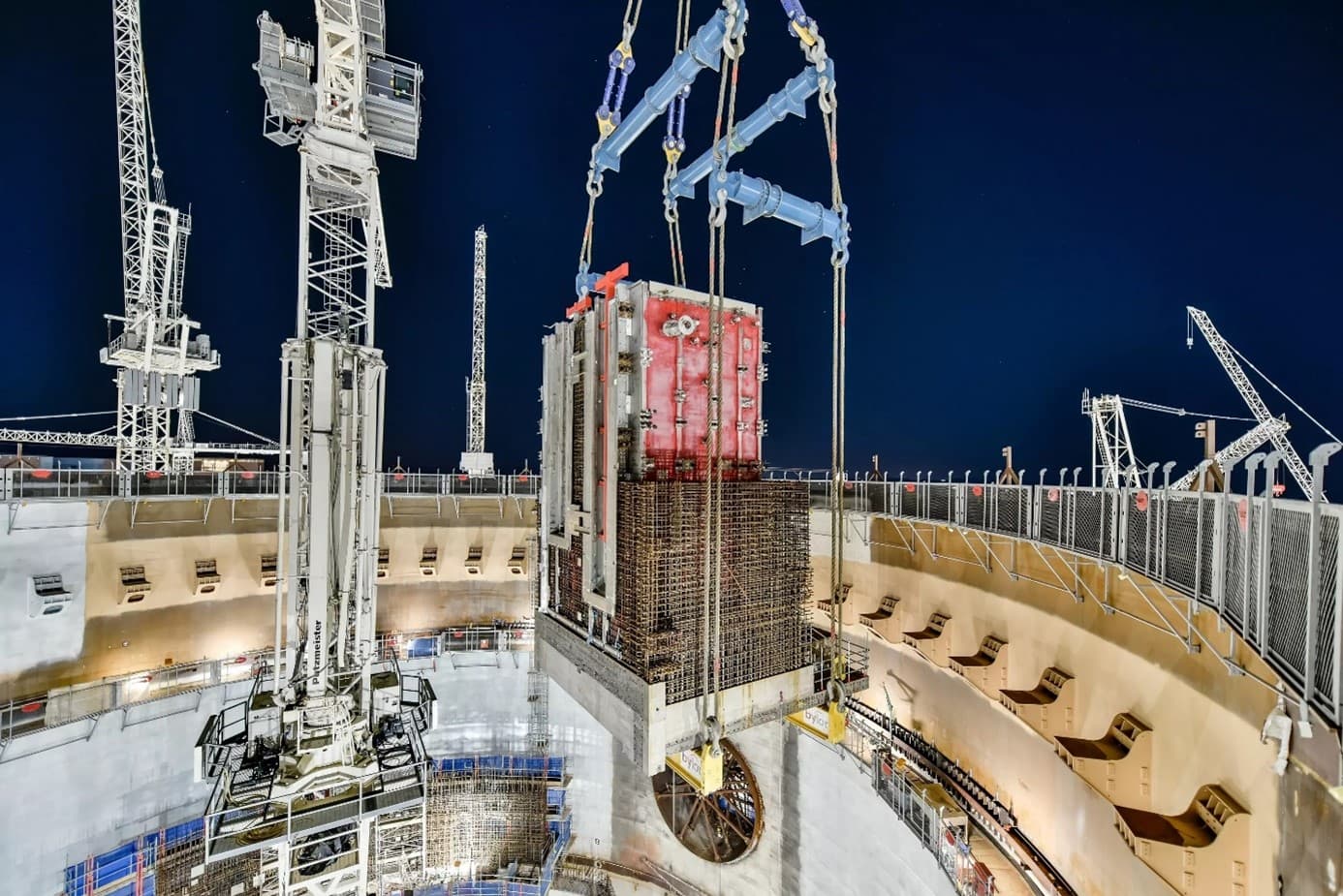
Construction site of the first EPR reactor at Hinkley Point C nuclear power plant (source: EDF).
The future of EPR reactors
The next EPR project was Hinkley Point C nuclear power plant in the United Kingdom. Two units are being built there, enabling the transfer of experience. The project was approved in 2016 and construction began in 2017. Construction has not been without problems and delays have occurred. Some of these can be linked to the impact of the COVID-19 pandemic. Nevertheless, an improvement in construction efficiency is apparent, and above all, experience from the first unit is being used to accelerate construction of the second. The progress of construction of this pair of nuclear reactors will show whether lessons from the previous problems and failures have been applied. The units are expected to be completed in 2027 and 2028.
The project for a pair of EPR units at Sizewell C is also close to approval. In this case, the exact same EPR model being built at Hinkley Point C has deliberately been retained. The aim is to minimise changes and modifications in order to simplify the approval process and make maximum use of experience from the previous construction project. Construction itself should begin relatively soon.
Construction of six EPR units has been under preparation for some time at the Jaipatur nuclear power plant in India. This would make it the world’s largest power plant, with capacity of 10 GWe. If this project is implemented, the EPR reactor will be on the path to series production and sufficiently widespread deployment for its potential as a Generation III reactor to be realised.
Further EPR reactors to be built in France will be of the EPR2 type. This should be a modified design incorporating certain simplifications, improvements and modifications based on experience from building the existing EPR units. A number of problems that accompanied EPR construction should thus be eliminated. Following a dramatic change in its view of nuclear power, France now plans to build up to 14 of these reactors over the coming decades. The first pair of units should be built at Penly, the second at Gravelines and the third at Bugey or Tricastin. The first EPR2 reactor could be completed as early as 2036.
A smaller variant of this reactor type, designated EPR1200, is also being prepared. It is based on the improved EPR2 variant, but will have lower output of 1,200 MWe. The reactor has three steam generators rather than four. This is the variant entered in the tender for construction of Dukovany 5. The same reactor has recently also begun to be considered for the completion of Slovenia’s Krško nuclear power plant.
Weld problems at existing units
One of the key factors for the future development of nuclear power in France is the reliability and efficiency of the existing nuclear fleet. From this perspective, weld problems and outages at several units over the past two years were a major warning. In December 2021, ultrasonic inspections of piping found signs of possible corrosion on welds in auxiliary systems at Civaux 1. These were welds on the emergency boron injection system. Similar weld problems then emerged at the turn of 2021 and 2022 at Civaux 2, Chooz B1 and B2, and Penly 1. In March and April 2022, they were discovered at another five units: Chinon B-3, Cattenom 3, Bugey‑4, Flamanville 2 and Golfech 1.
In total, twelve units had to be shut down by mid-year, inspected and, where necessary, have their problems addressed; Bugey 3 and Flamanville 1 were added to those mentioned. Paradoxically, the more modern units proved more susceptible to these problems due to differences in their design. Detailed inspections of at-risk welds were gradually carried out, with repairs undertaken where necessary. The work was significantly prolonged, and some units, namely Civaux 2, Cattenom 3, Golfech 1 and Penly 1, are only gradually being restarted during 2023; some will not restart until mid-year.
Several very negative factors therefore coincided in 2022 and 2023. These included the aforementioned corrosion cracking problems, maintenance and fuel replacement postponed from the previous period as a result of the COVID-19 pandemic, and very intensive strike activity, including in the energy sector.
Outlook for French nuclear power
Current events have had an impact on the French power sector similar to that of the oil crises in the 1970s. France has returned to the path of using and developing nuclear power. Nuclear power plants should therefore remain one of the main components of the energy mix in the future. Nuclear energy currently dominates electricity generation and, through electric heating, also heat generation. In future, it should also gain ground in transport through electromobility, hydrogen production and synthetic fuels, and should also be used to produce industrial heat. This should ensure France’s gradual transition to low-emission industry and transport.
The French government and parliament have repealed laws restricting the future use of nuclear sources and construction of new units. France has focused on maintaining its existing assets and expects to use them for at least 60 years, meaning another twenty years. French companies also operate nuclear units in other European countries, where maximum use of the service life of existing reactors is likewise expected.
For construction of new units, it has prepared a range of different capacities, namely the EPR2 reactor with output of up to around 1,650 MWe and the EPR1200 reactor with output of around 1,200 MWe. Work has now begun under EDF’s leadership on the small modular reactor NUVARDTM. This is a compact system containing two independent reactor modules, each with electrical output of 170 MWe. The reactors will be pressurised-water designs and their design draws on all the experience from EPR reactor construction. For now, it is expected to be used in France. Construction of the first prototype reactor should begin in 2030.
France has put in place the entire chain needed to deliver the nuclear asset life cycle. It has complete supply chains. It produces fuel and develops and introduces new advanced types of fuel assemblies. ORANO carries out spent fuel recycling and produces fuel assemblies using recycled fuel. It can offer all this abroad as well. It has a site selected and is working on preparations for a permanent geological repository for high-level nuclear waste.
France has also once again begun to intensively support development and research in advanced nuclear technologies, whether Generation IV reactors or innovative small modular reactors. The task of all these activities is to restore the capabilities of French science and industry in this sector and return France to a leading position in this field.
Conclusion
Finally, let us consider what recommendations for Czech nuclear power can be drawn from the development of French nuclear power. France has shown above all that it is possible to build a low-emission energy mix based on a combination of nuclear and renewable sources. The current problems in the French power sector clearly show how important strategic, long-term support and care are for the effective use of the entire lifetime potential of existing nuclear units.
The advantage of building units in pairs, and the problems posed by constructing a single stand-alone unit, have also become clear. Czechia needs to increase nuclear capacity and replace the gradually ageing nuclear units at Dukovany. It has space reserved for two further large reactors at Temelín. It should therefore not stop at a single new large unit, Dukovany 5. Construction should begin simultaneously on two identical units at Temelín and one more at Dukovany. With the assistance of experts, the government should already be working to justify and negotiate construction of another three units at European Union level.
When negotiating support for nuclear power at European Union level, it is necessary to join forces with France and other countries that want to use this energy source. This is the only way to counter the very strong anti-nuclear lobby.
A presentation on spent fuel recycling, closing the fuel cycle and the repository in the current EU taxonomy is available here.
Translation disclaimer
This article is a machine translation of the Czech original and has not yet been fully reviewed. In case of any doubt, please refer to the Czech version.
Sdílejte článek prostřednictvím:
You might also like
23 October 2026, 11:01
23 October 2026, 06:34