
23 October 2026, 14:38
Loading...
Path to decarbonising Czech energy – part two
Oldřich Sklenář
17 October 2020, 09:09

This short series summarises topics related to the decarbonisation of Czech energy. The second part is devoted to existing energy scenarios.
Overview of energy scenarios for Czechia
In recent years, a wide range of studies, scenarios and strategic documents addressing the further development of Czech energy have been produced. They were commissioned by both state institutions and non-governmental non-profit organisations. Alongside domestic companies and consultancies, their authors include foreign universities and research centres. An overview of selected studies is provided in Table 1.
| Publication date | Title | Prepared by | Commissioned by |
| June 2012 | Energy [r]evolution | German Aerospace Center (Deutsches Zentrum für Luft- und Raumfahrt) | Greenpeace, European Renewable Energy Council |
| August 2015 (approved in May 2015) | Updated State Energy Policy | MPO | Government of the Czech Republic |
| December 2016 | 80% reduction in greenhouse gas emissions: an analysis of the development of the Czech Republic's energy sector to 2050 | Institute for Democracy and Economic Analysis | – |
| November 2017 | Global Energy System based on 100% Renewable Energy – Power Sector | Lappeenranta University of Technology, Energy Watch Group | German Federal Environmental Foundation, Stiftung Mercator |
| May 2018 | Czech Power Grid without Electricity From Coal by 2030 | Energynautics | Glopolis, Frank Bold, Hnutí Duha, CEE Bankwatch Network, Alliance for Energy Self-Sufficiency |
| October 2018 | Czech Power Grid without Electricity From Coal by 2030: Sensitivity Analysis (Grid study II) | Energynautics | Glopolis, Frank Bold, Hnutí DUHA |
| September 2019 | Development of renewable sources to 2030 | Deloitte | Modern Energy Association |
| December 2019 | Impacts of Green New Deal Energy Plans on Grid Stability, Costs, Jobs, Health, and Climate in 143 Countries | Stanford University | – |
| January 2020 | National Energy and Climate Plan of the Czech Republic (NECP) | MPO | Government of the Czech Republic |
| June 2020 (unpublished – internal document) | Scenarios for the future of Czech energy | ČEPS | Coal Commission |
| June 2020 | Modernisation of the European lignite triangle: Towards a secure, affordable and sustainable energy transition | Aurora Energy Research, Forum Energii, Agora Energiewende | – |
| July 2020 | Investing in the Recovery and Transition of Europe’s Coal Regions | Bloomberg NEF, Bloomberg Philanthropies | – |
Table 1 – overview of selected studies addressing the further development of Czech energy
The studies listed, or rather the scenarios they contain, address different areas and timeframes of the decarbonisation process. They include work focused purely on the further development of renewable energy sources in the coming years (for example, Deloitte's analysis), as well as studies examining the possibility of transitioning to a fully renewable energy supply over a longer timeframe (a study by Stanford University or by Lappeenranta University of Technology).
The Bloomberg study and its focus
The following chapters will discuss in greater detail in particular the study entitled Investing in the Recovery and Transition of Europe’s Coal Regions by Bloomberg (specifically Bloomberg NEF and Bloomberg Philanthropies), which is the most recent of the works listed above. It examines the possibility of transitioning to a low-carbon economy in selected EU countries that have a high share of fossil-fuel sources in electricity generation but have not yet set a date for retiring coal-fired power plants. It therefore models the transition to clean energy in Poland, Czechia, Romania and Bulgaria (cf. the data in Chart 7 in the previous part) by 2030.
The study compares two scenarios. The first is Bloomberg's own scenario, prepared on the basis of the cost-optimal option for the fastest possible transition to a coal-free energy system. The second is a reference scenario compiled using data from the National Energy and Climate Plan (NECP). The Czech NECP was prepared in November last year, based on requirements under a European Parliament regulation. Similar plans were drawn up by all EU countries and are available at this link.
Assumed demand development
An important parameter for modelling future developments in the energy sector is expected electricity consumption. The study under discussion assumes a slight decline in both scenarios. By the end of the decade, consumption should therefore stand at around 95 % of current levels; see Chart 1.
Expected consumption is based on an in-house model which, among other factors, also takes into account the impacts of the coronavirus pandemic. Under the scenario calculated, it was expected to unfold in several waves (subsequent developments have only confirmed this assumption).
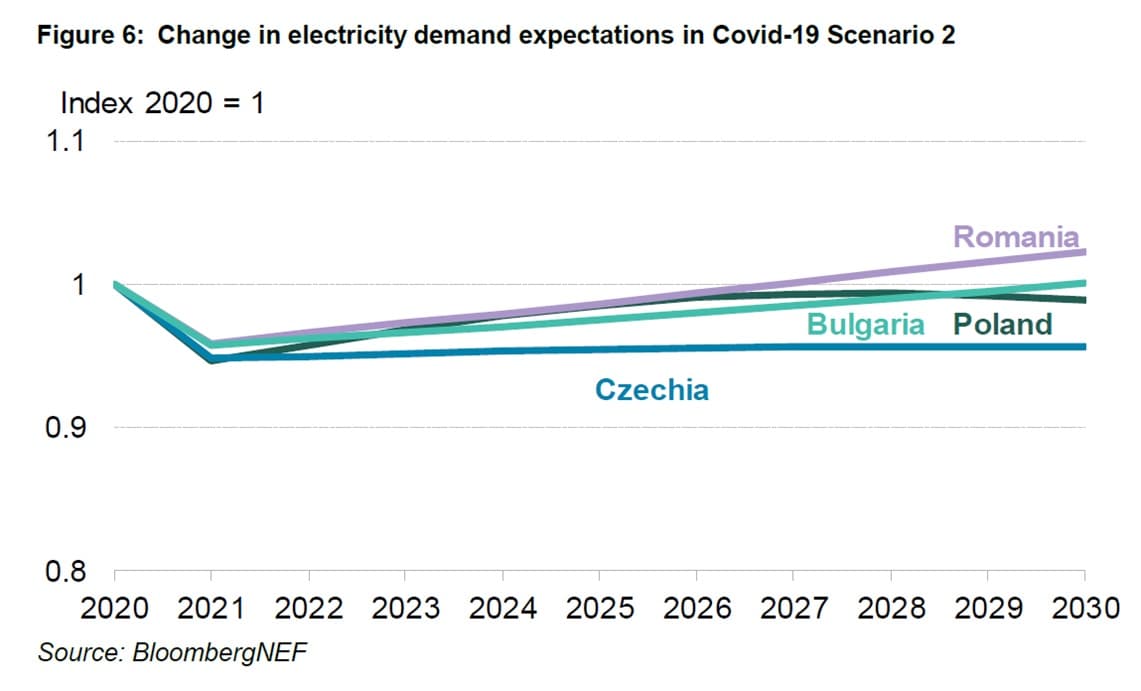
For reference, net consumption in 2018 was 61 TWh; see Chart 9 in the previous part. According to the cited study, it should therefore be around 58 TWh in 2030.
Generally speaking, while a decline in industry (particularly heavy industry) results in lower electricity demand, advancing electrification in heating (heat pumps), cooling (air-conditioning units) and transport (electric mobility) increases demand.
Only future developments will show to what extent domestic industry can recover from the current downturn; however, an increase in consumption in line with earlier forecasts is unlikely, see for example an EGÚ Brno study (page 48). At the same time, the industrial sector, which is the largest consumer of electricity, offers substantial potential for energy savings at relatively low investment costs; see the same study (page 43). This topic is discussed in greater detail, for example, in an analysis by ENVIROS, or in an older EkoWATT study.
In the case of heat pumps (HPs), their efficiency (or rather coefficient of performance) is increasing, but at the same time—indeed, largely because of this, due to the Jevons paradox)—their deployment and total consumption are also growing. The situation is similar for air-conditioning units. On the other hand, their consumption could increasingly be covered by photovoltaic installations in future. The same applies, to a limited extent, to HPs. Final consumption for heating will depend, among other things, on further growth in installed HP capacity in connection with their potential integration into existing district heating systems. In certain cases, HPs can also serve as a local replacement for these systems. For example, a study by Aurora Energy Research (page 32) expects HP electricity consumption of 5 TWh by 2040.
As for transport electrification, according to the author's calculations, a complete transition of road transport to electric mobility would increase electricity consumption by around 27 TWh. This figure corresponds to a calculated increase of 20 TWh for passenger car transport, or 28 TWh for full electrification and shifting part of transport from road to rail (it is also worth noting that the calculated consumption does not differ much from Czech electricity exports, which ranged from 25,5 to 28,7 TWh between 2014 and 2018). The fact is that only a small part of the vehicle fleet will be electrified by 2030. According to the National Action Plan for Clean Mobility, around half a million electric vehicles should be in operation in 2030 under the optimistic scenario, or around 6 % of the current total number of road vehicles. Consequently, over this timeframe, the increase in consumption due to the transition to electric mobility will be rather marginal (less than 2 TWh according to the author). At the same time, integrating electric vehicles into the power system may contribute to its stability; see the first pilot projects of this kind in Europe.
It is difficult to forecast anything today, but in view of the above facts, Bloomberg's estimate appears relatively realistic, while there remains some potential to reduce consumption through energy-saving measures. It should be recalled here that although the electricity intensity of our gross value added has been steadily declining, we still rank fourth worst in the EU in terms of energy consumption per unit of GDP.
Proposed energy mix
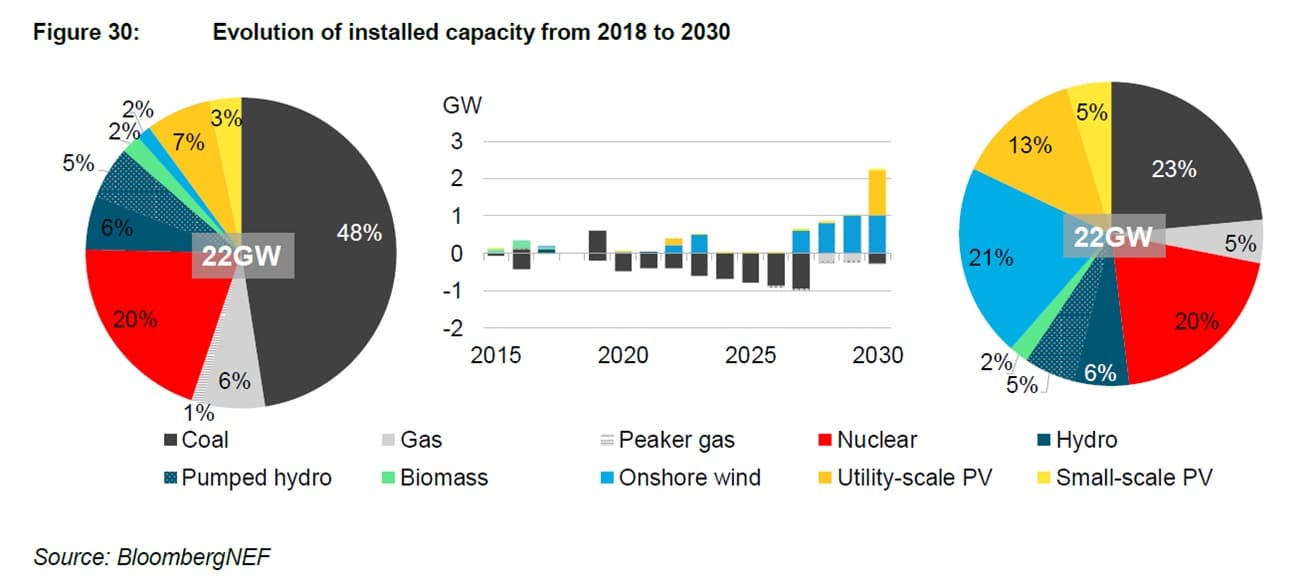
The energy mix proposed in Bloomberg's scenario is based on its own methodology, the New Energy Outlook. Further information is available, for example, at this link. Chart 2 shows how installed capacity for individual sources would change by 2030 under the scenario in question.
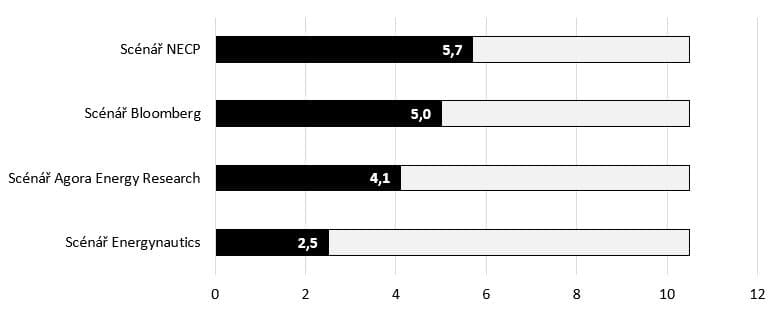
In terms of the phase-out of coal-fired sources, this scenario is relatively conservative, as studies by Energynautics and Agora Energy Research, for example, assume a significantly lower share of coal-fired sources over the same timeframe; see Chart 3 for details.
It also differs from existing studies in assuming a modest reduction in installed gas-fired capacity (most studies instead anticipate an increase), no electricity storage in battery systems (unlike the future Czech energy scenarios prepared by ČEPS), and especially a significantly higher share of wind power plants. Under Bloomberg's scenario, wind power plants should account for a full 21 % of installed capacity in 2030, slightly more than nuclear sources at 20 %. This is particularly apparent when compared with the NECP scenario; see Chart 4.
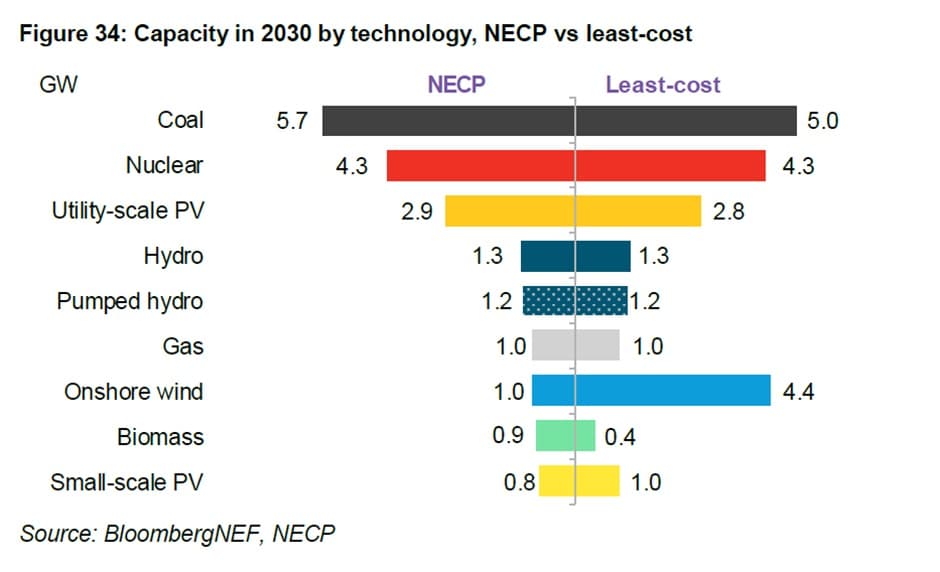
While the reference option (NECP) assumes “only” 0,7 GW of newly installed wind capacity, the cost-optimal option would add 4,1 GW of new capacity by 2030, almost 6 times more. Such capacity corresponds to just under 1 400 wind power plants with a unit capacity of 3 MW.
Given the assumed increase in installed renewable capacity, it is appropriate to critically assess its actual potential under Czech conditions. The next part of this series will therefore address this topic.
Note: all charts cited from the study Investing in the Recovery and Transition of Europe’s Coal Regions were used with the written consent of Bloomberg NEF.
The author is an analyst at the AMO Research Centre and Facts on Climate.
Translation disclaimer
This article is a machine translation of the Czech original and has not yet been fully reviewed. In case of any doubt, please refer to the Czech version.
Sdílejte článek prostřednictvím:
You might also like
23 October 2026, 11:01

23 October 2026, 06:34