23 October 2026, 14:38
Loading...
Path to decarbonising the Czech energy sector – part three
Oldřich Sklenář
27 November 2020, 10:15
This short series summarises topics related to the decarbonisation of the Czech energy sector. Together with the Facts about Climate team, the author analysed in greater detail some of the studies presented in the previous instalment. These were further supplemented by a scenario published by Ember last Friday.
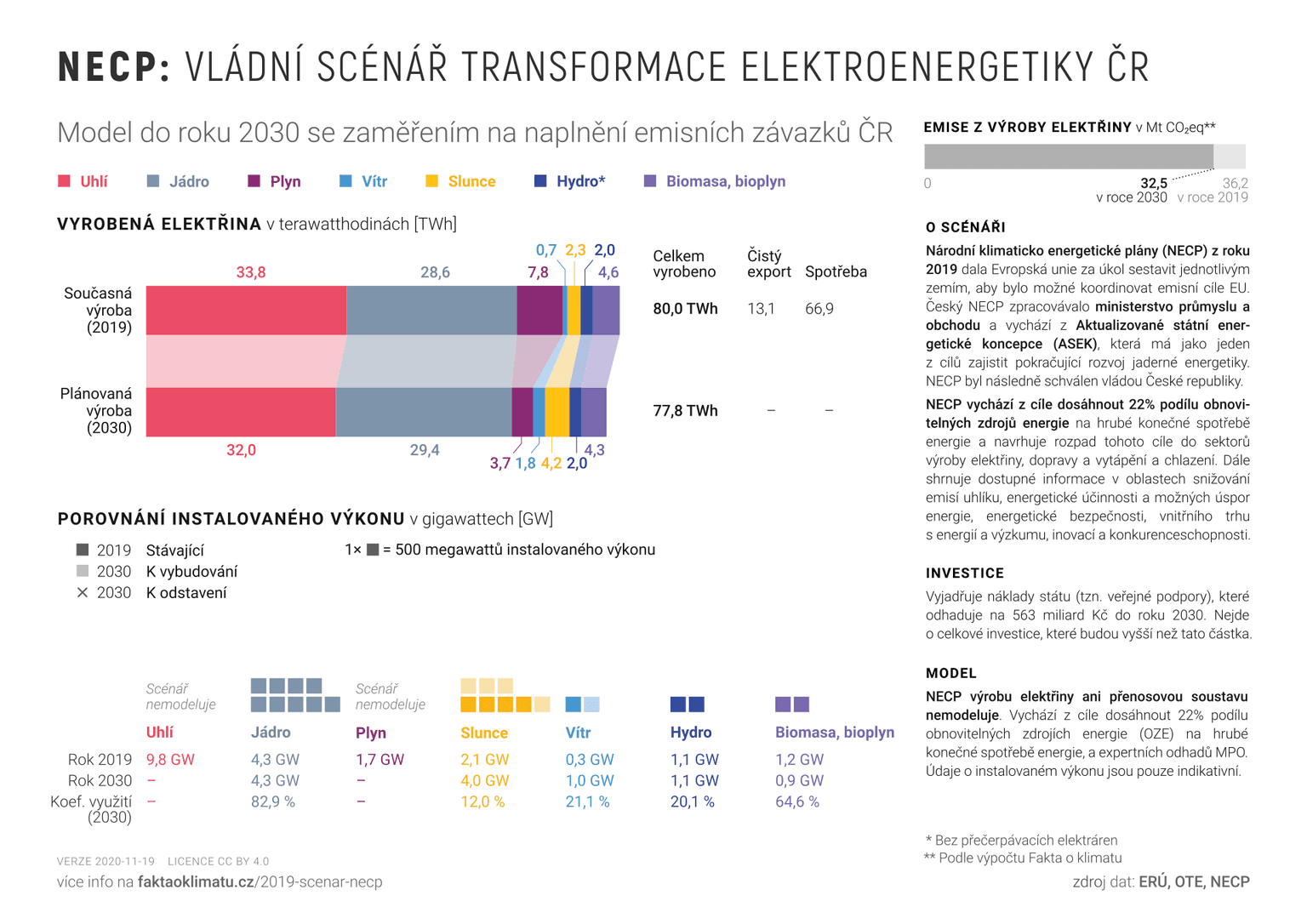
Czechia’s National Energy and Climate Plan
Czechia’s National Energy and Climate Plan, also known by the abbreviation NECP (National Energy and Climate Plan), is a document prepared by the Ministry of Industry and Trade in line with the requirements of an EU European Parliament and Council regulation. Its purpose is to coordinate the delivery of emissions targets across Member States. The document was officially submitted to representatives of the European Commission in January 2020.
In addition to electricity, the NECP also addresses heat production and transport. Its main objective is to meet the commitment to reduce greenhouse-gas emissions by 30 % by 2030 compared with 2005.
Another commitment is to increase the share of renewables in gross final energy consumption to 22 % (the resulting value across all the sectors mentioned) over the same period. For electricity alone, this means increasing the share of renewables to just under 17 % (currently around 13 %).
The methodology used to determine installed renewable capacity and generation is unfortunately not particularly clear. The NECP always limits itself to the phrase “Prepared in-house by the Ministry of Industry and Trade for the purposes of the National Plan”, without providing further details on the calculation used or the criteria considered. The NECP does not mention installed coal and gas capacity at all.
In general, it can be said that the government scenario is by far the least ambitious of the works compared in terms of coal phase-out and, consequently, emissions. See the overview below for details.
BloombergNEF scenario
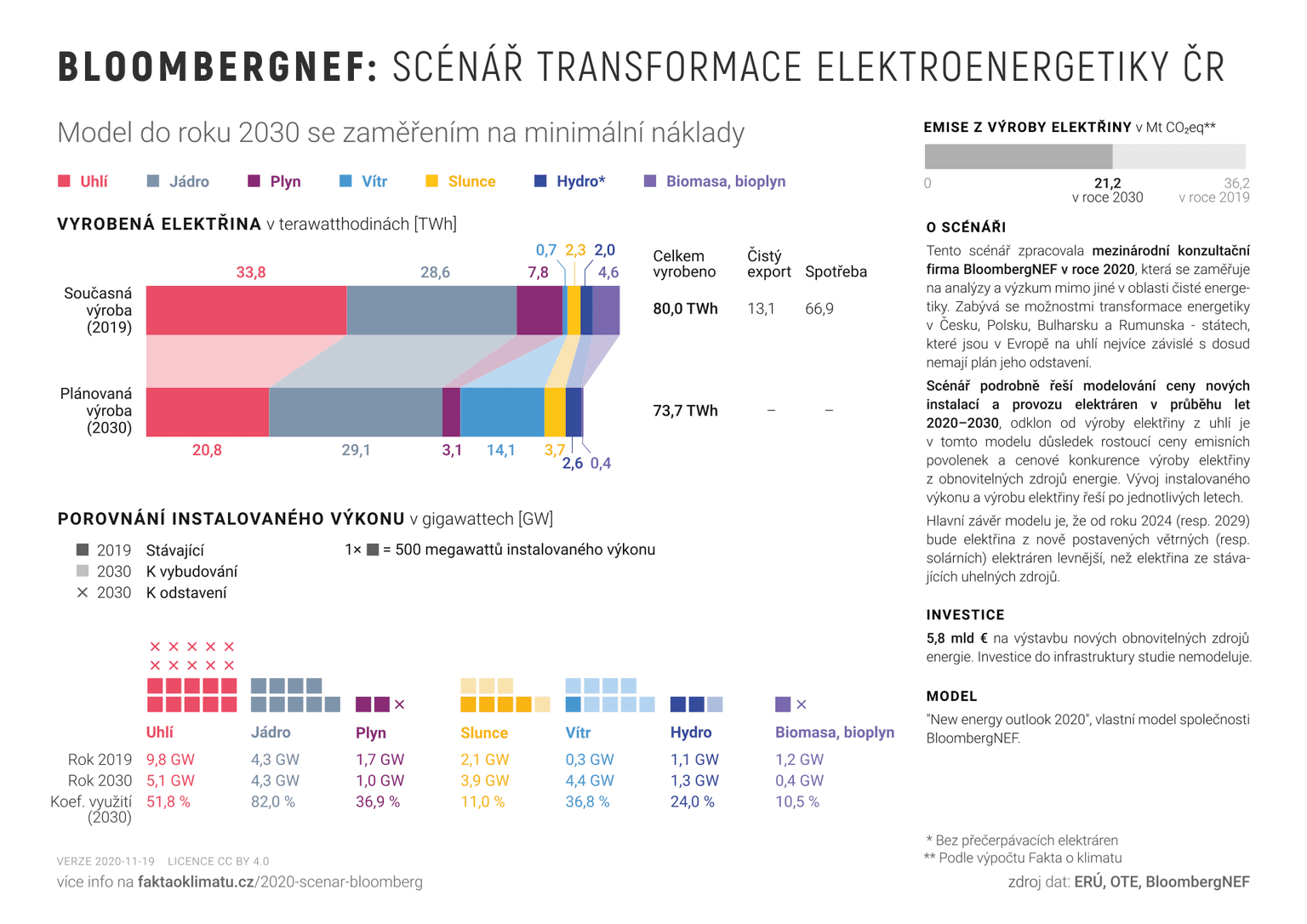
This scenario, mentioned in the previous instalment, represents, according to its authors, a cost-optimal option for a rapid transition to carbon-free energy. The study containing the scenario was published in July 2020.
The scenario is based on the organisation’s own methodology, known as the New Energy Outlook. It is based on existing schemes (and does not consider new support mechanisms), while identifying the economic factors and tipping points that shape the resulting outcome.
In this case, these include a comparison of levelised costs of electricity generation (including the carbon price, or carbon allowances traded under the ETS), the availability of individual electricity sources, and operating conditions determining their utilisation over time.
The generation mix is addressed using the proprietary NEFM model, which aims to minimise system costs while meeting peak demand. However, the study provides no further details on power-system modelling, either at the Czech level or at any broader level.
The aforementioned tipping points are key to the deployment of renewable energy sources, as they determine when generation from these sources becomes cheaper than generation from fossil-fuel power plants. For wind power plants (WPPs), BloombergNEF therefore expects deployment primarily after 2025, while it expects the largest increase in photovoltaic plants (PVs) only towards the very end of the decade.
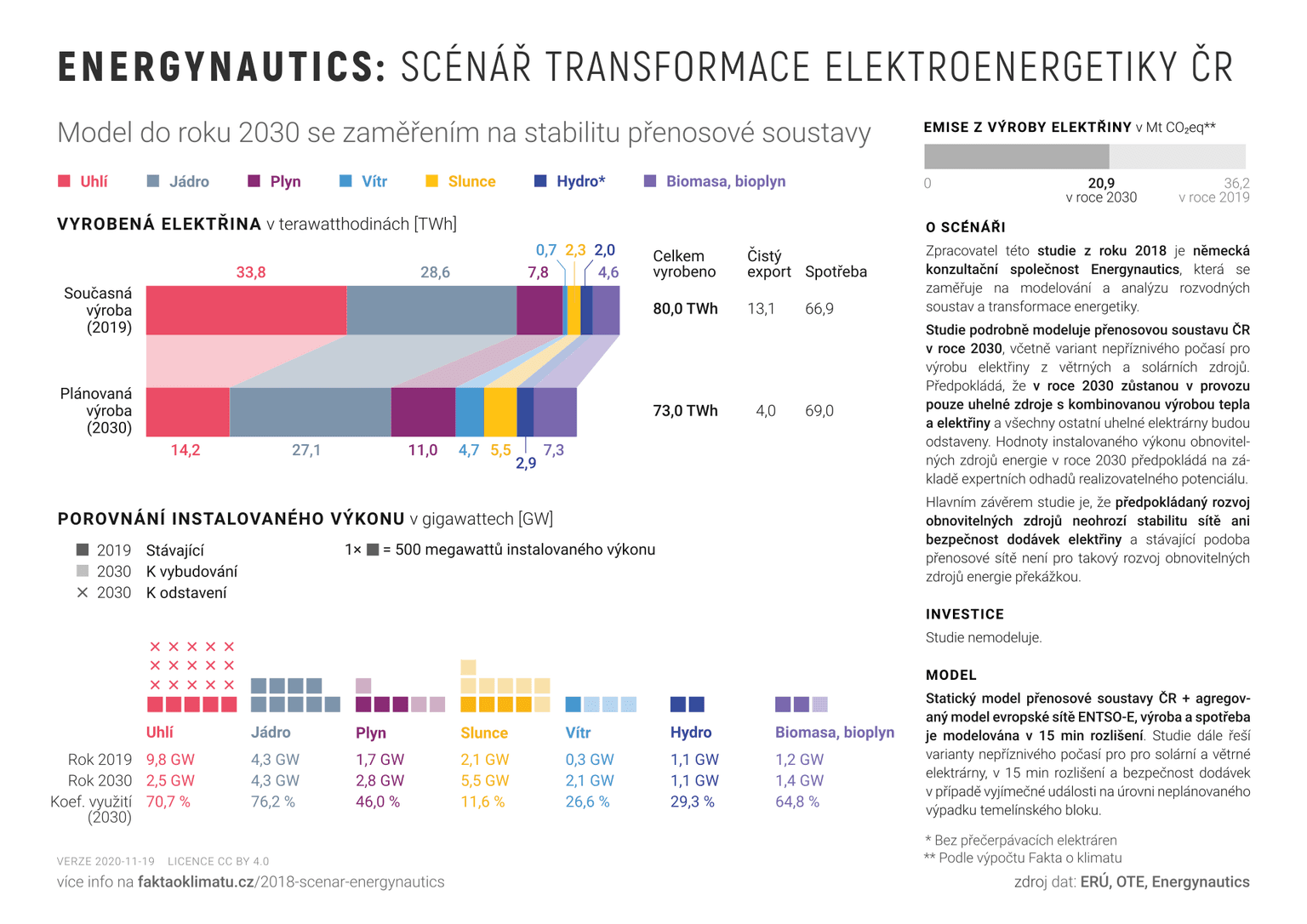
Energynautics scenario
This is the oldest of the studies compared. In 2018, Czech non-profit organisations commissioned it from German consultancy Energynautics.
The aim of this work is to answer the question of whether the stability of the Czech electricity system can be maintained if coal-fired power plants are phased out by 2030. However, the study continues to envisage the operation of coal-fired CHP plants.
The Energynautics scenario models the electricity system at two levels of detail. For Czechia, it uses a detailed static transmission-system model. At the international level, it considers an aggregated model of the European ENTSO-E grid. Electricity generation and consumption are modelled at hourly resolution. Weather is modelled at 15-minute intervals. The reference year used was 2012, which was relatively unfavourable for solar and wind resources. The study does not address economic aspects.
This scenario replaces generation from coal-fired sources with output from PV and wind power plants, while grid stabilisation is mainly provided by newly installed gas-fired capacity. These are supplemented by biomass and biogas plants, which are dispatchable to a certain extent.
Ember scenario
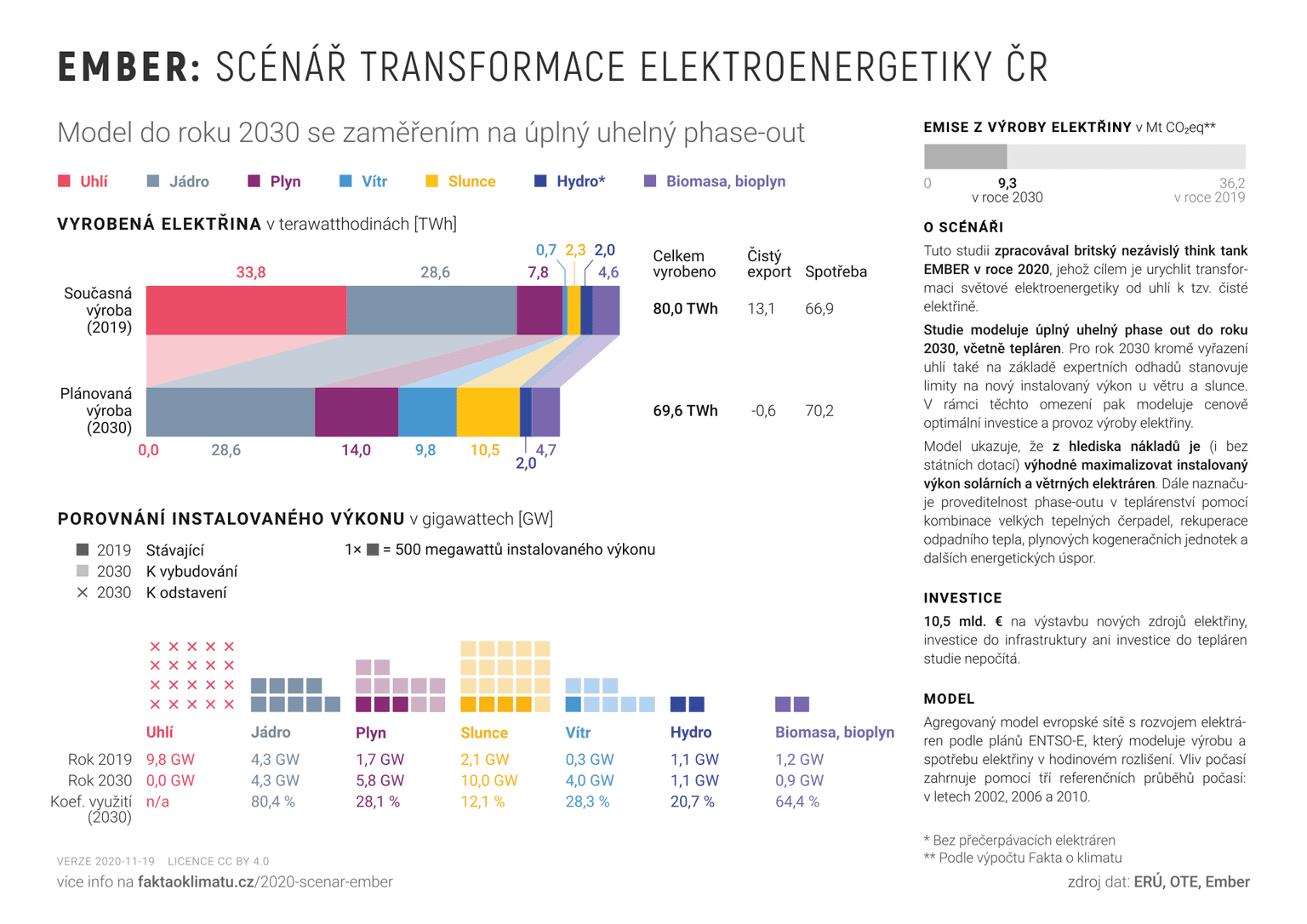
It was prepared by the eponymous British think tank, which aims to accelerate the transformation of the global energy sector.
Unlike the Energynautics scenario, this work envisages the phase-out by 2030 not only of coal-fired power plants, but also of CHP plants.
The model used takes into account the transmission system at the international level (again based on the ENTSO-E model at hourly resolution), the impact of weather (with 2002, 2006 and 2010 used as reference years), and existing market mechanisms. The result should be a cost-optimised build-out of new capacity with regard to meeting electricity demand.
According to the study’s conclusions, a complete coal phase-out by 2030 is technically feasible. However, its implementation requires massive deployment of new renewable capacity, particularly photovoltaic plants (10 GW of installed capacity in 2030). Newly installed gas-fired capacity is again used to stabilise the grid.
Natural gas also supplements heat generation, which should primarily use waste heat and large heat pumps.
In addition to the main scenario, the Ember study includes two alternative scenarios, one of which envisages the deployment of large-scale battery storage (equivalent to 20 % of installed PV capacity). This in turn makes it possible to reduce the required newly installed gas-fired power capacity (3 GW in the “battery” scenario instead of 4 GW in the main scenario).
Comparison of scenarios
The following infographic compares all of the above scenarios according to their basic parameters.
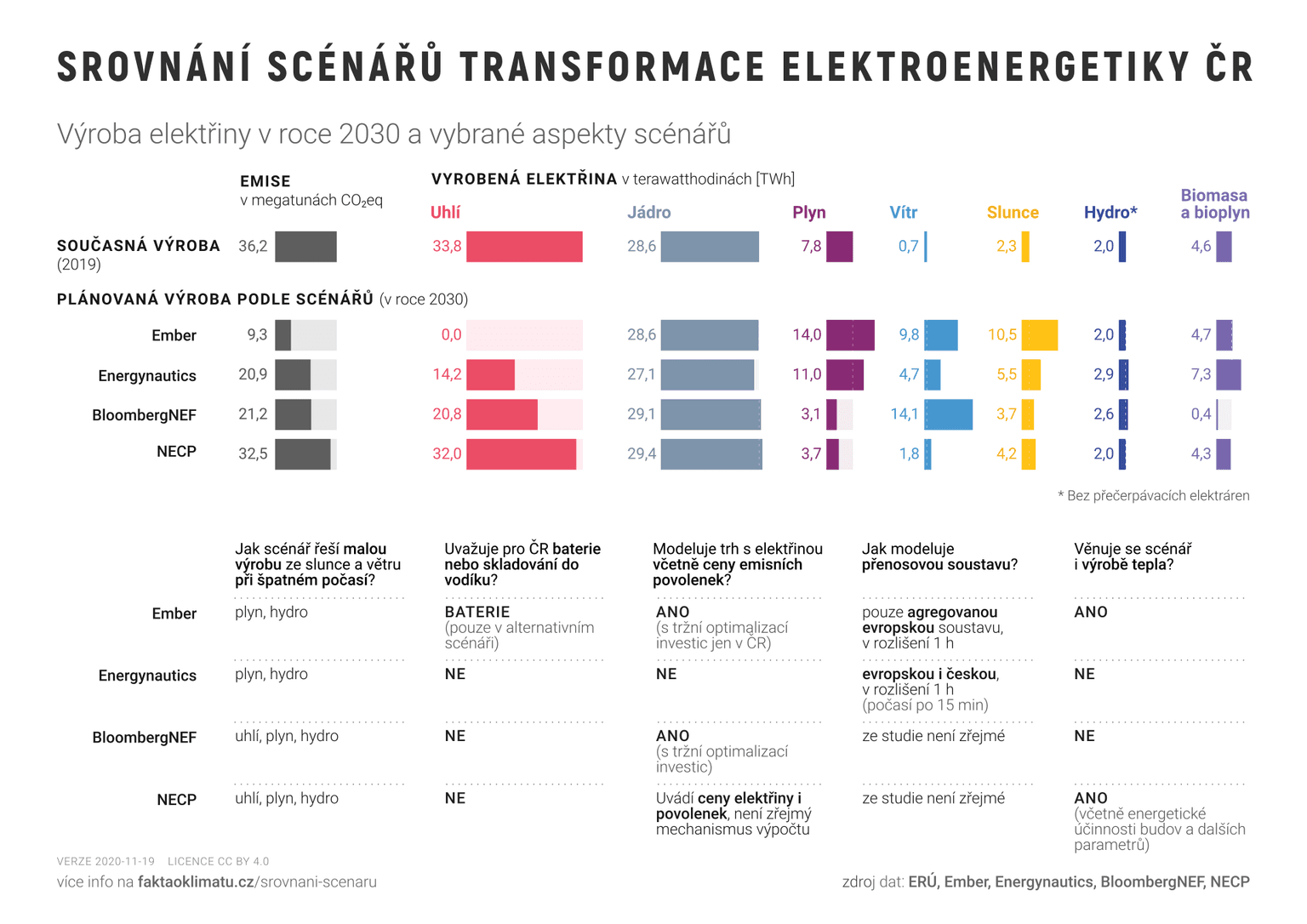
These studies indicate that:
- A partial shift away from coal using renewable energy sources is economically desirable by the end of the decade (BloombergNEF).
- Phasing out coal-fired power plants by 2030 is manageable with increased renewable and gas capacity, without jeopardising grid stability (Energynautics).
- Provided that renewable energy sources are deployed on a massive scale and gas capacity is further increased, a complete coal phase-out by 2030 is also possible (Ember).
The next instalment will focus on the previously announced assessment of renewable energy potential in Czechia.
The author is an analyst at the AMO Research Centre and Facts about Climate.
Translation disclaimer
This article is a machine translation of the Czech original and has not yet been fully reviewed. In case of any doubt, please refer to the Czech version.
Sdílejte článek prostřednictvím:
Topics:Opinion
You might also like
23 October 2026, 11:01
23 October 2026, 06:34