23 October 2026, 14:38
Loading...
Reality of the Paks II nuclear power plant construction project
Vladimír Wagner
2 October 2021, 13:04
It has already been decided that Rosatom and its technology will not take part in the construction of the new nuclear unit at Dukovany. Nevertheless, as part of the permanent pre-election battle, ideological fanatics still need to fight against this company. One of the means is to smear the Paks II and Hanhikivi projects. At the same time, Hungary’s nuclear safety authority, HAEA, has postponed its decision on issuing a construction permit for the nuclear part of the plant. It is therefore sensible to summarise the real current state of these projects.
I recently wrote in an article on Neviditelný pes that journalist Lukáš Valášek does not understand nuclear energy and is trying, through his purely ideological articles, to return society to the 1950s. Recently, the aforementioned journalist from Aktuálně focused in his article on the Paks II power plant construction project. Lukáš Valášek employs a very specific writing method. He does not understand the issue at all, so he compiles his text from statements, mainly by politicians, regardless of when they were made, in what context and for what purpose. He does not consider whether they are merely part of a political battle, only whether a statement suits his ideological witch-hunt.
So let us look at the reality compared with Lukáš Valášek’s text. This is also topical in connection with the fact that on Friday, the Hungarian nuclear safety authority HAEA (Hungarian Atomic Energy Authority) announced the postponement of its decision on authorising the start of construction of the nuclear part of the Paks II plant. First, it should be stressed that every chosen method of selecting a financial model and supplier has its advantages and disadvantages. Each is also associated with certain risks. How a specific option performs can only be determined by whether the project can ultimately be delivered, at what price and within what timeframe. Whether the Hungarians and Finns made the right decision in selecting Rosatom as supplier, or whether it will become the cautionary tale claimed by Lukáš Valášek, remains to be seen.
To begin with, it should be said that nuclear experts, including those in Czechia, mostly agree that the VVER1200 reactor is a highly successful design both technologically and from the perspective of nuclear safety. Dana Drábová, for example, agrees with this, although she otherwise takes a negative view of awarding the contract to a Russian company. The design meets all requirements for Generation III+ reactors. Five are already in operation, one of them outside Russia, and experience with them has so far been very good. Rosatom has two under construction in Russia and a further twelve VVER1200 and VVER1000 reactors abroad (3 in Turkey, 1 in Belarus, 3 in India, 2 in China, 1 in Bangladesh and 1 in Iran). Further projects are being prepared. These include the two aforementioned reactors at Paks II and one at Hanhikivi. A large four-unit power plant is also planned in Egypt. As a result, Rosatom has already built up supply chains involving a relatively large number of Czech companies. But not only Czech companies: other subcontractors are also involved in new VVER reactor projects. Examples include turbine supplies by GE Power—which, incidentally, are to be supplied for Paks II by its Hungarian unit—or control systems supplied by Framatome.
As can be seen, Rosatom has a number of units at an advanced stage of construction in various countries. However, it has not yet built any reactors in the European Union, and the Paks II and Hanhikivi projects are its first ventures there. Official rules and bureaucratic constraints in the European Union are very demanding. Problems can therefore always be expected, especially when this concerns an industry as controversial as nuclear energy. Delays were thus naturally to be expected, because Rosatom is only now gaining experience in this environment.
Let us recall that in March 2009, a decision was made to begin preparations for the construction of two new units at the Paks power plant. In January 2014, Hungary and Russia signed an intergovernmental agreement on the construction of two VVER1200 units. Rosatom was selected not only for technological reasons, but also because it offered financing through an intergovernmental agreement. The contract price is fixed, while loan repayments only begin on the actual date when construction is completed and both units begin operating. Repayments can therefore be made from the plant’s profits. In April 2021, an agreement was confirmed that repayments do not have to begin before 2031. Naturally, it would have been possible to borrow money elsewhere to finance the project, but this would probably have been far less advantageous. The criticism of Hungary’s financing model by opposition Hungarian politicians, presented in Mr Valášek’s article, is rather absurd: they argue that because it is tied to the euro, it is exposed to exchange-rate risks. This would probably be the case with any foreign loan.
European Union bodies began assessing the selected financing model. It was not until 2017 that the European Commission in Brussels gave approval for implementation. It should be recalled that this lengthy assessment, also driven by Austrian opposition, has so far been the main source of construction delays. This is because intensive preparations and finalisation, followed by submission of the application for the relevant permit to the Hungarian nuclear safety authority HAEA, could only begin after that approval. Construction of the nuclear unit therefore could not really start in 2018 as originally planned.
The project received a positive environmental impact assessment as early as 2016. At the turn of June and July 2020, Rosatom submitted all project documentation to the Hungarian nuclear safety authority HAEA. It was therefore expected to receive the construction permit in autumn 2021, that is, sometime soon. This was based on the fact that the assessment deadline is 12 months, but can be extended by a further three months if necessary. At the end of November 2020, the project received a permit from the energy regulator MEKH. In spring 2021, the project received a permit for earthworks unrelated to construction of the nuclear island. In August 2021, the nuclear safety authority HAEA approved the plant’s physical protection plan and confirmed that it fully met requirements. This was another important step.
The only remaining step is the final permit for construction of the nuclear part from HAEA. That the authority would need more time for its assessment was confirmed by a statement on 1 October 2021. The authority declared that a thorough assessment of the 280,000-page documentation would require more time. It did not announce a new deadline for completing the assessment. It therefore remains uncertain whether HAEA will indeed soon issue a permit to begin construction of the nuclear island. Should it identify shortcomings in the submitted documentation, it may of course further postpone its decision and request corrections. On the one hand, the postponement is certainly unpleasant; on the other, it may indicate that the authority is taking the assessment very seriously and prioritising thoroughness and quality.
However, if a decision is made around the turn of the year, full-scale construction will begin next year and concrete pouring for the nuclear island of the first reactor—the official start of reactor construction—will be imminent. Rosatom demonstrated in the construction of the Ostrovets nuclear power plant in Belarus that it can complete a unit of this type within seven years. Construction itself should no longer be as strongly affected by bureaucratic obstacles in the European Union. Drawing on experience, as this is already the several-th unit of this type, the construction period could even be shorter. Naturally, problems may arise and instead lead to construction delays. Nevertheless, the first reactor can be expected to start up between 2028 and 2030.
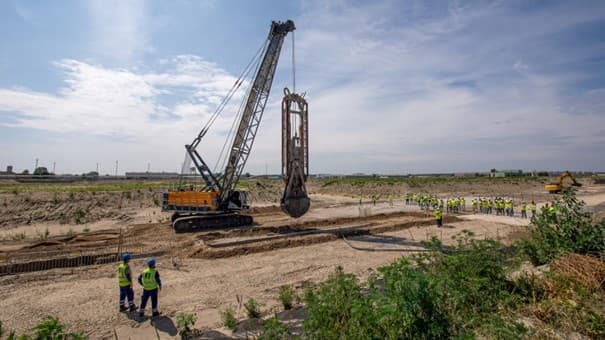
For now, site preparation is under way, the heating pipeline that crossed the site has been rerouted, and the necessary office buildings, concrete plants and other facilities forming the construction site infrastructure are being built. Access roads with the required bridges are also being constructed. At the same time, supply chains involving subcontractors that will participate in deliveries are being finalised.
Hungary originally envisaged a very high level of local content in the project. However, the European Union set a condition that a large part of subcontracting must be tendered at the EU level. The degree of localisation is therefore limited. Yet this may be an advantage for Czech industry. Also because Hungary is very close, Czech companies can be expected to participate intensively in both the Paks II and Hanhikivi projects. Supply opportunities involving Sigma Group, Kabelovna Kabex, I&C Eńergo and ZAT are under discussion. For the Hanhikivi plant, for example, boiler house supplies from Třebíč-based MICo Group have already been approved; work is under way and they should soon be commissioned.
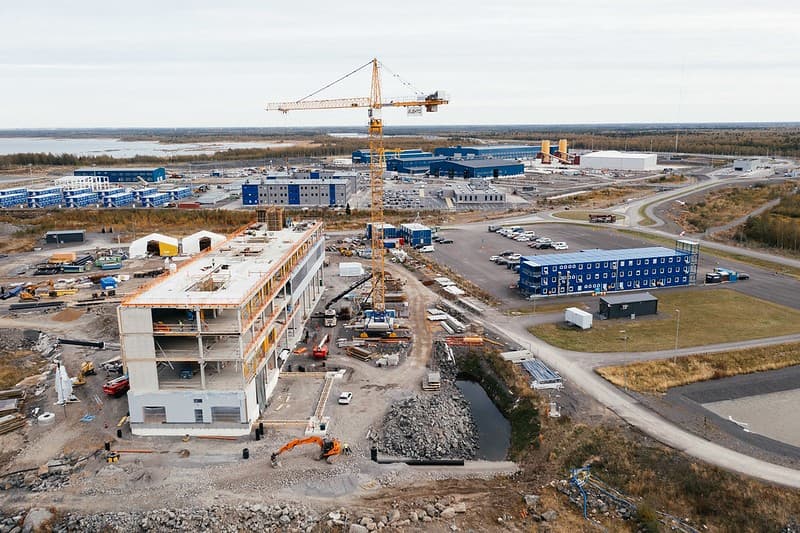
Work on the non-nuclear parts and construction facilities for the Hanhikivi power plant is proceeding very intensively (source: Fennovoima).
In the case of Finland’s Hanhikivi power plant as well, the key decision by the local nuclear safety authority is expected around the turn of the year. Construction of the reactor itself could therefore also begin there next year. Naturally, delays cannot be ruled out there either, as the Finnish nuclear safety authority STUK is renowned for its stringent standards. However, if it issues the permit, Rosatom will have gained experience and a reference project for delivering a unit in the most demanding European environment. It will then most likely have no problems with further projects.
As for the situation in Czechia, the tender has not even been launched yet. Even under an ideal scenario, construction of one unit is expected to begin at a time when the two Paks II units will probably be starting up. Had Rosatom not been excluded from the tender, its outcome would have been decided at a time when the decisions of both the Hungarian and Finnish nuclear safety authorities were known, whether positive or negative. They could therefore have been taken into account in the selection.
The Czech Republic, which was at the forefront of nuclear energy and industry in Central Europe, is successfully slipping to the back of the pack due to incompetent politicians and journalists such as Lukáš Valášek, who know nothing about the energy sector, especially nuclear energy, and merely exploit it for political manoeuvring and ideological struggle.
Especially at a time when practice is showing what a lack of stable energy sources and reliance on massive use of gas-fired generation leads to, the criticism of the price of electricity from the planned Paks II nuclear plant in Lukáš Valášek’s article is downright absurd. It relies solely on statements by opposition Hungarian politicians made at a time when a surplus of fossil-fuel and coal-fired capacity and low carbon allowance prices, together with subsidised renewable sources during windy and sunny periods, ensured low electricity prices. Their statements were based on the slogans of green activist campaigns claiming that renewable sources would only make electricity cheaper and cheaper. The problem is that these slogans have nothing in common with reality.
Together with opposition Hungarian politicians, Lukáš Valášek criticises the construction delay of several years and its impacts on Hungarian energy and the economy. Yet he is not concerned about the many years of delays in nuclear unit construction in Czechia and their impacts, to which ideological campaigns by journalists and politicians like him have contributed significantly.
In the current Czech situation, in my view the only rational solution that could lead to construction of a unit at Dukovany within a reasonable timeframe is to complete the planned tender and select the best of the three remaining bidders based on rational expert criteria. Cancelling the second tender as well, this time just before its launch, would have highly destructive impacts. This is probably also why the president signed the law excluding Russian and Chinese companies from the tender, despite his views on the matter. It is somewhat absurd that Lukáš Valášek continues to use this issue for ideological struggle. If we are unable to agree on a rational course of action in Czechia, at least now, we can forget about building new nuclear units. The current situation, in which the price of electricity purchased for next year exceeds 100 EUR/MWh and current prices on wholesale exchanges in Germany and surrounding countries exceed 200 EUR/MWh, shows where we can end up without nuclear power and with reliance on gas.
The progress of construction at the Paks II and Hanhikivi nuclear power plants is, of course, still an open question. Only the actual completion date and cost matter. Only in the future will we see how the situation develops with the new units in Hungary, Finland, Czechia and Poland, which is also pursuing direct selection without a tender. Only a comparison of the different approaches in these countries over the coming years will show who made the right decision.
Translation disclaimer
This article is a machine translation of the Czech original and has not yet been fully reviewed. In case of any doubt, please refer to the Czech version.
Sdílejte článek prostřednictvím:
You might also like
23 October 2026, 11:01

23 October 2026, 06:34