Slovakia – a land promised to electric cars. Or not?
How does an electric car perform in the mountains, why is it so well suited to Slovakia, and why is the reality completely different?
In an article on winter electric-car consumption, I compared a conventional combustion-engine drivetrain with an electric car. Even in the winter months, an electric car's energy consumption is around 3× lower than that of an equivalent combustion-engine vehicle. Things may look somewhat different in Slovakia, whose terrain is considerably more mountainous than that of Czechia. My family and I travel from the Ostrava region to Slovakia fairly often, whether for day trips or longer holidays. We like the mountains, so Slovakia's natural treasures are very appealing to us. However, for our most recent winter holiday in Orava, we could not fit into the Kona with its small boot, so for once we used our old Octavia Combi, which offers sufficient space in its class for ski equipment for a family of four.
Regenerative braking on mountain hairpins
After several tens of thousands of kilometres in an electric car, I had to remind myself somewhat of the need to change gears on mountain hairpins. Not that I had any major problem with it, but the constant need to find the right gear in corners does not exactly add to the driving dynamics. Nevertheless, the benefits of an electric car are more apparent on the way downhill. While a combustion-engine vehicle turns all braking energy into heat, an electric car can recover a substantial part of that energy back into the battery, which is very quickly reflected in consumption. My Octavia has a long-term average of between 5.5 and 6l of diesel per 100km, but on journeys in the mountains it is currently not possible to get below 6. On shorter trips of around 20 km, 7l or more is not unusual. Converted into kWh, this amounts to consumption of around 60kWh/100km, about 10% above the official value in the vehicle registration document.
The situation is diametrically different for an electric car. While consumption on motorways is generally higher than under the standardised WLTP cycle, the opposite is often true on mountain stretches. The Kona has standardised consumption of 14.3kWh/100km, but on mountain routes I routinely achieve less than 13kWh/100km. Even after accounting for charging losses, driving on mountain stretches is not 3× but rather 4× more economical than in a combustion-engine vehicle.
There is a simple physical explanation for why this is the case. The standardised consumption cycle is measured across a combined urban, extra-urban and motorway cycle. Since aerodynamic drag rises with the square of speed, the higher driving resistance quickly affects consumption in an efficient electric car. This is why consumption rises rapidly at higher motorway speeds in electric cars. Consumption also rises in a combustion-engine vehicle, but the higher driving resistance is partly offset by the better efficiency of an engine operating at optimal revs under a steady load. The increase in motorway consumption is therefore not as pronounced, especially in diesels. In mountainous terrain, by contrast, the combustion engine must constantly change revs while also converting the vehicle's potential energy into heat. Consumption in a combustion-engine vehicle is therefore generally above average on mountain stretches, while the opposite applies to an electric car travelling at lower speeds on hairpins and with intensive regenerative braking. The difference between the two drivetrains is therefore greater than the official figures suggest. Regenerative braking also significantly reduces brake-pad wear.
The difference in wear is immediately visible on the wheels of a combustion-engine and electric vehicle with roughly the same mileage since their last wash. While a layer of black brake-pad dust appears on the combustion-engine vehicle after just a few hundred kilometres, only normal dirt from the surrounding environment is visible on the electric vehicle.
A more detailed analysis of particulate matter from transport was recently carried out by Brno University of Technology.
Electric mobility in Slovakia
Slovakia is a relatively small and highly mountainous country. For many journeys, the much-discussed range issue therefore does not arise. From this perspective, an electric car appears to be a highly attractive option for the average user. In Czechia, the origin of electricity is very often discussed in connection with electric mobility. It is generated partly from coal, creating an environmental burden through power generation. The emissions footprint of an average electric car is roughly 80g/km, which is significantly lower than that of a combustion-engine equivalent, but there is considerable room for improvement. In Slovakia, however, the situation is substantially better. According to the elektricitymaps.com website, electricity generation over the past year consisted primarily of a combination of nuclear and hydropower generation, supplemented by gas-fired sources with a share of up to 10%. The emissions intensity of electricity generation averaged 120g/kWh over the past year, so an average electric car operates with emissions intensity of around 25g/km, a fraction of that of even the most economical combustion-engine vehicles.
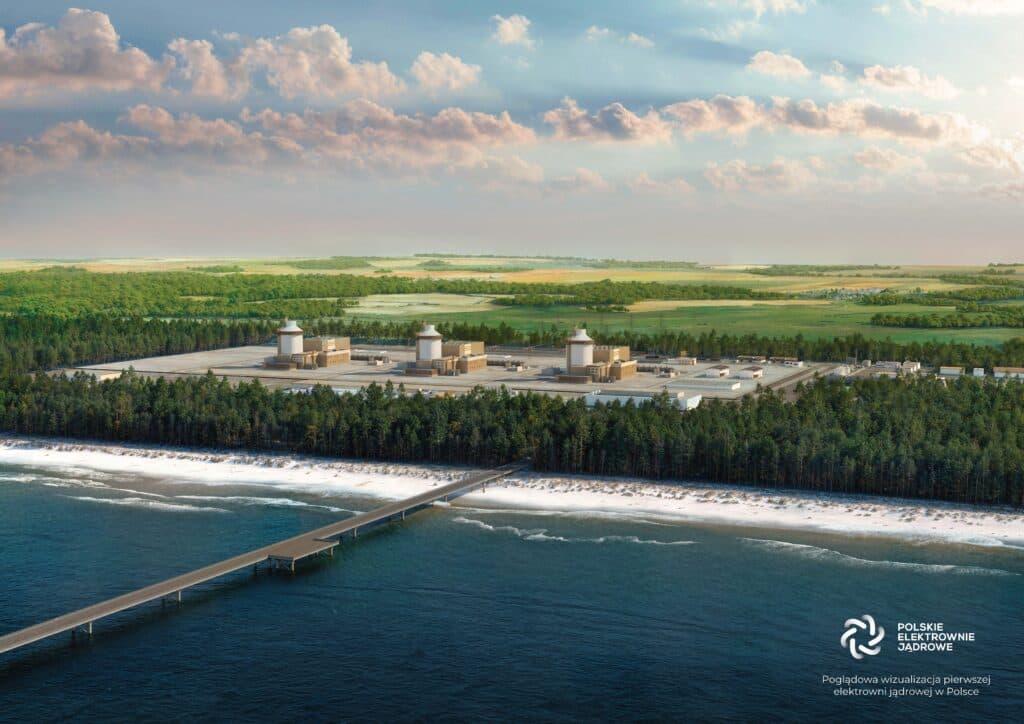
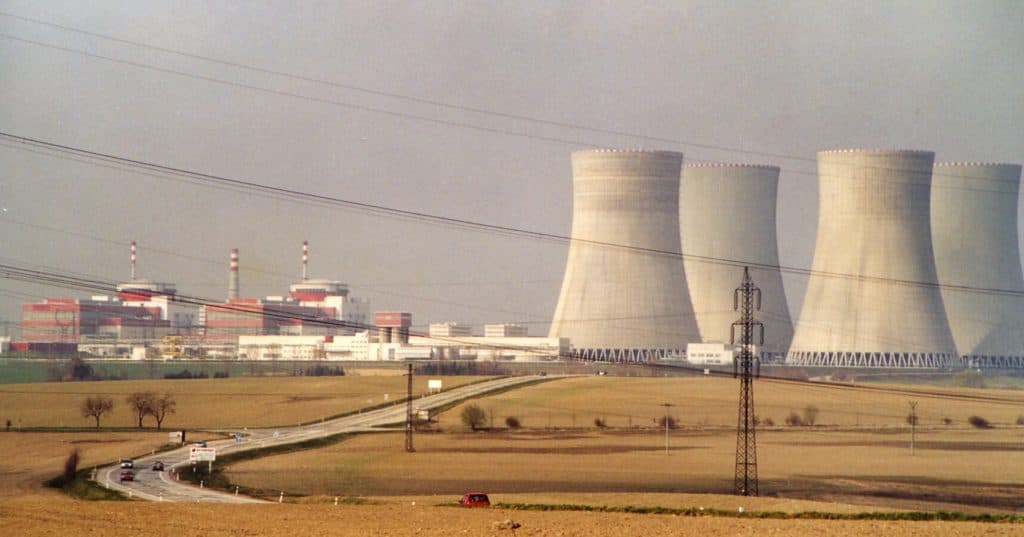
Moreover, after nearly 40 years of construction, Slovakia plans to open the fourth unit of the Mochovce nuclear power plant this year, in addition to Unit 3. The two units will generate roughly 7-8TWh of electricity a year, approximately equivalent to the consumption of all passenger cars in the country.
It should be noted that nuclear energy will account for a strongly dominant share of Slovakia's energy mix, and the VVER reactor technology used cannot easily be regulated. Even if it could technically be done, its owner, having built these costly facilities over a long period, would not want to do so at all because it reduces the return on this huge investment. Especially when the sun shines on Hungary's existing 8GW of photovoltaic power plants, cheap energy flows into Slovakia and it would have to reduce output from its expensively built nuclear facilities. Since Hungary and other neighbouring countries are unlikely to remain at current levels of photovoltaic build-out, the government has opted to address this with storage in the form of the Málinec pumped-storage hydropower plant, priced at nearly €2.5bn and estimated to enter operation in 2036. The grid does need storage, but the question is whether it would not be more efficient to store energy directly in vehicle batteries instead. A fleet of 3 million electric cars with an average capacity of 60kWh corresponds to around 50 Dlouhé Stráně pumped-storage plants. Even if only a small part of that capacity were used for grid management, it would amount to multiples of the capacity of the newly planned pumped-storage plant.
Reality
Slovakia is an automotive powerhouse in terms of car production per capita. In addition to the carmakers themselves, Inobat also manufactures and develops batteries in Slovakia. Given its terrain, energy mix, energy storage for distribution-grid needs and support for domestic industry, one might expect electric cars to have everything going for them here. Paradoxically, the reality is completely the opposite. Slovakia ranks last in the EU for electric-car sales.
Conclusion
What more is there to say? For many reasons, our eastern neighbours have literally ideal conditions for electric mobility, and the Slovak energy grid would certainly benefit from storage, but “we are hardly going to drive on our own electricity, in Slovak cars, with batteries made in Slovakia, when we can send a few billion euros a year to Russia for oil”.
That is obvious, isn't it?
The article was originally published here.Translation disclaimer
This article is a machine translation of the Czech original and has not yet been fully reviewed. In case of any doubt, please refer to the Czech version.