
23 October 2026, 14:38
Loading...
Ukrainian nuclear power plants amid Russia’s effort to destroy the country’s civilian infrastructure
Vladimír Wagner
28 November 2022, 06:39
Russia has failed to defeat Ukraine militarily, so it has decided to break it by completely destroying civilian infrastructure ahead of the coming winter. It is focusing primarily on sources of electricity and heat. Ukraine relies heavily on nuclear power plants for electricity generation. Let us look at the impact that the current massive missile strikes are having on this sector.
Russia launched its massive attack on Ukrainian civilian infrastructure on 10 October, when it became clear that it could not achieve any of its stated objectives on the battlefield. To break Ukrainians’ resolve and force them to capitulate, or at least to suspend combat operations for the winter, Russia decided to use its last option: its dwindling stocks of long-range missiles and cruise missiles. It thus began massive bombardment of civilian critical infrastructure facilities. These mainly include power grid equipment and heat sources: thermal power plants and combined heat and power plants, hydropower plants, transformers, substations and other critical elements. One of the largest attacks, which plunged Ukraine into a complete blackout and also affected Moldova, took place on 23 November.
Russian terrorist attacks on Ukrainian civilian infrastructure
It is very much an open question whether this terrorist tactic can achieve the goals Russia expects of it. Historically, massive bombing of civilian targets and infrastructure has generally failed to break an opponent. London did not surrender after massive Nazi bombing. It may even strengthen Ukrainian society’s will to fight the Russian invasion. Ukrainians across the country can now see what Russia is aiming at. Soldiers at the front also feel even more strongly that they are defending their families and loved ones, and that only they will determine when and how the war ends. It is also questionable whether Russia, given the growing capabilities of Ukrainian air defence, has sufficient stocks to truly destroy Ukraine’s infrastructure. However, this issue is more for political scientists and military experts; we will focus instead on the impact on the power system and nuclear power plants.
Ukraine has four large nuclear power plants. In the far southeast lies the Zaporizhzhia nuclear power plant. With its six large VVER1000 units, it is one of Europe’s largest nuclear power plants. It is currently occupied by Russian forces. To its west, in the south, is the South Ukraine nuclear power plant with four VVER1000 units. If the Russian army succeeded in advancing towards Odesa and occupying southern Ukraine as far as Transnistria, this plant would also be occupied. The remaining two are in the western part of the country. These are the Rivne plant, which has two VVER440 units and two VVER1000 units, and the Khmelnytskyi plant, which has two VVER1000 reactors in operation and two unfinished reactors.
In normal times, nuclear sources supplied half or more of Ukraine’s electricity. Ukraine has now lost the Zaporizhzhia nuclear power plant, but it still has reactors with total capacity of around 9 GWe. Electricity consumption has fallen dramatically, with many businesses forced to halt production and many residents having left the country. Thus, despite the loss of the Zaporizhzhia plant, nuclear units can still cover a large share of electricity needs. Their output is a truly crucial element of Ukraine’s survival.
It should be stressed that in large cities without electricity, water supply and sewerage do not function, heating often does not work, and much of public transport and communications are disrupted. Industrial facilities do not operate either, while rail transport faces dramatic problems. Diesel locomotives can be used, but it is very difficult to manage without electricity for rail operations and to support diesel trains.
Emergency backup supplies can be provided by decentralised sources, most often diesel generators. These may also include a small gas turbine, a hydropower plant or photovoltaics, although the latter can supply only minimal amounts during winter. Such sources can support hospitals, control centres, communications and other elements of critical infrastructure. They can create critical hubs where people can warm up, eat hot food and charge their mobile phones. It is therefore very important for the West to supply as many of these sources as possible, along with fuel for them. This can help overcome the critical hours and days before a blackout is resolved.
Specific features of nuclear power plants during the current attacks on Ukrainian infrastructure
However, restoring the functioning of cities, rail connections and industrial production cannot be achieved without restoring supplies from large generating sources. For this reason, nuclear power plants have a key role. Compared with other large sources, nuclear reactors have a number of advantages in the current situation. Paradoxically, these are advantages from a safety perspective.
The first, and very important, advantage is that providing air defence for three large, compact facilities is much easier than for a large number of small facilities dispersed over a wide area. Very effective missile defence can be organised for three nuclear plants. It is also an advantage that nuclear power plants are located away from cities and residential areas. If air-defence missiles collide with their targets or fail, there is no risk of debris hitting residential buildings and harming residents.
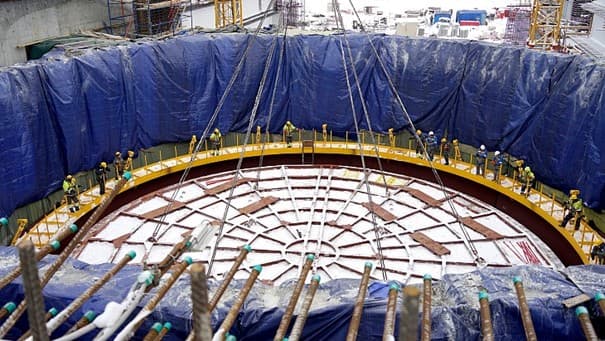
The reactors themselves are housed in very strong and resilient concrete containment structures. These should withstand an aircraft crash, and most types of missiles should not damage them either. It is similar at hydropower plants, where turbines are usually also hidden beneath a thick layer of protective concrete. They are therefore difficult to destroy with long-range missiles. In their case, attacks focus on transformers and other supporting equipment that ensure power evacuation, operation and control of the facilities. This can put a hydropower plant out of service.
Naturally, an attack on transformers and other equipment at nuclear power plants would also take them out of service. However, it would also entail a risk of a nuclear accident. Fuel in reactors and spent fuel in pools must be cooled continuously and constantly monitored. This requires electricity supplies. This is why Russian infrastructure attacks have so far not targeted nuclear power plants. It would provoke a very negative political response, including from states that have so far remained to some extent neutral towards Russia.
Following the 23 November attack, the Rivne nuclear power plant switched to emergency mode, while the South Ukraine and Khmelnytskyi plants were disconnected from the grid. During the attack on key power grid elements, the network was significantly damaged and fragmented. The grid must maintain a balance between electricity generation and consumption. When the grid broke apart, the nuclear power plants lost demand for their electricity, and protection against grid overvoltage shut down the reactors. Subsequent developments depend on whether the grid around the plant remains in island mode or fails completely. If the outage is complete, the necessary electricity must be supplied by emergency diesel generators.
To overcome blackout conditions such as those on 23 November, Ukraine needs the largest possible number of emergency generators and generating sets. It is therefore very important that deliveries from Western countries increase. To restore the integrated grid and the large-scale supplies needed for cities and railways to function, the intact nuclear units and the maintenance and repair of transformers and substations are vital. It is therefore important for the West to help Ukraine with spare parts and the necessary equipment, as well as electricity supplies and balancing capacity.
Zaporizhzhia nuclear power plant
The Zaporizhzhia nuclear power plant is a special case, having been occupied at the very beginning of the invasion. It is still operated by Ukrainian personnel, but under the supervision of the Russian occupying army. The plant is on the front line, on the left bank of the Kakhovka reservoir. The right bank is controlled by Ukraine.
Across the reservoir from the nuclear power plant lies one of Ukraine’s larger cities, Nikopol. Mutual shelling across the reservoir is therefore relatively frequent. Russia also uses the plant as a shield to protect its heavy military equipment. It has S-300 air-defence missile systems in the area around the plant, and justifies their deployment there as protection for the plant. The problem is that these types of systems are also very often used against ground targets. It is genuinely difficult to decipher the ongoing exchanges of fire and establish the origin of missiles or debris that fall within the plant site. Both sides accuse each other of shelling the plant.
As I have already mentioned, a missile breach of the containment during the shelling described above is unlikely. The containment can withstand a great deal, but it would not withstand direct, targeted hits from munitions of sufficient calibre. However, I cannot imagine anyone carrying out such a direct, targeted attack. Especially as, on the one hand, the scale of any accident and potential radioactive release would be limited: another Chernobyl could not occur, as this is a different type of reactor, and the actual reach would be tens rather than a hundred kilometres. On the other hand, the army carrying out such an attack would itself be affected. In this case, the greater risk concerns the spent-fuel storage pools.
The power lines enabling both the evacuation of power from the plant and electricity supply when reactors are shut down also often cross the front line. At present, when the war often takes the form of infrastructure destruction, these lines are frequently damaged and difficult to repair near the front. This is why the Zaporizhzhia nuclear power plant has repeatedly lost external power supplies and had to rely on its diesel generators. It is important that these have sufficient diesel fuel stocks.
A risk also highlighted by the director general of the International Atomic Energy Agency (IAEA) is the enormous pressure on Ukrainian workers, who must work under the supervision of an occupying army in a war that has lasted more than eight months. Stress under such conditions can increase the risk that they make a mistake. IAEA staff have been at the plant for several months, attempting to monitor the situation. However, it must be stressed that their capabilities are very limited. Their task is not to investigate whose missiles are falling on the site; they do not even have the equipment for that. They primarily oversee the handling of nuclear materials and compliance with safety rules.
Ukrainians are very open in reporting on the situation at all Ukrainian nuclear power plants. Not only the IAEA, but also the nuclear regulators of European countries, including the Czech one, have direct online viewing and visual access to key information and the situation. This openness, along with inspections by IAEA commissioners, also helped ensure that the international community clearly rejected Russia’s claims about the production of a dirty bomb in Ukraine. The IAEA is seeking to establish a protection zone around the nuclear power plant. However, this will not be possible without Ukraine and Russia agreeing to the relevant rules and conditions, which will not be easy. Russia is also trying to appropriate the plant. It remains an open question what international consequences Rosatom will face for becoming involved in this effort.

IAEA Director General Rafael Grossi during an inspection at the Zaporizhzhia nuclear power plant (source: @rafaelmgrossi/Twitter).
Conclusion
Ukraine is currently defending itself against Russia’s terrorist attacks on its civilian infrastructure. Missiles and suicide drones have destroyed a significant number of thermal power plants and combined heat and power plants, hydropower plants and other energy sources. Destroyed transformers and substations are also a major problem. Paradoxically, nuclear power plants are the safest facilities in such a situation, and as a result are now firm pillars of Ukraine’s power system.
On 23 November, one of the largest air raids triggered a blackout in the already significantly weakened energy system, plunging almost all of Ukraine and part of Moldova into darkness. It also resulted in the shutdown of all nuclear reactors. The power system is gradually being restored, and reactors at individual nuclear power plants are gradually restarting. The work of the specialists caring for the power system is truly admirable.
Continually improving and strengthening air defence, together with dwindling Russian missile stocks, increases the chances that Ukraine’s power system will successfully withstand further Russian attacks. Let us hope that the operation of Ukraine’s three nuclear power plants and assistance from other European countries will help Ukraine win this part of the insane war unleashed by Putin as well.
An interview with the author on this issue on Czech Radio is available here.
Translation disclaimer
This article is a machine translation of the Czech original and has not yet been fully reviewed. In case of any doubt, please refer to the Czech version.
Sdílejte článek prostřednictvím:
You might also like

23 October 2026, 11:01


23 October 2026, 06:34