23 October 2026, 14:38
Loading...
What does the current energy crisis tell us in Czechia?
Vladimír Wagner
2 January 2022, 08:49
A proper winter has not even begun yet, and it is already becoming clear where unhealthy trends in European and global energy could lead. Gas and electricity prices are reaching record highs across the European Union. Very long periods with minimal wind clearly demonstrate that an energy mix cannot be built on renewables alone.
Just before Christmas, a windless period began in which wind farms supplied negligible amounts of electricity. Since photovoltaic sources inherently deliver minimal output in our region at this time of year, on Monday 21 December, for example, Germany’s largest renewable electricity source was biomass combustion. At that time, the remaining nuclear power plants there supplied more electricity for most of the day than all renewable sources combined. The marginal plants during the daily peak were the most expensive gas-fired units, and electricity prices at that time exceeded 500 EUR/MWh. During the evening peak, they even exceeded 600 EUR/MWh.

The emissions map from the current windless winter period clearly shows that low-emission countries are those that use a combination of nuclear and renewable sources or have exceptionally favourable conditions for hydropower. Despite massive investment in renewables, Germany has higher emissions than Czechia (source: Electricitymap).
What are the causes of the current situation?
The current situation in the energy sector and high gas and energy prices have several causes. Not only in Europe, a number of nuclear and coal-fired sources have been shut down without equivalent replacement. They are being replaced mainly by wind and photovoltaic sources, which, even with high installed capacity, supply minimal electricity during windless winter periods. At such times, gas-fired power plants must increasingly provide the required capacity. Gas consumption is therefore rising, which also affects its price.
Within the European Union, another factor is the very rapid rise in the price of emissions allowances, which have become not only a means of putting pressure on emissions reductions but also an investment instrument. Their purpose is to push out coal-fired sources. However, these are being replaced predominantly by gas, which leads to higher gas consumption. Carbon dioxide emissions from gas combustion are roughly half those from coal. However, it should be noted that at the current extremely high gas prices, the price of emissions allowances would have to be extremely high—many times higher than today—for gas to displace coal. It should be stressed that the impact of the high allowance price is not only in its absolute value. It also leads to increased gas consumption and thus higher gas prices.

Electricity generation in Germany before the Christmas holidays clearly shows that solar and wind sources alone are not sufficient during a number of periods (source: Agorametr).
At the same time, there is pressure in Europe to ban investment in fossil fuel sources, and gas production there has therefore declined. High fossil fuel consumption in Asia meant that liquefied gas, including from the US, went predominantly to East Asia, where prices were higher. Russia, too, has increasingly greater opportunities to supply the Asian market. Another major factor is the strong pressure in the European Union to move from long-term gas purchase contracts to purchases on the spot market. This leads to lower prices when gas is in surplus. The problem arises in a crisis period such as the one we are experiencing now.
This year has been much less windy than the previous one. Gas-fired electricity had to replace wind power. This also contributed to increased gas consumption. On the other hand, it should be recalled that last winter was not particularly extreme either. Nor has the current start of winter been exceptionally cold or windless. Similar conditions, or even worse ones in terms of wind generation and energy consumption, can recur at any time. If more and more gas is needed for electricity generation, this will also raise its price for district heating, which relies on it.
A significant driver of the current energy crisis is also the recovery of the economy following the downturn caused by the coronavirus pandemic. This is a factor that will fade in the future. However, most of the other factors mentioned that increase gas consumption and prices can be expected in the years ahead as well. Germany will shut down all its remaining nuclear units within a year, and further coal-fired sources are expected to be closed.

During periods without sunshine or wind, electricity prices in Germany rose to more than 600 EUR/MWh (source: Agorametr).
What determines the spot price of electricity?
Let us recall that the spot price is set by so-called marginal power plants. Sources are ranked according to their operating costs. Renewables come first, followed by nuclear. Then come fossil fuels according to the price of fuel and allowances. At present, their order is predominantly determined by the high price of gas. Despite the high allowance price, coal-fired units are therefore cheaper. This is especially the case where domestic lignite is used near the power plant. If there are not enough coal-fired power plants, gas-fired units come into play. Those with the lowest fuel and operating costs are used first, followed gradually by more expensive ones.
At present, the spot price in a given region therefore depends on whether there are sufficient coal-fired sources and, where applicable, gas-fired sources with cheaper gas. If we look at prices during critical windless periods, the lowest price is in Poland. It has substantial coal-fired capacity and relatively little gas-fired capacity. At the same time, its ability to transmit electricity outside Poland is limited. As a result, prices there are currently among the lowest during windless periods. Germany must reckon with the need to cover almost all of its required capacity with fossil fuel sources during windless periods. It still has substantial installed coal-fired capacity. Installed gas-fired capacity is also high there. Moreover, at least part of the gas for these plants is procured under long-term contracts at a lower price.
France is in a very different situation. There, a dominant share of capacity is provided by stable nuclear power plants. Coal-fired units have therefore almost disappeared, and installed gas-fired capacity is also limited. Moreover, gas is procured to a large extent on the exchange. Spot electricity prices during critical days are therefore far higher in France than in Germany. It should be stressed that spot prices represent only a very limited volume of electricity. They do not indicate the price of electricity for consumers. On the contrary, thanks to nuclear sources, it is much lower in France than in Germany.

The share of individual electricity sources in France in 2021. France already has a low-emission mix, with fossil fuel sources accounting for only 7,1 % of electricity generation in 2021. France is also one of the largest electricity exporters (source: oenergetice.cz).
Risks posed by the current crisis
The shutdown of nuclear and fossil fuel sources and increasing reliance on wind and photovoltaic sources lead to a shortage of available capacity during winter inversion periods and threaten grid stability. Electricity consumption is also rising as heating shifts to electricity, for example through heat pumps, and as electric mobility develops. Balancing capabilities are also declining with the loss of rotating sources. This increases the threat of a blackout.
The shift from coal and nuclear to gas significantly increases the European Union’s dependence on Russia. Rising gas and electricity prices could then result in industry moving outside the European Union in search of lower energy prices. High energy prices for households, together with job losses, may lead to a decline in people’s economic standing and living standards. All this could then threaten the social and political stability of society.
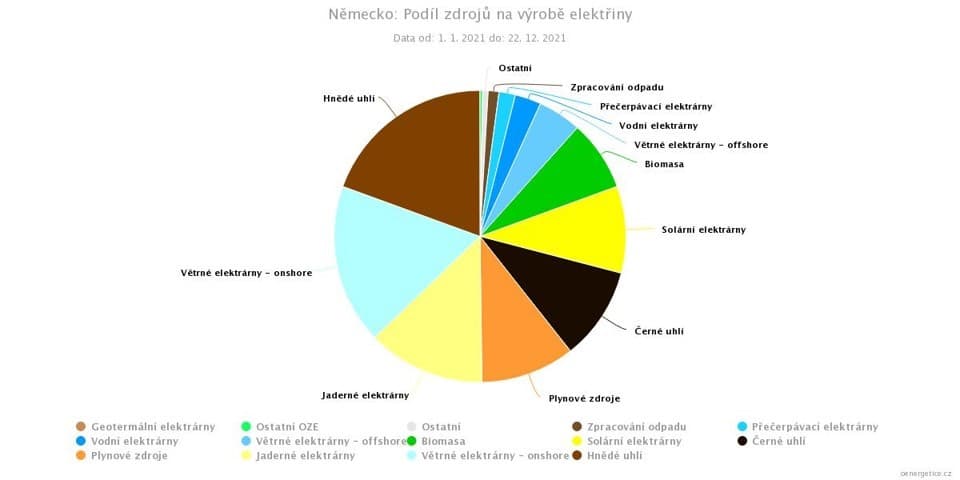
The share of individual electricity sources in Germany in 2021. Coal still has the largest share of electricity generation in Germany. Wind is the second-largest source, but nuclear remains third, supplying 13 % of electricity. However, it is to be completely shut down next year. Fossil fuel sources supplied 40,1 % of electricity there (source: oenergetice.cz).
How to address the situation?
Measures that would make it possible to address the coming problems can be divided into short-term and long-term ones. It is necessary to take into account that building any source takes time. Let us recall that gas prices are unlikely to fall in the future. As for greenhouse gas emissions, once methane emissions from extraction and transport are included, gas does not fare much better than coal. The future position of the European Union on gas is therefore highly uncertain.
The closure of coal-fired sources should therefore be conditional on completing construction of their corresponding replacements. This applies not only to overall generation, but also to covering capacity at every moment and ensuring grid balancing and stability.
Available balancing and storage options need to be used as efficiently as possible, supplemented and developed, for example through the deployment of micro-regulation and smart grids. The construction of renewable sources, particularly in decentralised form, should be supported. However, it must be stressed that Germany plans to build enormous wind and photovoltaic capacity. At times when the sun shines and the wind blows in our region, there will rather be a surplus of electricity. At the same time, it will focus intensively on gas-fired sources. If we were to focus on them too, we would increase gas consumption and prices through mutual competition. This is also linked to my view of how we should respond to Germany’s energy policy, which affects us very strongly. We cannot simply adopt Germany’s nuclear phase-out and rely on the massive build-out of renewable and gas-fired sources. In my view, the right response is instead to build sources that complement the German mix and will supply electricity when there is no wind or sunshine. The use of nuclear power plants should therefore continue, and new nuclear sources should also be built. If Bavaria could do so, it would most likely follow this path as well.
A very important task facing the current government is to negotiate several important issues with European institutions. One is the possibility of introducing capacity payments if necessary. Germany, for example, has already negotiated these. Another area is the possibility, in a situation where high electricity prices arising in neighbouring countries threaten the social standing of a large part of the population here, of selling Czech electricity directly to Czech citizens. This is a safeguard against a wealthy and economically strong neighbour that has failed to secure sufficient energy sources outbidding Czech citizens and industry when purchasing electricity generated in Czechia. Another important point is to negotiate reform of the allowance system so that it fulfils its purpose: to provide predictable and reasonably timed pressure for the transition to lower-emission technologies. This is far more useful than using it as an investment commodity. A very important task is to ensure that nuclear sources are classified as sustainable in the European taxonomy.
This is extremely important, especially from a long-term perspective. A new nuclear source cannot be built quickly. This is why it is necessary to negotiate a financial model for the new unit at Dukovany with European institutions very quickly, carry out the tender and begin construction. At the same time, a financial model should be selected for the construction of new units at Temelín, and their construction should also begin as soon as possible. The strategy for a gradual transition to a low-emission mix needs to be progressively refined. In doing so, it is necessary to maintain energy security and the social affordability of this transition, while being prepared to make maximum use of potential new technologies, for example new storage options, grid balancing using elements of artificial intelligence or small modular reactors.

The share of individual electricity sources in Czechia in 2021. Nuclear is the most important source in Czechia. The share of fossil fuel sources is 45,5 %, which is not a very large difference compared with Germany (source: oenergetice.cz).
Conclusion
This autumn and winter clearly show that a low-emission energy system cannot be built on renewables alone. Closing nuclear and coal-fired units and replacing them with gas increases gas consumption. The result is pressure to increase its price and growing dependence on supplies from Russia. Since the trends mentioned cannot be expected to change in the coming years, gas and electricity prices cannot be expected to return to their former levels in the years ahead. If less windy and colder weather persists, the situation in our region could become quite dramatic. After the new year, Germany will shut down another three of its nuclear units. Four nuclear units will also be missing in France. The risk of a blackout will therefore not be merely theoretical.
Gas and electricity prices could stabilise and fall in spring. However, as already mentioned, this will be at a different level than in previous years. The question is how households and industry will cope with this. Low-income groups and energy-intensive industry are particularly at risk. A major problem is that different European countries have different levels of economic prosperity, both in society and among individual citizens. Residents of Germany therefore experience harmonised energy prices differently from residents of Czechia, for example. And the new German coalition wants to tighten its approach further in the transition away from coal and towards electric mobility. Likewise, it is unlikely to relent in its fight against nuclear power. It is therefore unlikely that the European Union will respond rationally to the coming situation. Its political leaders proclaim that the solution is an ever faster closure of fossil fuel sources and a massive build-out of wind and photovoltaic power plants. Yet this is an entirely misguided notion. This autumn has shown that there can very often be periods lasting many days with almost no wind, when no amount of installed wind turbine capacity will help. Batteries are also useless over such a long period, as there is nothing to charge them from. Continuing down this path only increases the risk of an energy system collapse and the dramatic social impacts of such an event.
Last week, we held a seminar and discussion on the issue at the CIIRC CTU.
EDIT 2 January 2021, 19:57: After publication of the article, part of it was removed by the oEnergetice.cz website in breach of the rules under which we publish articles in the opinion section of the oEnergetice.cz website.
Translation disclaimer
This article is a machine translation of the Czech original and has not yet been fully reviewed. In case of any doubt, please refer to the Czech version.
Sdílejte článek prostřednictvím:
You might also like
23 October 2026, 11:01
23 October 2026, 06:34