23 October 2026, 14:38
Loading...
What is the cost of different energy mixes in Czechia?
Vladimír Wagner
14 July 2025, 11:27
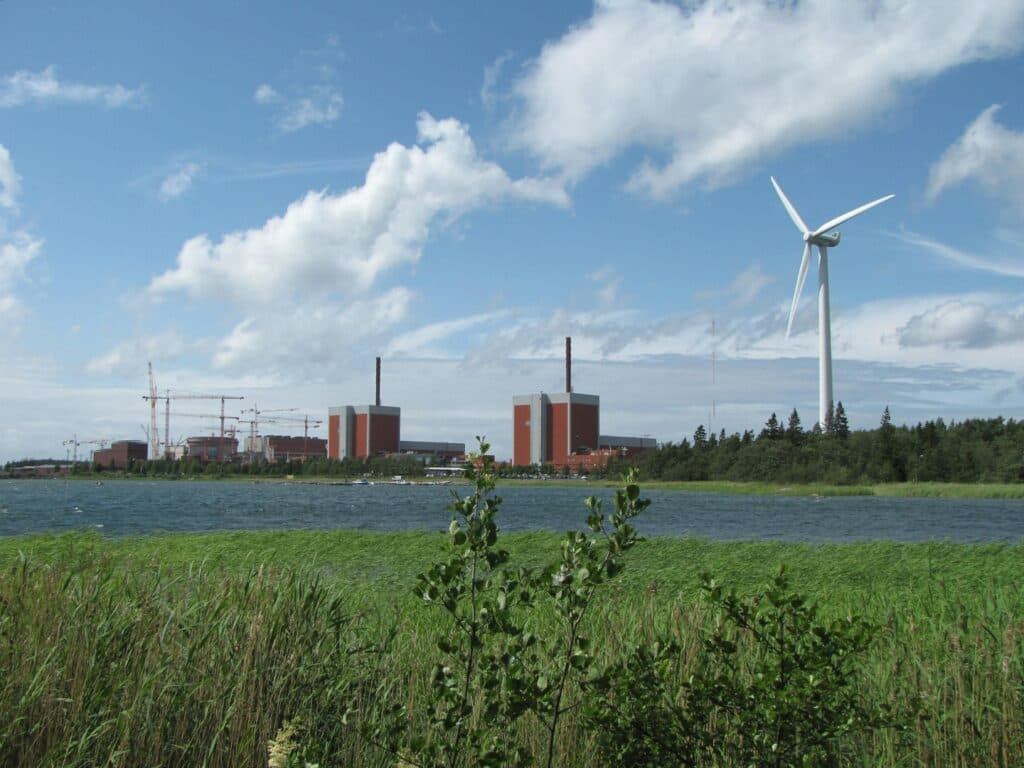
Very often, discussions of which energy sources we should use involve arguments about their cost. However, especially when using weather-dependent fluctuating sources, it is necessary to assess the operation and costs of the entire energy mix. Let us look from this perspective at the options available to the Czech Republic in this area.
Recently, a contract was signed between KHNP and ČEZ for the construction of two new nuclear units, and preparations for their construction should get under way. At the same time, the campaign by green anti-nuclear activists, who criticise the use of “extremely expensive” nuclear sources and the failure to use “extremely cheap” renewable sources, is intensifying again. It is therefore worth examining in more detail whether this notion, presented for example by the Fakta o klimatu organisation, corresponds to reality.
I recently responded to one similar attack on nuclear power in Britské listy with two articles (here and here), in which, besides refuting certain false claims, I also analysed the impacts of using different combinations of energy sources.
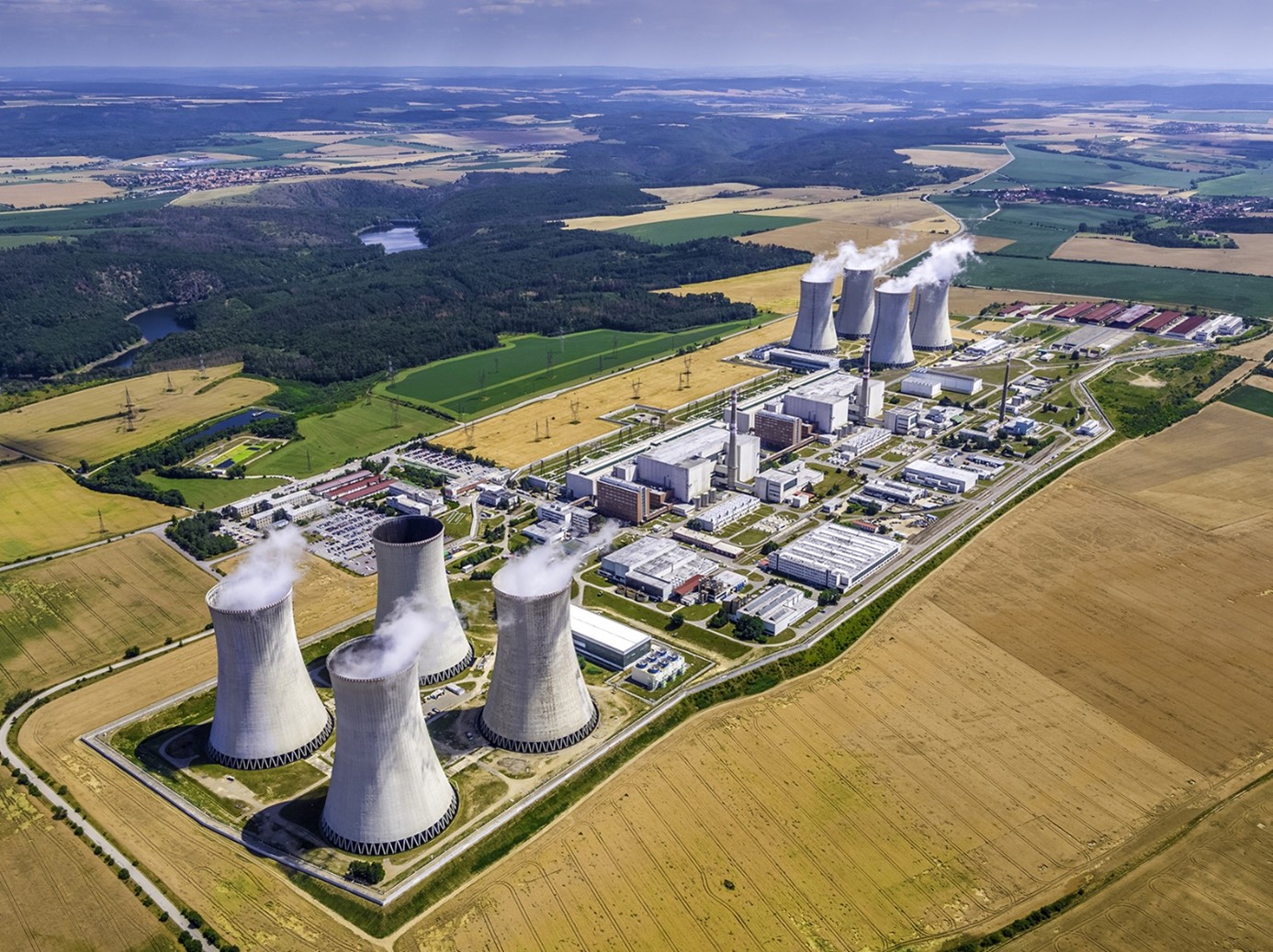
The four VVER440 units at Dukovany could operate until 2055 and could be supplemented by two APR1000 units (photo: ČEZ).
A programme for testing different energy mixes
To test the impacts of different scenarios, colleagues from the Institute of Plasma Physics of the Czech Academy of Sciences prepared a simulation programme, which I used to assess different energy mixes. It is highly user-friendly and freely available online. It uses data on electricity generation and consumption from recent years to simulate the operation of different mixes that users can select. Consumption, the capacities of different sources and storage capacity can all be increased or reduced.
The programme can be used to test any mix that interests you. It can also estimate its cost and carbon intensity. Naturally, it is based on a simplified model. It uses the specific consumption profile (daily load curves, industrial consumption, heating demand, etc.) in a particular year, which you can select. The programme’s database includes the years 2019 to 2024, but data from another year can also be used. Future consumption is then expressed as multiples of this consumption. Generation also comes from a specific year, which determines efficiency, weather, operating regime and so on for the relevant sources. Only storage is added under the most ideal possible operating regime. Here, too, however, a wide range of parameters can be varied as needed. Estimates of capacity shortfalls or surpluses, which indicate the instability of the mix, are relatively realistic even with these simplifications. It is also possible to relatively reliably try out the optimisation of the mix being sought, and check whether it will work.
Let us therefore use the programme and look at the characteristics of different energy mixes. Clearly, the results may differ between years. We will use 2019, which was not affected by the COVID-19 pandemic, as the reference year. In some cases, we will also look at other years to see whether the results differ dramatically.
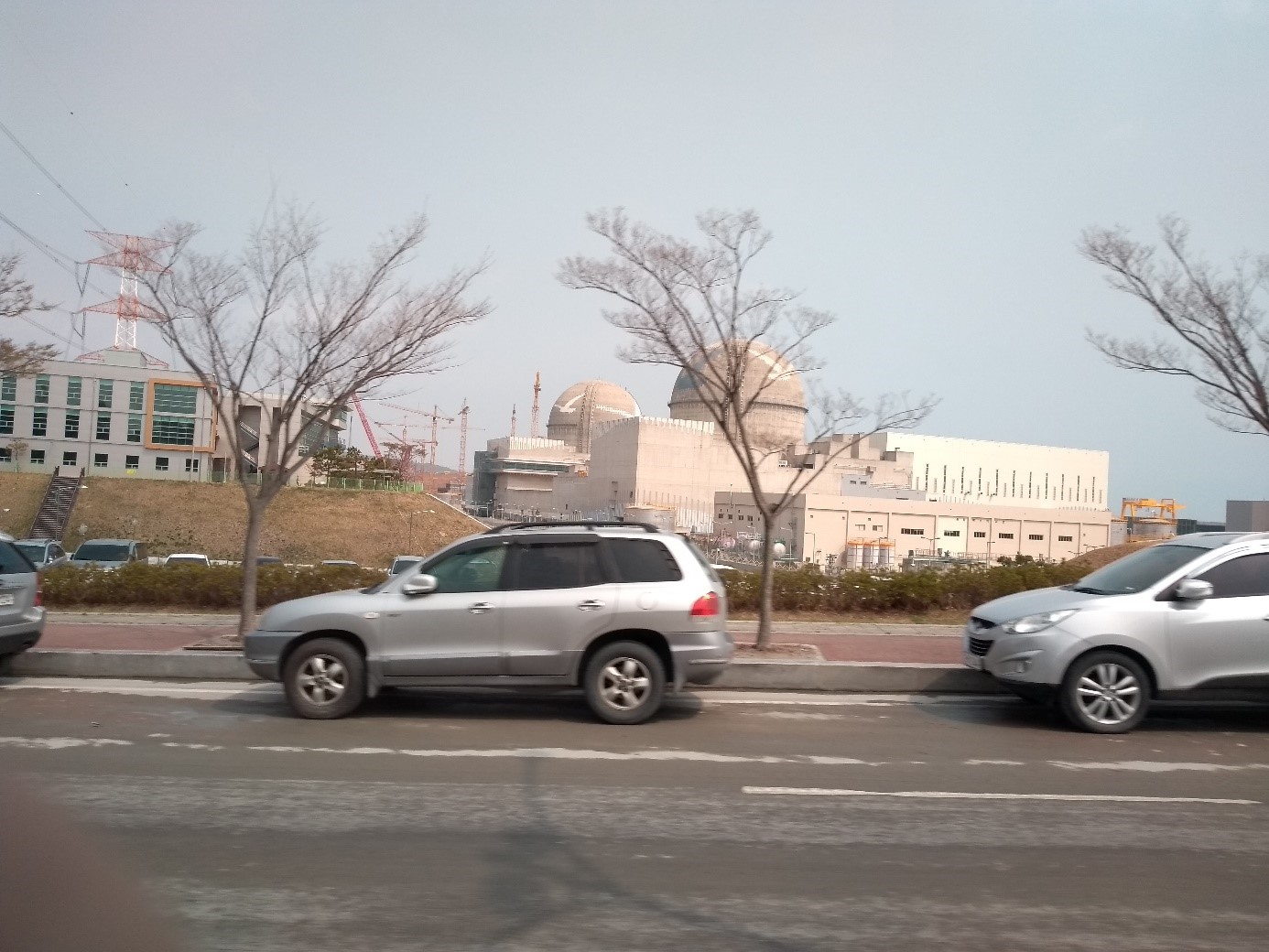
The new South Korean APR1000 design draws on knowledge gained from developing Generation II OPR1000 reactors and Generation III APR1400 reactors (photo: Vladimír Wagner).
What can individual low-emission sources achieve on their own?
First, let us compare how individual sources can cover demand on their own. Let us simplify the situation by having only photovoltaics and gradually increasing their capacity. We will use data for each year from 2019 to 2023. With installed capacity of 5 GW, photovoltaics can cover between 8 and 11 % of annual demand, with no electricity going to waste. At 10 GW, between 16 and 18 % of demand is covered and losses remain negligible. At 20 GW, coverage reaches 28 to 36 %, but unused electricity already amounts to 18 to 37 % of that used. At 40 GW, coverage rises only relatively little further, to 34 to 45 % of demand, while the amount of unused electricity is already 80 to 110 % of the amount used. This shows that almost half of the installed potential is no longer utilised.
For wind power, the situation is better in terms of covering demand, due to better annual capacity utilisation. However, surplus generation grows rapidly at high capacities. Dependence on weather conditions in a given year is also even stronger. With installed capacity of 5 GW, wind turbines can cover between 14 and 17 % of annual demand, with no electricity going to waste. At 10 GW, between 27 and 34 % of demand is covered and losses remain negligible. At 20 GW, coverage reaches 48 to 58 %, while unused electricity already amounts to 11 to 19 % of that used. At 40 GW, coverage rises further to 70 to 77 % of demand, but the amount of unused electricity is already 64 to 77 % of the amount used. This shows that here too, almost half of the installed potential is no longer utilised.
Let us look at nuclear sources. With reactor capacity of 5 GWe, consumption coverage is 53 to 57 %. At this capacity, the generation surplus is negligible. At 10 GWe, consumption coverage is already 95 to 98 %. In this case, the surplus generated is only 8 to 11 % of the electricity used.
An even more fundamental difference is that photovoltaics and wind turbines quite often generate almost nothing, leaving the entire required capacity short. For nuclear sources, however, the maximum capacity shortfall in a given year with 5 GWe installed was between 6 and 7 GW, and with reactor capacity of 10 GWe it was only 2 to 4 GW. For photovoltaics with capacity of 40 GWp, the maximum capacity shortfall in a given year ranges between 10 and 11 GW, while for wind turbines with capacity of 40 GWp it is between 9 and 10 GWp.
The overall composition of a specific mix naturally affects the entire situation. Storage in particular can help significantly, but it is only short-term and its potential is limited. Moreover, its deployment significantly increases costs. Wind and photovoltaic sources also have periods when they supply almost nothing, meaning backup from weather-independent sources must be available at a capacity sufficient to cover all demand at peak times. As can be seen from the previous analysis, the additional supplementary backup required in the case of nuclear power is only one-third of that needed for photovoltaics or wind. And that represents further additional costs.
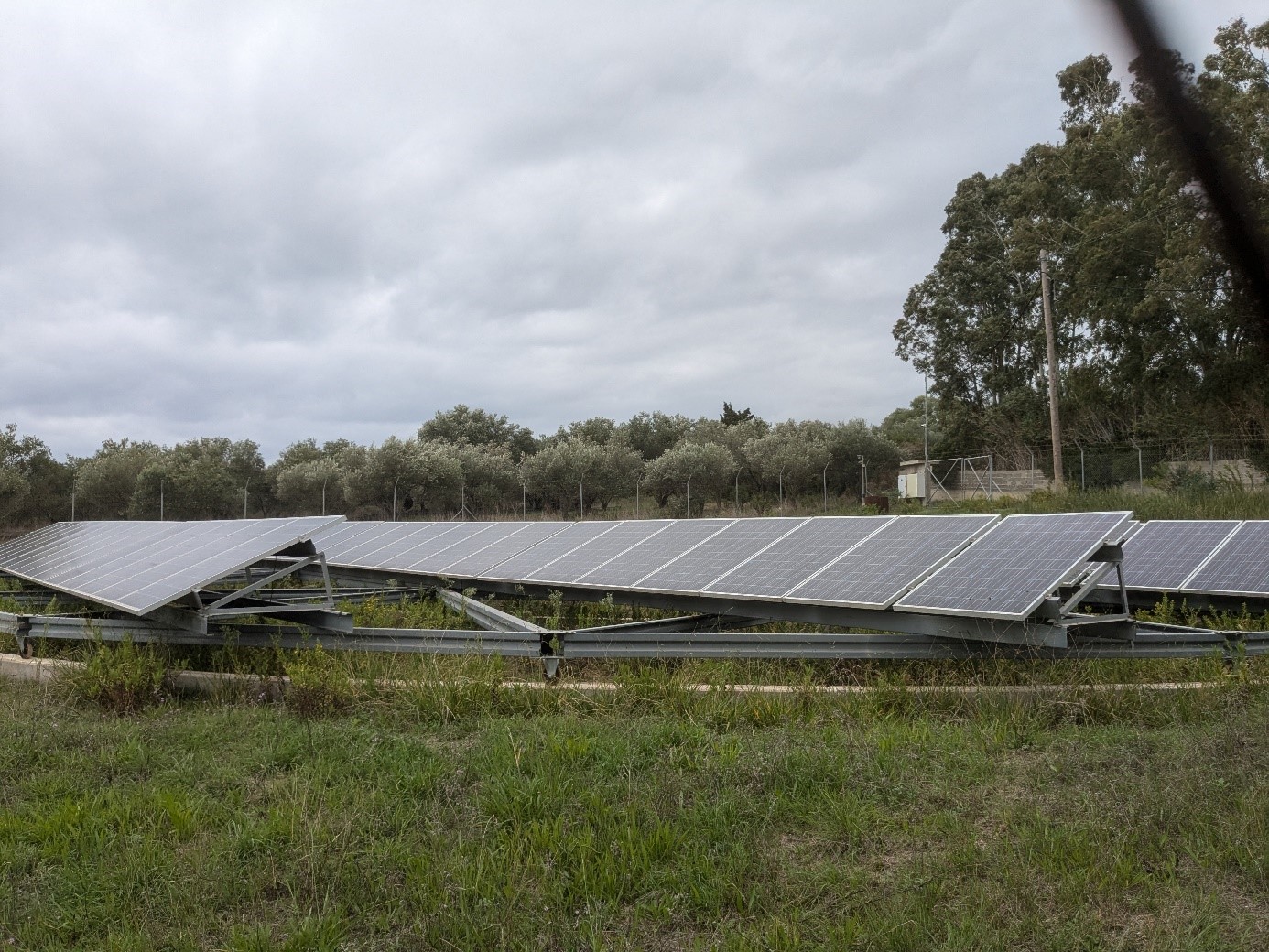
A solar power plant on the Greek island of Corfu has somewhat better conditions than we do. But only when it is not cloudy. (Photo: Vladimír Wagner)
Comparison of a nuclear-based and a renewable-based scenario
The programme used also includes simplified calculations of the investment costs and CO2 emissions of a given mix. We can therefore look at the costs and CO2 emissions of different mixes. Hnutí Duha, Greenpeace and other green activist organisations originally campaigned for the shutdown of Dukovany after 30 years of operation and for the complete cancellation of the Temelín project. Had they succeeded in the 1990s and at the beginning of this century, we would be without nuclear sources today. They now accept the operation of existing nuclear sources to some extent, but campaign against the construction of new ones. Even a current study by the green activist movement Fakta o klimatu promotes for Czechia a mix based on a combination of photovoltaics and wind, supplemented by storage and backup sources.
Let us therefore consider what three energy-mix scenarios for the Czech Republic would look like. The first assumes construction of four new large nuclear units, two at Dukovany and two at Temelín, and operation of the existing Dukovany units for as long as possible (70 years). The second assumes building very large solar and wind capacity in the ratio recommended by the Fakta o klimatu study, namely a wind-to-solar generation ratio of 3:1. The third assumes retaining the existing Temelín units, operating Dukovany for a limited period, and again deploying the largest possible capacity of photovoltaics and wind. All three cases assume the complete shutdown of all coal-fired units. Hydropower and biomass capacity are kept at current levels. The mix is then supplemented with storage and gas so that all required electricity is supplied at every moment. The resulting energy mixes are then assessed for their investment cost and carbon intensity.
One more note on prices. In its basic configuration, the programme assumes nuclear investment costs of 150 billion Kč/GW, which is similar to values from various sources. For wind sources it assumes 56,5 billion Kč/GW, and for photovoltaics 24,0 billion Kč/GW; the programme sets storage costs at 11,5 billion Kč/GWh. Investment costs of 27 billion Kč/GW are assumed for gas sources. These values fall within the price ranges found in various sources. You can also use your own values in your analyses. The price stated for the supply of the Korean units for Dukovany is assumed to be 200 billion Kč, which is why we considered a price of 200 billion Kč/GW for nuclear power.
A combination of nuclear and renewable low-emission sources
For the nuclear mix, we have 8 GW of capacity. We must build four new sources at a total cost of 800 billion Kč. We set photovoltaics at 4 GW of capacity (in reality, this is the current level, with replacement of retiring capacity assumed). Wind was increased to 3 GW at a cost of 152 billion Kč. In order to make the greatest possible use of surpluses, storage was increased to 4 GW (with capacity of 20,0 GWh). The cost is 173 billion Kč. To ensure capacity at all times, gas-source capacity had to be increased to 2,6 GW, at a cost of 37 billion Kč. Such a mix was able to fully cover consumption and ensure the required capacity at every moment. The generation surplus is 9,2 TWh, part of which can be exported because it is generated even when there is no wind or sunshine. The total investment cost for building new sources in this mix is 1210 billion Kč. Nuclear sources provide a total of 74 % of electricity. Gas covers only 0,7 % of electricity generation here, so carbon intensity is only approximately 5 000 kt CO2.
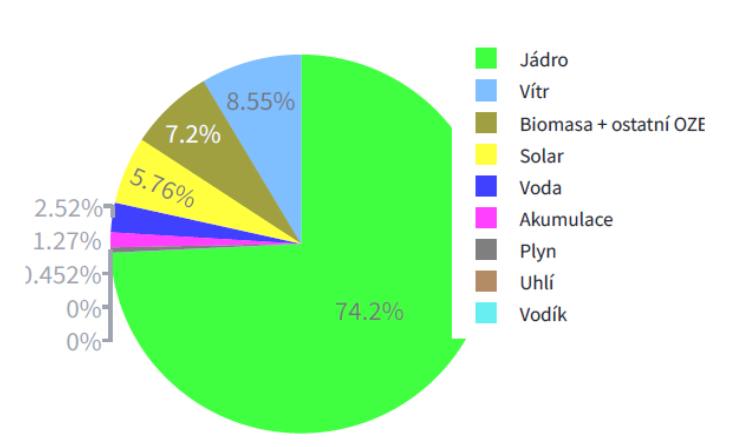
Share of individual sources in a mix comprising nuclear and renewable low-emission sources.
Purely renewable low-emission sources
The renewable mix uses a very high level of photovoltaic deployment, increasing capacity to 20 GW; any further increase brings no visible improvement without extreme storage. The cost is 433 billion Kč. Wind capacity was increased to 30 GW, so that the ratio corresponds to the recommendation in the Fakta o klimatu study, at a cost of 1680 billion Kč. To use the generation surpluses efficiently, approximately 12 GW of storage (60,0 GWh of capacity) was needed, at a cost of 635 billion Kč. Even so, gas capacity had to be increased to 8,5 GW at a cost of 196 billion Kč to cover capacity shortfalls during prolonged periods without wind and sunshine. Such a mix was able to cover all demand and capacity at every moment. Total investment costs in this case are 2939 billion Kč. The generation surplus is 30,9 TWh, unfortunately mostly at times when there is plenty of sunshine and wind, when neighbouring countries can also be expected to have surpluses. Photovoltaics provided 21,3 %, wind 63,2 %, and together they supplied 85 % of electricity generated. Gas sources here must cover 3,1 % of electricity generation, so carbon intensity is higher than in the nuclear mix, at approximately 6 078 kt CO2.
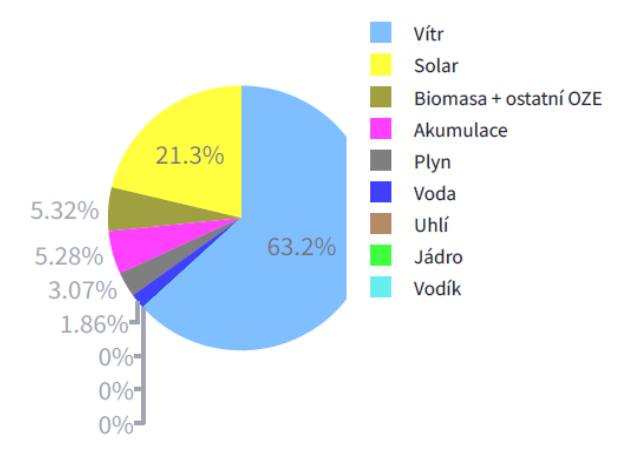
Share of individual electricity sources in generation from a mix of purely renewable low-emission sources
Temelín and only renewable low-emission sources beyond that
If Temelín is used and supplemented by a renewable mix, the need for gas-source reserve capacity can be reduced compared with a purely renewable mix. First, let us look at very high deployment of photovoltaics at the aforementioned 20 GW and wind sources at 30 GW. To use surpluses, we again build approximately 12 GW of storage (60,0 GWh of capacity). Even so, gas capacity had to be increased to 6,5 GW at a cost of 142 billion Kč to cover capacity shortfalls during prolonged periods without wind and sunshine. Such a mix was able to cover all demand and capacity at every moment. Total investment costs are thus very close to the previous variant, reduced only by part of the investment in gas, specifically to 2890 billion Kč. The generation surplus is naturally even higher, at 43,4 TWh, again at times when there is plenty of wind and sunshine. Photovoltaics generate 19,4 %, wind 57,7 % and nuclear power 12,5 % of electricity generated. Gas sources here need cover only 1,1 % of electricity generation, so carbon intensity is low, at approximately 5 420 kt CO2.
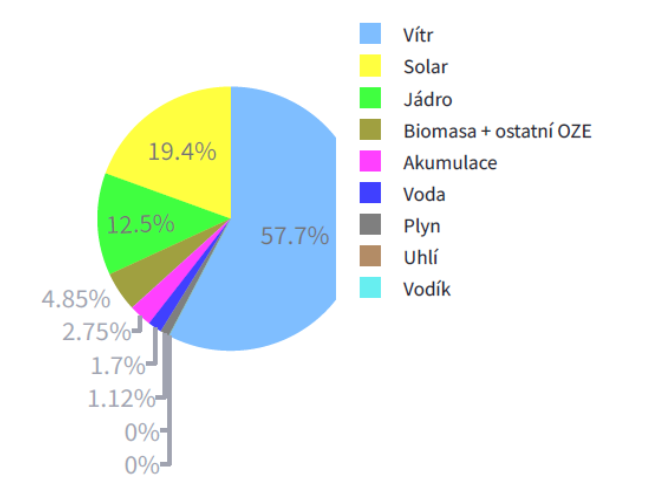
Share of individual sources in electricity generation in a mix using Temelín and only renewable low-emission sources, with very high photovoltaic and wind capacity.
If we do not want to go for such extreme photovoltaic and wind capacity, we can make the mix cheaper. Let us consider a combination of 10 GW of photovoltaics and 15 GW of wind turbines. To use surpluses, it makes little sense to build more than 8 GW of storage (40 GWh of capacity). For gas, we then need 7,2 GW to cover capacity shortfalls. Total investment costs in this case are 1 586 billion Kč. The annual surplus is 6,6 TWh. Photovoltaics generate 14,4 %, wind 42,7 % and nuclear power 18,5 %. Gas must generate 10,2 %, while total carbon intensity is 8 030 kt CO2.
The data presented are for 2019; the required gas-source capacity was also checked for subsequent years up to 2024. Only an individual extreme outage caused by a non-standard outage of a scaled source on a particular day of a given year was not taken into account. Clearly, in a real-world situation, all mixes will need somewhat higher reserve capacity to cover unexpected outages, for example due to faults. However, this will not affect the overall comparison.
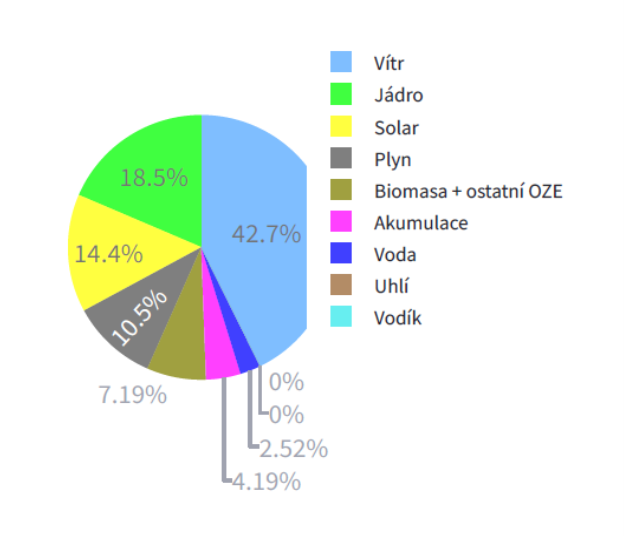
Share of individual sources in electricity generation in a mix using Temelín and only renewable low-emission sources, with lower photovoltaic and wind capacity.
Conclusion
It should be emphasised that the programme involves a number of simplifications and provides only a rough picture of the mixes in question. The energy mixes compared are also simplified, and could be adjusted and refined further. At the same time, the response to changes in consumption and other modifications could be studied. Naturally, electricity imports can be considered in times of shortage. However, the fundamental problem with a mix based on photovoltaics and wind is that surpluses and shortages will occur here at the same time as they do among our neighbours. Germany in particular is focusing primarily on photovoltaics and wind turbines.
The model shows only investment costs; fuel costs, especially for gas, operating costs and funds set aside for decommissioning could of course also be added. It should also be recalled that a nuclear source has approximately three times the lifetime of wind and photovoltaic sources. A rough analysis of these costs is available in an earlier article. Although it is now six years old and some prices have changed, it provides an idea and allows the current situation to be traced through the sources.
At the same time, electricity prices will also be affected by the necessary modernisation of the transmission grid, which is more demanding when renewable sources are used. Electricity consumption can be expected to rise through the electrification of transport and industry, as well as growing demand from data centres and artificial intelligence. In this case, consumption will increase. This growth can be addressed by increasing renewable capacity, storage and nuclear power, for example in the form of small modular reactors. However, the relationships between source generation, mix cost and emissions remain the same for the different options. It is naturally possible to consider demand-side response, better scheduling of nuclear outages and other measures to optimise the use of the mix compared with the situation in previous years. However, this does not change the fundamental findings we have obtained.
Despite the simplifications mentioned, the comparison of the three scenarios clearly shows that using nuclear sources is not disadvantageous compared with renewable ones. On the contrary, if we pursue the construction of four new nuclear units and supplement them with the other necessary sources, the investment cost will even be lower than for mixes based on photovoltaics and wind turbines, whether with Temelín or without nuclear sources. This is mainly because, where renewables dominate, three power plants—photovoltaic, wind and gas—as well as significant storage are needed to cover the same capacity. The carbon intensity of the nuclear mix is also lower, and only with extreme photovoltaic, wind and storage capacity does the carbon intensity of the purely renewable mix approach it.
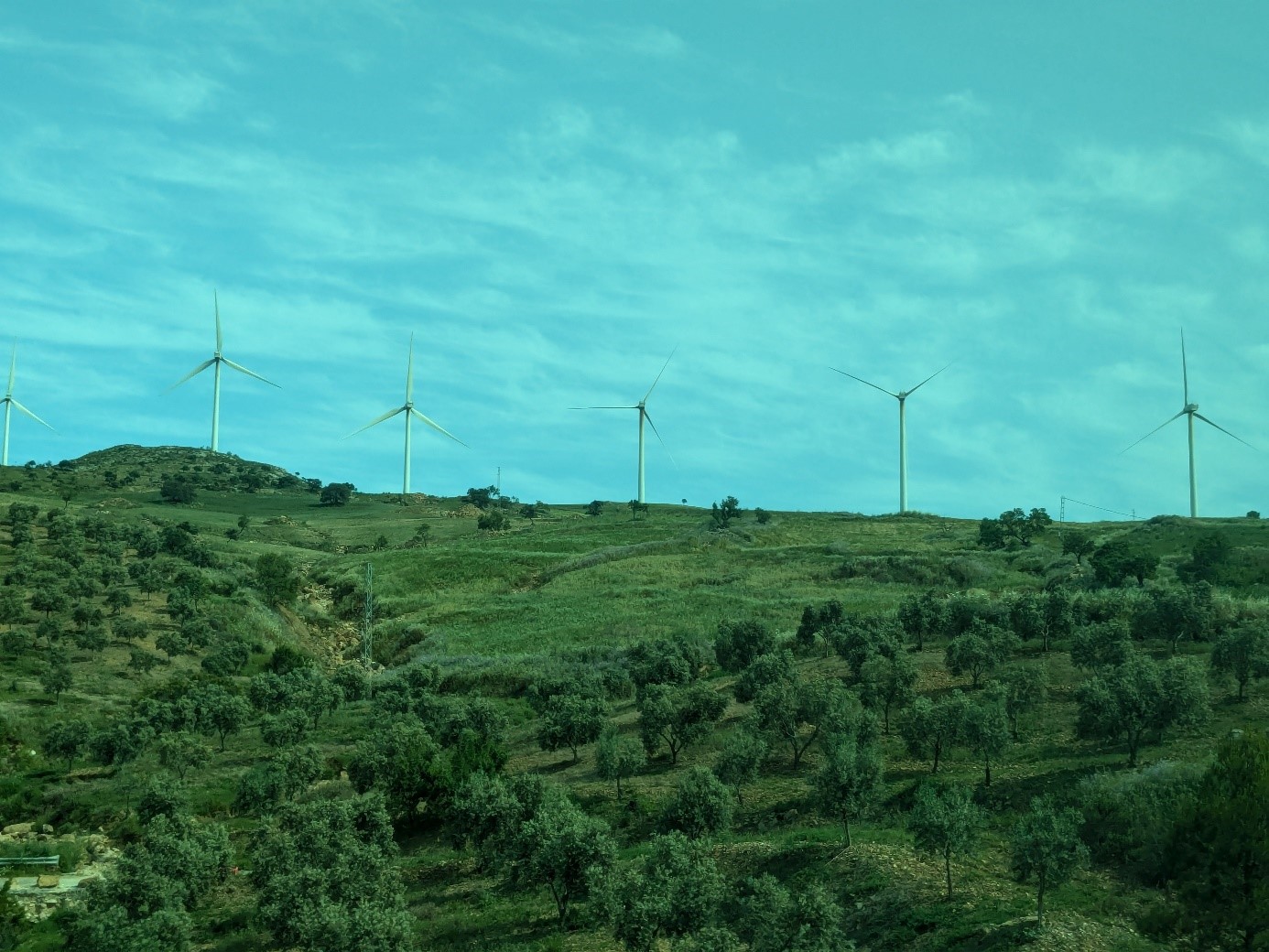
In Spain, renewables dominate the mix during certain periods. A wind farm in Andalusia, southern Spain (photo: Vladimír Wagner).
What do the Fakta o klimatu study and our analysis say together?
It should be emphasised that the results presented here are fully consistent with the data and charts presented in the Fakta o klimatu study. I would recall the conclusion highlighted by the study’s authors: “Solar and wind power plants can reliably supply a large share of electricity under Czech conditions – if they are correctly combined and supplemented by storage and backup sources. With a good combination of wind and solar, it is therefore possible to cover a large share of consumption – even in winter, when generation fluctuates most.” The charts presented in the study show that the total generation from wind turbines and photovoltaics with sufficiently large capacity can meet the needs of Czech electricity consumption over a sufficiently long period and in annual volume. However, it cannot ensure generation, particularly during sometimes quite long winter periods when there is no wind and it is cloudy—periods of inversion, or, as the Germans call it, dunkelflaute. Storage helps only partially; we do not yet have seasonal storage or truly massive short-term storage. Backup sources are therefore indeed necessary.
This article has shown what the very high photovoltaic and wind capacity recommended by Fakta o klimatu, together with the necessary scale of storage and backup gas sources, leads to. Such a mix is not only more costly than one using nuclear sources efficiently, but also produces far worse results in the drive to reduce emissions. This is also confirmed by practice, as can be seen in a comparison of the electricity sectors in Germany and France.
Another problem that must not be forgotten is the growing instability of the system as weather-dependent volatile capacity increases and stable rotating sources decline in the system. The blackout in Spain demonstrated this dramatically. There are options for modifying electricity-grid management that can reduce these risks, but it remains to be seen whether such blackouts can be effectively prevented. The dramatic impacts of such blackouts were also demonstrated by the one that recently occurred in Czechia. It was not related to renewable sources, but in any case it is clear that we should seek to minimise the likelihood of such events also through the choice of energy mix.
I gave a lecture on the future of nuclear energy at Dominikánská 8:
https://www.youtube.com/watch?v=IbmlYKj382I
I also discussed energy in the Vysoké napětí interview series:
Translation disclaimer
This article is a machine translation of the Czech original and has not yet been fully reviewed. In case of any doubt, please refer to the Czech version.
Sdílejte článek prostřednictvím:
Topics:Opinion
You might also like
23 October 2026, 11:01
23 October 2026, 06:34