
23 October 2026, 14:38
Loading...
What is the future of nuclear energy? – Part 2
Vladimír Wagner
15 August 2016, 20:04
Several articles have recently been published on this site (for example here, here and here) analysing developments in low-emission energy in recent years and future trends. Here too, particularly in discussions, claims appear about the unstoppable, intensive growth of renewable sources and the decline of nuclear energy. I would therefore like to look at this area and show that this is far from the case.
This is a continuation of Part 1 of the article…
New reactors must replace those being shut down. Overall, the number of reactors increased by only two, but capacity rose by 5 GW. The small increase in the number of reactors was mainly due to the removal from the database of five small Japanese reactors more than 40 years old, for which repairs and adaptation to new safety requirements would no longer have been economically viable. A sixth unit was added to these five this year.
In mid-2015, operations also ended at the Grafenrheinfeld power plant, the first large 1,345 MWe unit in Bavaria. The shutdown of the Bavarian unit is a consequence of the Energiewende and marks the start of the closure of sources that had until then produced 50 % of Bavaria's electricity. The reactor was licensed to operate until the end of the year. However, during negotiations on the extension of nuclear unit operations in 2010, a special tax was introduced, also determined by the amount of fresh fuel loaded. This tax remained after the extension of operating lifetimes for German units was cancelled following Fukushima. Operating for half a year, which would entail the payment of a range of fees while the fresh fuel would burn up very little over that period, was therefore economically unviable.
The shutdown of Sweden's Oskarshamn 2 unit was mainly caused by increasing taxation of nuclear power generation and unfavourable conditions in the distorted European market. In this case, it is a 638 MWe boiling water reactor more than 40 years old. It had been shut down since 2013, and refurbishment was being prepared to further extend its operation. Under the given conditions, this was not economically viable. Encouragingly, this case led Sweden to reassess the special additional taxes imposed on nuclear power.
The final reactor shut down in 2015 was Wylfa 1, the last old Magnox gas-cooled reactor in the United Kingdom. As planned, it ceased operation on 30 December 2015 after 45 years of operation. In this case, it was a facility that had reached the end of its service life.
In Vermont, nuclear power will be replaced by gas
Another characteristic example of a shutdown dates from the end of 2014. In the US, Vermont Yankee, with one 602 MWe boiling water reactor, was shut down on 29 December 2014 after 42 years of operation. Operating a single smaller unit was no longer economically viable amid low shale gas prices. The plant produced 72 % of Vermont's electricity, while hydro sources produced 22 %. Electricity generation therefore had very low CO2 emissions.
This will now change. Nuclear power will be replaced by gas. Several nuclear units are at risk in the United States, particularly in regions with access to cheap shale gas. Unlike subsidised renewable sources, they do not have guaranteed prices or offtake. As a result, these sources are largely being replaced by gas-fired generation. Gas obtained through fracking is thus replacing not only coal, thereby reducing carbon dioxide emissions, but also nuclear power, which conversely contributes to increasing these emissions.
In the near future, two reactors in India will also probably be shut down. These are Tarapur 1 and 2, among the oldest reactors still in use. They entered operation in 1969 and are now 47 years old. They are also very small, with a capacity of only 150 MWe each. Their age is reflected in operating efficiency and capacity factors, and thus in their economics. The situation and considerations surrounding these Indian reactors point to another open question. Reactors age. A range of components can be replaced and even upgraded. This is also why the capacity of many reactors has increased following refurbishment. Their overall operating lifetime therefore depends on the lifetime of key parts that cannot be replaced, especially the reactor vessel.
It depends on the reactor type, but for most of them operation for up to sixty years is possible. In the US, the first licence applications for operation beyond sixty years are already being prepared for review. On the other hand, older reactor designs may naturally not have such favourable economic parameters, and the required improvements in their safety performance can also be costly. Moreover, not only the industrial structure but also the needs of the region in which they are located can of course change. The final decision on extending operations can therefore remain very open in individual cases. This applies particularly to Europe and the United States.
Nuclear electricity generation has started rising again in recent years
As mentioned, after the decline following the events at Fukushima I, nuclear electricity generation has started to rise again in recent years and its share has stabilised. Further developments will depend not only on the situation in the aforementioned China, India and South Korea, but also on how many units are restarted in Japan. After the write-off of the aforementioned six units, Japan still has 42 reactors and two under construction. However, only two reactors at the Sendai plant are operating. Two more reactors at the Takahama plant (units 3 and 4) were started, but a court suspended their operation through an injunction following a petition by a group of activists. A very lengthy court case with a highly uncertain outcome is now awaited.
Ikata 3 is also being prepared for restart. A further 20 units are being assessed by the Nuclear Regulation Authority (NRA) to determine whether they meet the conditions for resuming operation. As the course of political and judicial decisions is difficult to predict, the question of how many reactors will operate in Japan and when remains completely open. More details on the current situation in Fukushima and Japan can be found here and here.
Even without reactors in Japan, annual electricity generation from nuclear sources is increasing and approaching the level before 2011 and the highest levels achieved so far. This is highly important in terms of reducing emissions. Let us recall that low-emission sources generated 33,9 % of electricity overall last year, with the remainder produced by fossil-fuel sources. It is clear that a great deal will be needed to replace them at least in part. At the same time, there is enormous scope for different sources suited to different conditions and operating modes. Among low-emission sources, hydro generated 16,5 %, nuclear 10,7 % and all other renewables excluding hydro 6,7 %. It is clear that nuclear sources remain in second place despite the decline described and the rapid growth of renewable sources.
Only a certain share of nuclear sources is efficient in each region
It is true that renewable sources have grown very rapidly in recent years, and this is positive. However, nuclear sources grew at a similarly rapid pace in the 1970s and 1980s. They then encountered several factors. One was that only a certain share of nuclear sources is efficient in each region. Once France substantially exceeded a 50 % nuclear share of electricity generation, and Switzerland and Sweden roughly reached that 50 % level, any further increase in nuclear electricity generation in these countries was no longer efficient.
A number of countries operating nuclear power also encountered the fact that nuclear power plants cannot be built everywhere. However, the decisive turning point was caused by a very intensive and effective campaign by green activists led by Greenpeace, which generated very strong opposition to nuclear power plants in many countries.
Renewable sources are encountering similar limits
Renewable sources are also encountering similar limits, as developments in recent years demonstrate. In areas such as Germany, Denmark, some parts of the United States, Australia or China, where total wind or solar capacity comparable with electricity consumption in the given area has been built, every further increase means that the use of these sources becomes increasingly less efficient. In ideal weather, they significantly exceed demand, while when there is no wind or sunshine, they produce no electricity at all. What this is doing in South Australia is described here.
A further problem is the lack of the necessary grid interconnections that would connect areas with suitable conditions to those where electricity is needed. Germany is therefore being forced to limit the construction of these sources (see here). This is also why China uses its wind sources much less efficiently than the United States. With twice the installed capacity, it has the same annual electricity generation from these sources (see here). At the same time, strong opposition to the construction of wind turbines near inhabited areas is beginning to emerge in some regions (see here).
Developments in China and India are interesting
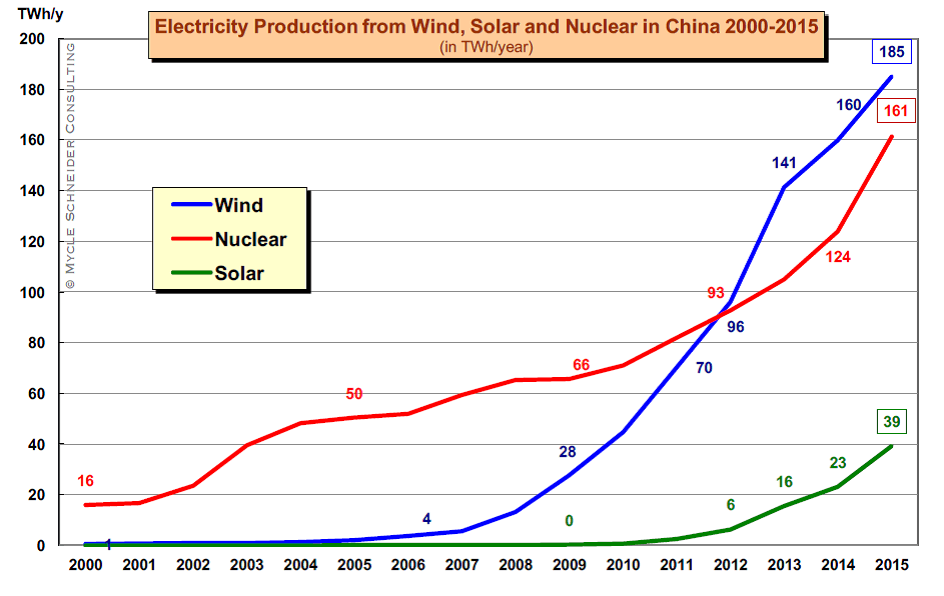
From this perspective, developments in China and India are interesting. Both countries are leaders in the deployment of all low-emission sources and politically favour none of them. In China, electricity generation from wind and nuclear power is roughly the same. Generation from solar sources is many times lower. Three years ago, wind generation overtook nuclear generation, but nuclear generation is now catching up with wind again. The number of wind turbine installations will be lower in the coming years for the reasons described, but grids enabling more efficient use of existing capacity will also be built. It can therefore be expected that the development of wind energy will keep pace with nuclear power, and that China will rely mainly on hydro, nuclear and wind on its path towards reducing emissions.
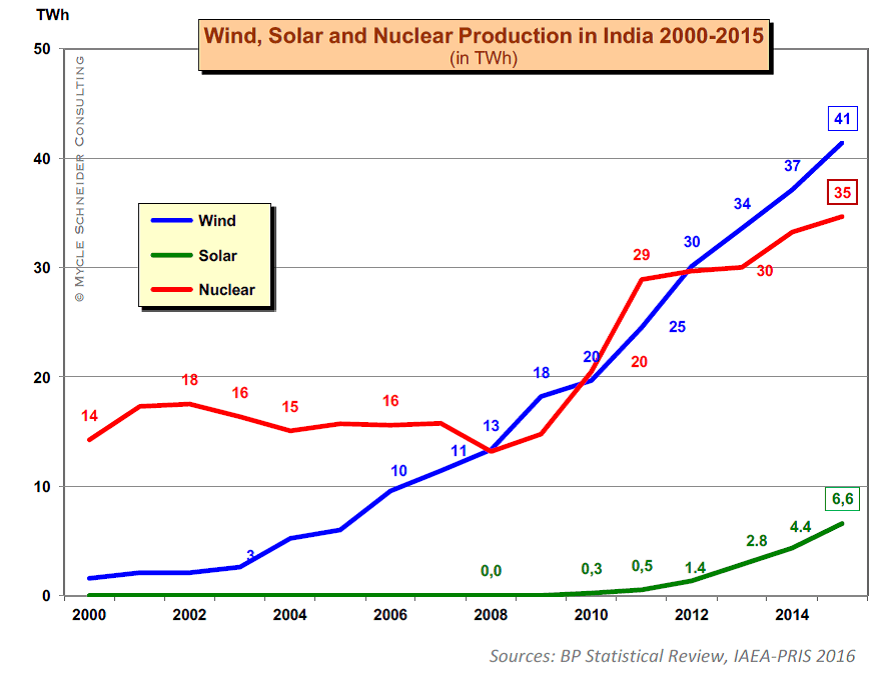
If we look at India, developments are very similar. It should be noted that the two largest units built at the Kudankulam plant have so far had only a minimal impact during the period shown. These two countries are among those where very rapid growth in electricity consumption can still be expected. They are therefore crucial to limiting global emissions growth, also because of their size. It is thus positive that they are succeeding in developing low-emission energy, and they are at the head of the global pack in terms of installed capacity. It is precisely in these countries that it is clear that without nuclear power, emissions reductions would be far smaller and slower.
At the same time, each low-emission source is suited to different conditions and operating modes. Truly radical emissions reductions can therefore only be achieved through an efficient energy mix tailored to local conditions. This too is demonstrated by a look at 2015, a highly successful year for low-emission sources. Primarily thanks to the combination of nuclear power and renewables, Ontario was able to completely eliminate coal-fired electricity generation in 2014. It thus shows that an efficient and relatively rapid path to reducing fossil-fuel sources and emissions exists. Another question is whether it will be feasible amid the various existing ideological campaigns that suppress the ability to make rational assessments.
The charts in the article are taken from a work by M. Schneider and A. Froggatt: The world nuclear industry, status report 2016. I certainly recommend consulting this work. I disagree with Mycle Schneider's anti-nuclear stance and with a number of his interpretations, and I have engaged in several debates with him. However, we have always agreed that we seek to present facts and discuss them. The figures and facts in his study are therefore presented with the greatest possible rigour and can be relied upon in forming one's own views and considerations.
One of the few fundamental critical comments I have on his work this year is that he adopted estimates of the number of radiation-related deaths from Chernobyl from Ian Fairlie's study, which are based on an utterly unscientific methodology. The justification for this claim of mine is here.
Translation disclaimer
This article is a machine translation of the Czech original and has not yet been fully reviewed. In case of any doubt, please refer to the Czech version.
Sdílejte článek prostřednictvím:
Topics:Opinion
You might also like
23 October 2026, 11:01
23 October 2026, 06:34