23 October 2026, 14:38
Loading...
What the current autumn tells us about the prospects for Germany’s Energiewende
Vladimír Wagner
14 November 2016, 18:48
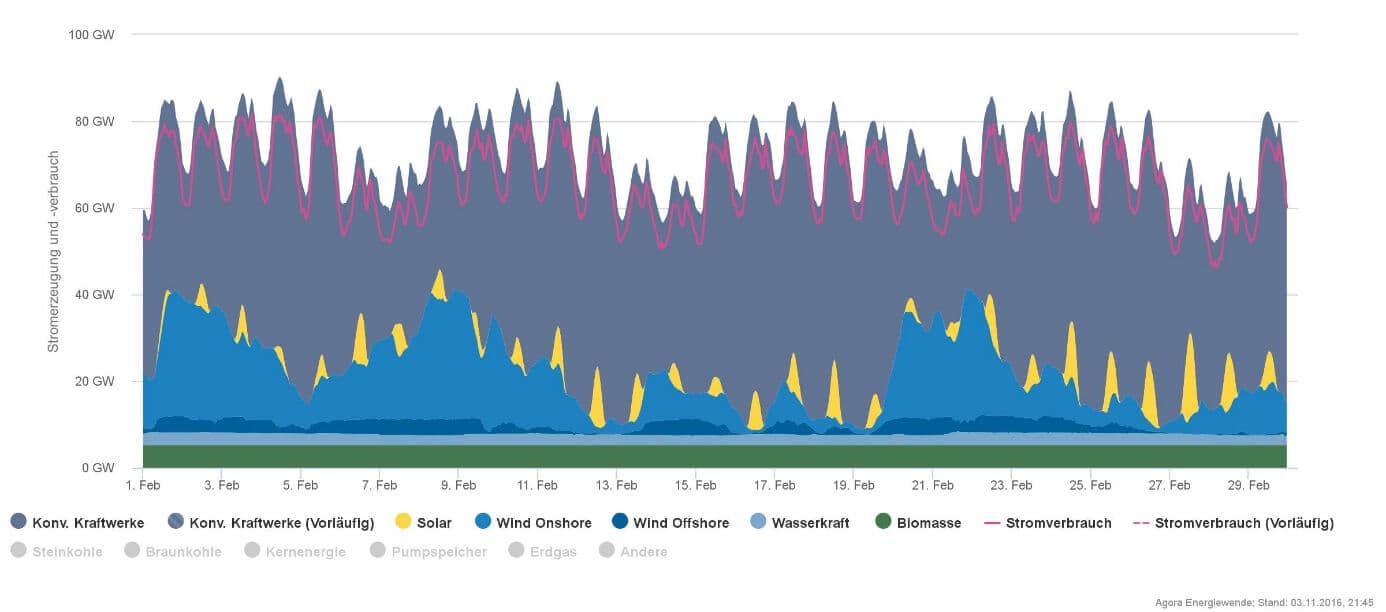
This autumn is not particularly extreme, but the stable weather pattern that has persisted since September highlights one of the main problems of the Energiewende. It is the windless conditions that have now lasted almost three months, not only in Germany but across much of Europe.
Germany currently has more than 40 GW of solar capacity and 50 GW of wind capacity installed. Its demand ranges from 50 to 80 GW, with specific values depending on the day of the week and the time of day. Consumption declines at weekends and on public holidays, and demand is also lower at night. There is a broad peak between 5:00 and 23:00, with maxima around 12:00 and then around 18:00.
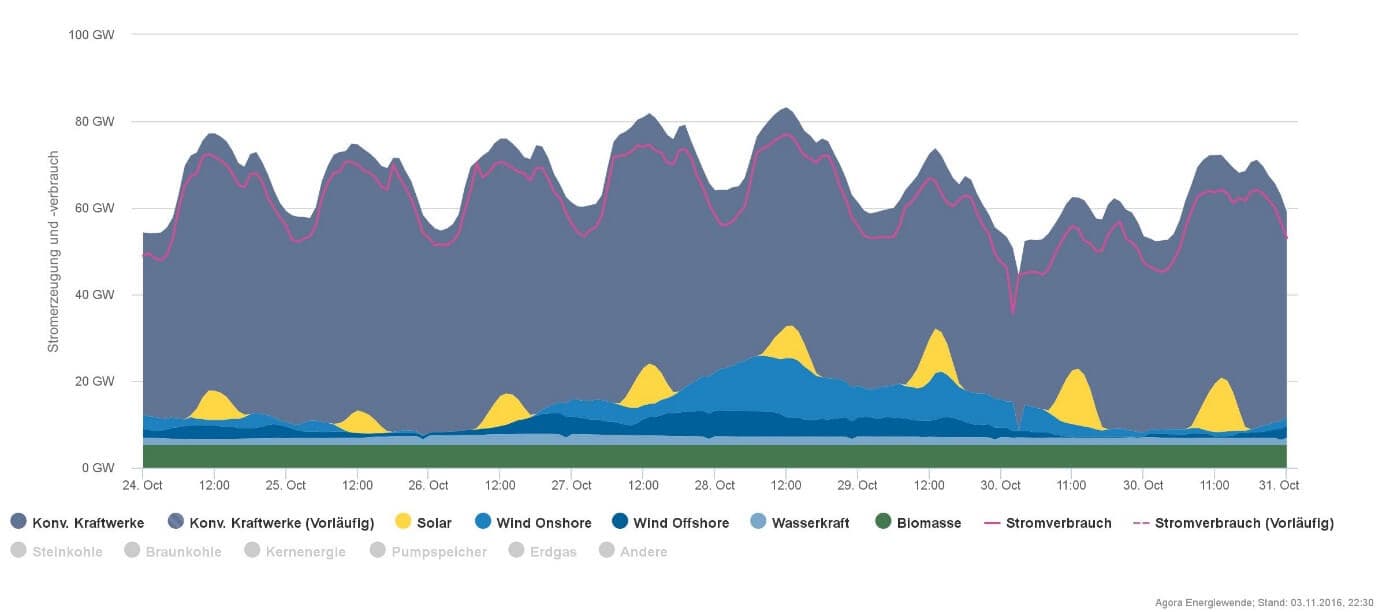
The sun is now at a point in the year when it supplies little electricity. Depending on the weather, output at its noon peak is somewhere between 2 GW and 12 GW. But this applies only to the two hours around noon, after which it falls rapidly, and between 16:00 and 7:00 it provides nothing at all. It helps cover the peak at 12:00, though only partly, but after that photovoltaics provide nothing. Wind, which is expected to contribute at this time of year, has been minimal throughout September and October due to the weather situation. Output has mostly ranged from 1 GW to 10 GW. The brief peaks when German wind turbines reached 15 GW can be counted on the fingers of one hand. The outlook for November has so far been very steady. This means that for at least three months, photovoltaics and wind may provide only a very small share of electricity generation not only in Germany, but also in Czechia and across much of Europe, as similar weather is currently prevailing there.
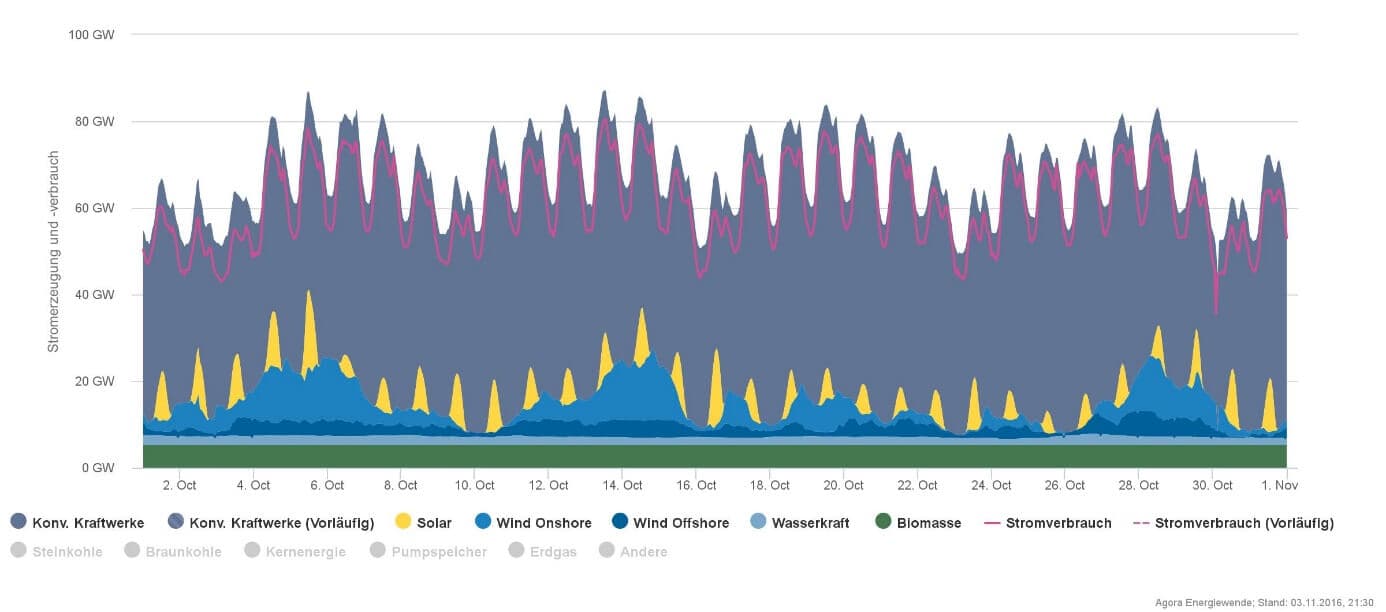
Of course, weather conditions in autumn and spring can be entirely different. This was the case, for example, this spring. At that time, during some wind-generation peaks, Germany was unable to transmit its wind power from north to south and use it. Wind turbines, not only fossil-fuel units, were therefore curtailed. However, to maintain the grid, some conventional sources still had to operate at reduced output even at peak generation. Yet even then, monthly renewable generation did not approach half of total generation.
If Germans wanted a higher annual share of renewables under this year’s weather conditions, they would have to store energy in spring and use it in autumn, requiring energy storage on the scale of monthly demand. This is truly technologically inconceivable. Even pumped-storage plants cease to be economic and efficient when they have to shift from covering daily peaks to covering even weekly changes in weather.
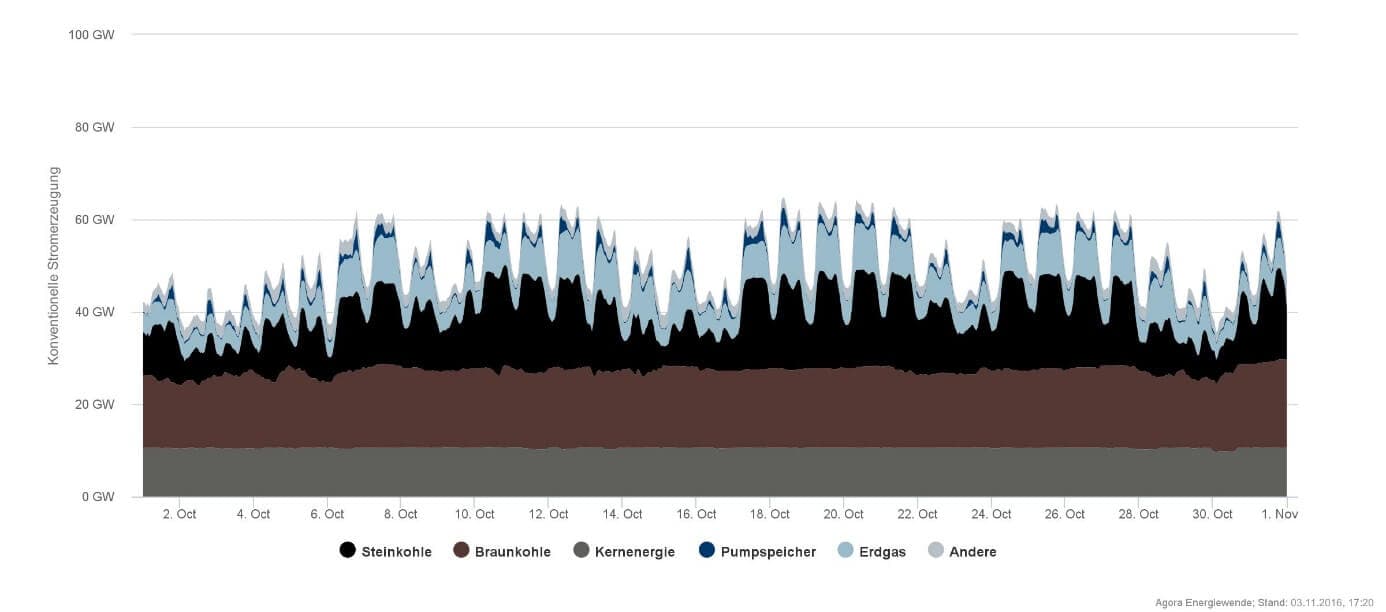
Throughout September, October and now November, low-emission generation in Germany has been saved by the remaining nuclear capacity, biomass and hydro, which operate continuously in baseload mode and together provide 17 GW (nuclear 10 GW, hydro 2 GW and biomass 5 GW). However, German electricity generation is currently dominated by coal-fired sources, which have operated in baseload mode for almost all of this period and provide around 30 GW. At times, gas-fired units also operate close to baseload mode.
Under current weather conditions, Germany would not be helped even if it had all the capacity it needs in wind power, which it is already approaching; all the capacity it needs in photovoltaics, likewise; or all the capacity it needs in pumped storage, which is utterly unrealistic. It would still need all the capacity it requires in fossil-fuel sources, and these would now again operate in baseload mode for extended periods. Studying the charts and data on Agorameter illustrates this very clearly.
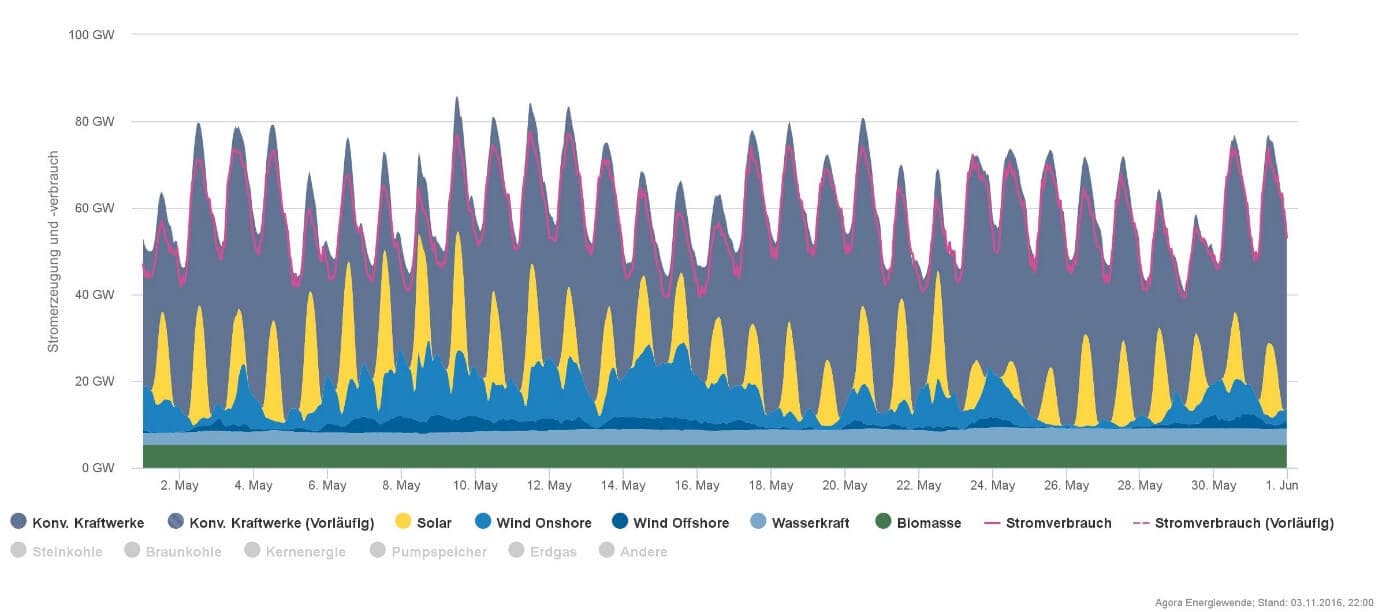
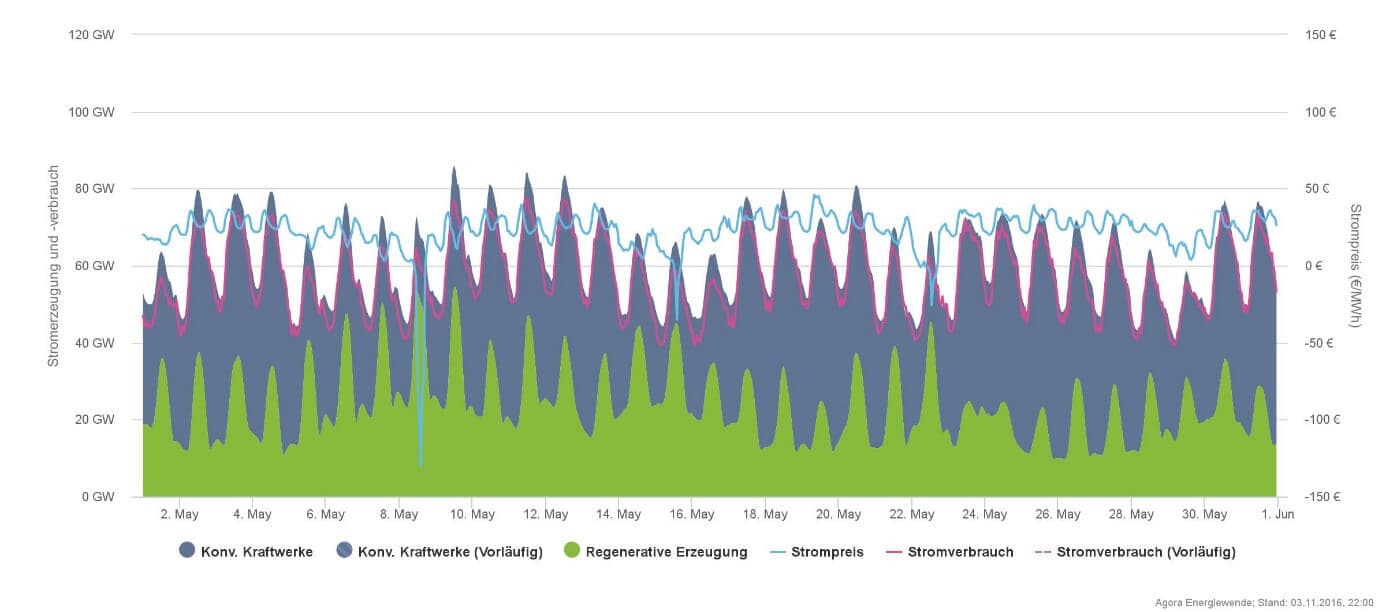
The situation in May, a month ideal for photovoltaics, is also very interesting. The sun is already high in the sky for a relatively long time and temperatures are low, so heat does not reduce the efficiency of photovoltaic panels. Installed solar capacity is approaching the level needed. Therefore, at noon photovoltaics can provide all the required generation. If Germany already has solar capacity comparable to what it needs, installing several times this amount will have highly problematic consequences. Around noon in May, it will have several times more capacity than needed. Even now, when required output was merely exceeded, the exchange price fell as low as -150 EUR. If multiples of the required capacity are installed, a large share of photovoltaics will have to be curtailed. At night, however, photovoltaic generation will be zero regardless of installed capacity. Most photovoltaic plants in Germany will then operate only when sunshine is moderate, and will be shut down under the best conditions. It will no longer be the case, as it is now, that they have guaranteed offtake and prices. Their financial returns will deteriorate considerably. In autumn and winter, noon output will be higher than it is now, though still insufficient to cover demand, but from 16:00 it will again be zero, as it is now.
The situation described shows that even as installed photovoltaic and wind capacity increases, periods with different characteristics will continue to alternate. In one, Germany will flood neighbouring countries with surplus wind and solar electricity and will have to curtail an ever greater share of these sources. In the other, wind and solar sources will continue to supply only minimal amounts of electricity. Germany will no longer have nuclear sources, so fossil-fuel sources will continue to dominate overall generation in the future.
When nuclear units are unavailable
The current problem with electricity supplies, caused by windless conditions and weak wind-turbine output in Germany, Denmark, the United Kingdom and other European countries, is compounded by two further factors: low water levels at European hydropower plants and, above all, the outage of 20 of France’s 58 nuclear units. They have been shut down for inspections of certain components manufactured by specific companies, which may have a higher carbon content in the steel than required. This could make them less resistant to stress. On the orders of the French nuclear regulator, all such components, found mainly in steam generators, must therefore be inspected.
Italy and the United Kingdom depend heavily on French nuclear power plants. Under normal conditions, France is by far the largest exporter of electricity and has provided support especially when there was no wind or sunshine. Conversely, during cold winter months with windy conditions, France took a large share of Germany’s wind-power surpluses. Due to low electricity prices and high electricity generation, electric heating is widely used in France. During severe frosts, electricity consumption therefore rises extremely sharply. Now, however, neither wind power nor roughly one-third of French nuclear units is available.
Fossil-fuel sources must therefore step in for renewable and nuclear sources. Germany has an advantage in this situation. It has had to account for periods when there is neither sunshine nor wind, and therefore has to cover all required output with fossil-fuel sources. It thus has sufficient such capacity. It has also largely built coal-fired units to replace the nuclear units that are to be shut down by the end of 2022. Fossil-fuel generation in Germany now exceeds domestic demand even when there is no wind or sunshine, and Germany exports electricity mainly to Austria, which does not cover its own electricity demand.
France is in a much worse position. Under the normal situation that prevailed for many decades, it only ever needed to provide backup for a few nuclear units. It did not envisage a situation in which more than ten units would be offline in winter. At present, as temperatures are also falling, France has difficulty maintaining sufficient electricity supplies, especially during peaks. The United Kingdom has the same problem, having relied on supplies of nuclear electricity from France when wind was scarce. Electricity exchange prices have therefore risen in Germany too, but nowhere near as dramatically as in France and the United Kingdom. It clearly shows that if France is forced into an Energiewende, it will have to build, and in practice frequently operate for long periods, a large number of fossil-fuel sources, with all the associated consequences for emissions and the environment.
The current situation shows how the situation in Europe will develop if the move away from nuclear power prevails. Fossil-fuel sources will then have to be built in place of nuclear units. Even with extremely high installed wind and photovoltaic capacity, there will be relatively long periods when these fossil-fuel sources dominate generation. This will continue until a fundamental technological breakthrough in large-scale energy storage is achieved. When that will happen remains a very open question. It cannot be expected in the coming decades, however. We will see what lessons Europe draws from the current electricity-generation situation for its energy policy.
Translation disclaimer
This article is a machine translation of the Czech original and has not yet been fully reviewed. In case of any doubt, please refer to the Czech version.
Sdílejte článek prostřednictvím:
Topics:Opinion
You might also like
23 October 2026, 11:01
23 October 2026, 06:34