23 October 2026, 14:38
Loading...
Zaporizhzhia nuclear power plant after destruction of the Kakhovka dam
Vladimír Wagner
5 July 2023, 12:28
The destruction of the Kakhovka dam also threatens the Zaporizhzhia nuclear power plant, which it supplied with water. While there is no immediate danger, conditions and risks at the plant have deteriorated significantly as a result. At the same time, fighting in its vicinity is intensifying, increasing the likelihood that it will take place directly near the plant. It is therefore useful to examine the implications of various possible events.
On the night of 5 to 6 June 2023, the Kakhovka dam was breached. This drained the reservoir and flooded the area downstream of the dam. The dam also served as a source of cooling water for the Zaporizhzhia nuclear power plant. We will most likely learn the main cause of the dam breach and exactly how the event unfolded only after the end of the war and a professional investigation of the dam and plant. In any case, however, Russia is responsible for the event, as it occupied the area and the dam, had them fully under its control at the time, and had its soldiers on and around it.
This event led to a further deterioration in the safety situation around the Zaporizhzhia nuclear power plant. A further increase in risks is linked to growing military activity in the relatively nearby area. It is therefore important to examine the impact of these events and the resulting risks. Russia's invasion of Ukraine affected three Ukrainian nuclear facilities: the Zaporizhzhia nuclear power plant, the Kharkiv research reactor and the Chernobyl nuclear power plant.
The Chernobyl nuclear power plant site was liberated at the end of March, and the consequences of the occupation have now largely been remedied (in more detail here). Russian forces also had to withdraw from Kharkiv. During the winter, Russia then sought to destabilise and bring Ukraine to its knees through attacks on Ukrainian infrastructure, predominantly energy infrastructure. I wrote about the impact of these events on nuclear power in an article at the end of last year. Here, too, the situation improved with the end of winter, when it became clear that Russian efforts were not achieving their aim. By contrast, the situation at the Zaporizhzhia nuclear power plant deteriorated.
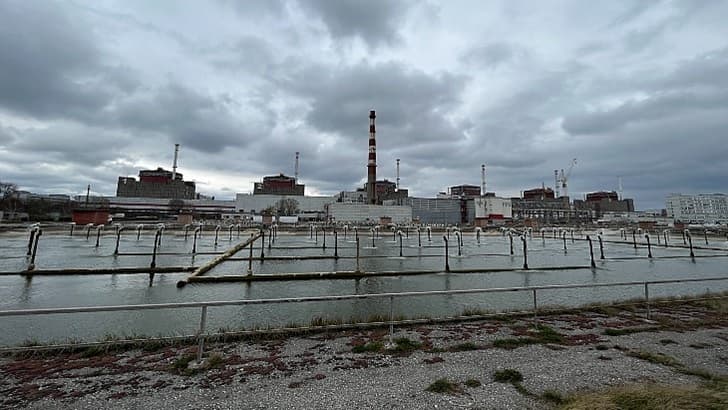
Water from the Dnipro is crucial for cooling the Zaporizhzhia nuclear power plant, which also uses a reservoir on the plant site for this purpose. Source: IAEA
Cooling the nuclear power plant
Cooling is crucial for every thermal power plant, and particularly for a nuclear power plant. It usually involves water cooling. A nuclear power plant must therefore have sufficient water resources for this cooling. VVER-1000 reactors have electrical output of around 1000 MWe and thermal output of around 3000 MWt. Even after shutdown, a nuclear power plant has residual thermal output, caused by energy production from the decay of radioactive nuclei produced in nuclear reactions during reactor operation. After shutdown, this output is below one percent of operating output and initially declines very rapidly. It soon falls to a few megawatts. After that, however, it declines only slowly.
The exponential pattern is caused by the fact that radioactive decay also follows an exponential pattern. At first, heat production from the decay of radioactive elements with short half-lives also dominates. For reactors that have been shut down for weeks or months, heat removal requirements are dramatically lower than for reactors in operation. Nevertheless, a cooling system is still needed, which is not passive for these reactors and requires pumps and electricity supplies.
Spent fuel assemblies are transferred to wet storage – a spent fuel pool. Their thermal output is even lower, naturally depending on the age of the fuel assemblies. Moreover, the pools tend to have a relatively large volume of water. Even if pumps fail or no fresh water is supplied, there are many days and weeks, or even months, to resolve a problem that would arise if the water evaporated. This was also demonstrated at Fukushima, where the spent fuel pools withstood the accident.
All reactors at the Zaporizhzhia nuclear power plant have already been shut down. Five have long been in cold shutdown. One was in hot shutdown and was used to supply heat for the plant's needs and for some surrounding settlements. However, it too will now be placed in cold shutdown. This means that cooling requirements will be very low compared with a plant in operation. The plant is not cooled directly by water from the Kakhovka reservoir, but has a special reservoir on site with sufficient supplies. There are therefore many months available to resolve the replenishment of this reservoir.
From this perspective, there is no immediate danger. The scenario of a possible drainage of the Kakhovka reservoir had been considered, and was one of those whose solutions were tested as part of the stress tests carried out in response to the Fukushima Daiichi nuclear power plant accident. Additional options for supplying water to the plant's reservoir are therefore known. Water can be pumped from a deepened excavation at the site of the plant's cargo port, from the water supply system of the city of Enerhodar, or using mobile pumps and a system of hoses, or delivered by tanker trucks. Each of these options is sufficient for the needs of the shut-down plant, so there are enough backup options. Staff are also trained for such a possibility and know what needs to be done.
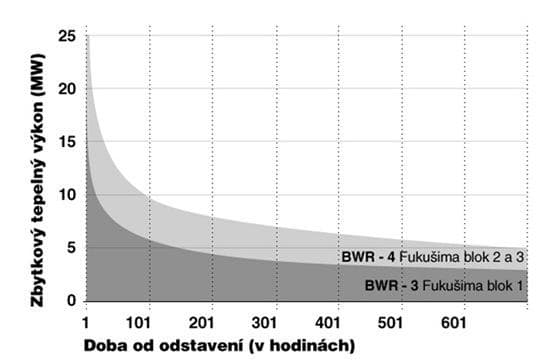
Decline in thermal output during the first month after a unit is shut down. The decline is rapid initially, then slows. Source: the book Fukushima Daiichi Afterwards
Securing the necessary electricity
It has already been mentioned that electricity is needed to operate the pumps in the cooling circuits. When a plant is operating, it uses its own electricity. However, if reactors have to be shut down, it needs electricity supplies from external sources. Every nuclear power plant therefore has several lines through which it can draw electricity from external sources. The problem in wartime is that lines between the source and the nuclear power plant may be damaged during fighting and shelling, especially when opponents begin targeting each other's infrastructure for destruction.
In this case, some lines cross the front line. Electricity supplies to the Zaporizhzhia nuclear power plant have already been completely interrupted seven times. The plant site has diesel generators that can provide the necessary electricity for these purposes. Required fuel reserves are also available there. Here too, the already mentioned relatively low thermal output is an advantage, providing sufficient time to address any problems. This is a fundamental difference from the situation at Fukushima, where the tsunami wave also destroyed all diesel generators.

International Atomic Energy Agency Director General Mariano Grossi en route to Ukraine on a mission to the Zaporizhzhia nuclear power plant. Source: IAEA
The main risk is a radioactive release
What we fear is a possible radioactive release. If reactors are shut down and also have containments, an event such as that at Chernobyl cannot occur. That is, a steam explosion, destruction of a large part of the reactor core and the release of significant radioactivity to great heights. Only such an event could have affected the European Union.
In this case, only an event comparable to those at Fukushima is possible. This would be so even if the containment were breached. The military has weapons capable of penetrating containment. However, even if it deliberately sought to damage it, which is unlikely, the breach would be limited. As at Fukushima, any radioactive release would affect only areas within several dozen kilometres. The impacts would thus be only local. Another very significant factor is that the reactors have been shut down for many days and short-lived radionuclides have already had time to decay completely. These include radioactive iodine-131, for example, which has a half-life of around eight days. These highly active, short-lived radionuclides are no longer present. There is therefore no point in using iodine tablets in this case.
As can be seen, a potential accident at the Zaporizhzhia nuclear power plant does not pose a threat of radioactive contamination to the European Union, including Czechia. Those at risk would be Ukrainian residents within several dozen kilometres of the plant. That does not mean that the international community should not be concerned about the situation or should not pressure Russia to act responsibly in this case. It must be stressed that Russia, which seized the plant and keeps it under military control, bears full responsibility for everything that happens there.
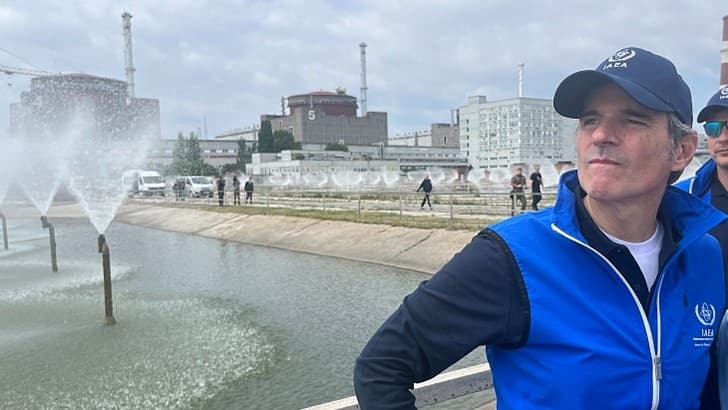
IAEA Director General Mariano Grossi at the cooling circuit basin of the Zaporizhzhia nuclear power plant. Source: IAEA
The situation at the Zaporizhzhia plant
The international community's concern is also reflected in the efforts of the International Atomic Energy Agency (IAEA) to monitor the situation on site. This is the reason for the agency's missions directly to the plant and its talks with both the Ukrainian and Russian sides. The plant has permanent observers from the organisation, and precisely because of the worsening situation, IAEA Director General Mariano Grossi recently visited the plant. The mission also involved the eighth rotation of IAEA experts on site and an expansion of the permanent group at the plant. Before visiting the plant, Mariano Grossi met Ukrainian politicians and Energoatom experts in Kyiv, and after completing the mission to the plant, he met Russian politicians and Rosatom experts in Kaliningrad.
The transfer of the mission from Ukraine to the occupied territories was delayed due to the difficult situation in ensuring passage through the frontline areas. The journey was relatively complicated, with the team having to travel part of the way on foot because of a destroyed bridge on the front line. In addition to the nuclear plant, the team also visited a nearby thermal power plant, which is one source of electricity for the nuclear plant. A substation is currently being repaired there. The main aim was to verify compliance with nuclear safety and the international community's basic requirements. These include a ban on firing at the plant and its critical infrastructure facilities; the plant site and its surroundings should also not be used to fire at the opponent, conduct military operations or shelter military units and materiel, especially heavy weapons and explosives not intended for its immediate protection.
It is true that, in the current situation, plant staff have quite a lot of time to resolve any problems. What is important, however, is that the necessary staff are professionally competent and have the conditions needed for their work. The psychological pressure imposed by the occupation and wartime conditions in the area certainly do not contribute to their wellbeing. This increases the risk of errors. The number of staff at the plant is already dramatically lower than under normal conditions. While this is sufficient for the current limited operation, it may be a problem in crisis situations. Reduced staffing is an additional burden on the workers who remain there.
The future of the Zaporizhzhia nuclear power plant
The future of this nuclear power plant is highly uncertain. At present, while the reactors are shut down, cooling requirements are lower. However, if they are to be returned to operation, their intensive cooling during normal operation must be resolved. This cannot be done without resolving the fate of the Kakhovka dam. A decision must be made on whether it will be repaired or rebuilt, or whether the restoration and revitalisation of the Dnipro near its mouth will be addressed differently. Such a long-term strategic decision will not be made before the war ends. There must be a stable resolution of the conflict that allows planning for the development of the destroyed areas over many decades. At the same time, it cannot be a frozen conflict with the line of contact at the dam and plant, as it is now. Such a situation would not allow reconstruction work on either the dam or the nuclear power plant.
Construction of the Zaporizhzhia nuclear power plant began at the turn of the 1970s and 1980s. The first unit was completed in 1985 and the sixth and final unit in 1996. They are VVER-1000 units, familiar from Temelín. They can be operated for at least sixty years and probably longer. In principle, the reactors at the Zaporizhzhia nuclear power plant can therefore operate for another twenty years or more. The reactor vessel is a crucial component that cannot be replaced. If a reactor is not operating, it does not age as a result of irradiation by high neutron fluxes. Thus, if it is possible to end the war, resolve the situation in the region and begin reconstruction of the area, restoring operation of the Zaporizhzhia plant makes sense despite the relatively high costs.

Meeting between Mariano Grossi and Volodymyr Zelenskyy before the trip to the Zaporizhzhia nuclear power plant. Source: IAEA
I am neither a military expert nor a political scientist, so my following considerations should naturally be taken with a grain of salt. In my view, Russia does not have the capacity to reoccupy the right bank of the Dnipro, while the costs of holding the left bank will continue to rise. These costs include the increasingly demanding task of maintaining the Zaporizhzhia nuclear power plant site and ensuring its safety, as well as addressing water supplies to Crimea and the Dnipro's left-bank area. They also include a dramatic threat to the credibility of Rosatom and Russian nuclear power. As I have already written, Russia, which seized and occupies the nuclear power plant, bears full responsibility for events connected with it.
To ensure its operation and safety, it must use its specialist companies. Rosatom is such a company, and is therefore forced to become involved in the war and occupation. Nuclear power is one of the few modern technologies in which Russia was at the forefront of global development. Alongside raw materials, nuclear technologies were one of the few areas in which Russia was capable of successfully exporting at scale. To a considerable extent, it relies on foreign technologies and opportunities for cooperation. Rosatom's connection to the war and any problems at the Zaporizhzhia nuclear power plant could therefore have very dramatic impacts on its foreign economic activities and on the reputation of the entire Russian nuclear industry.
Translation disclaimer
This article is a machine translation of the Czech original and has not yet been fully reviewed. In case of any doubt, please refer to the Czech version.
Sdílejte článek prostřednictvím:
You might also like

23 October 2026, 11:01
23 October 2026, 06:34