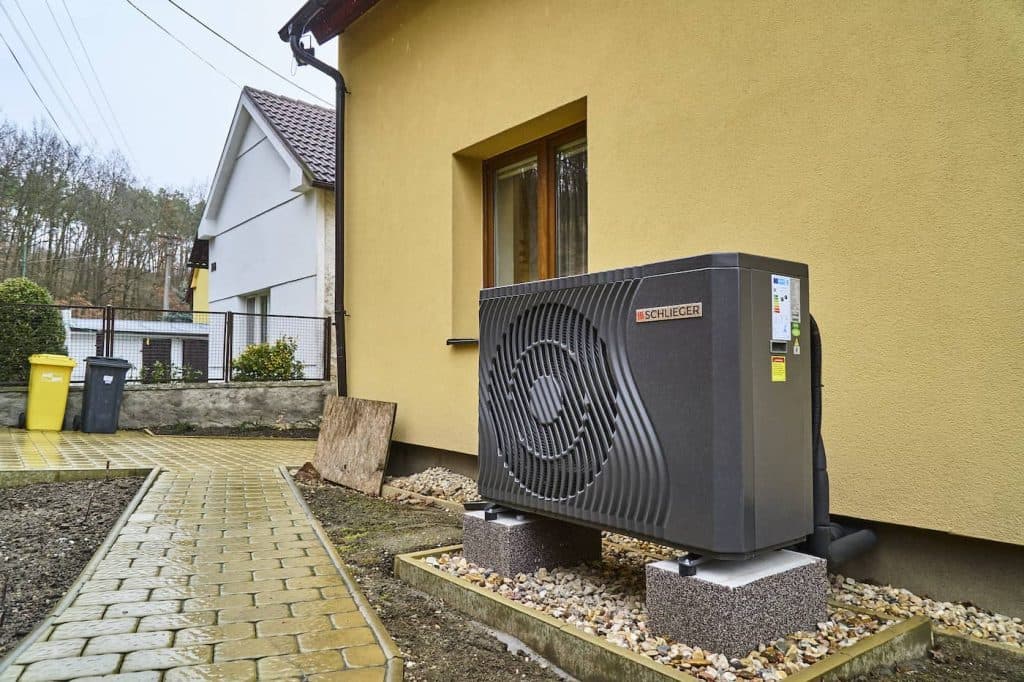
Air-to-water heat pumps are the most popular type, accounting for approximately 97 % of the entire market, according to statistics from the Czech Ministry of Industry and Trade (MPO). Since 2010, 265,000 heat pumps have been delivered to the domestic market, though many of them were installed in the past two years. Across Europe, annual growth of around 20 % is expected in the coming years. The Czech Renewable Energy Chamber forecasts a slightly lower figure for Czechia—approximately 15 % a year. On these projections, more than one million heat pumps could be installed in the Czech Republic by 2030.
Types of heat pumps
- Air-to-water heat pumps extract heat from the surrounding air and transfer it to a water circuit used for heating or hot water. They are relatively easy to install, operate and service. They can easily replace another heat source and are suitable for passive houses, standard family homes, apartment blocks and various industrial buildings and premises. In addition to heating, they can also provide cooling in the summer months.
- Ground-source heat pumps extract heat from soil or underground rock and transfer it to a water circuit. This option offers a stable heating system, both with a horizontal ground collector and with a borehole. Its disadvantages include higher upfront costs for drilling and excavation, greater space requirements on the property, and certain restrictions on future construction.
- Water-to-water heat pumps extract heat from groundwater or surface water and transfer it to the water circuit of a heating or hot-water system. According to available data, this technology is rarely used in the Czech Republic, mainly because a suitable water source is not readily available. It must provide sufficient flow, be warm enough and be free of pollution.
- Air-to-air heat pumps extract heat from the surrounding air and transfer it to an air circuit for heating or cooling. They are usually a supplementary heat source alongside electric heaters or other heating systems. The system can cool a room relatively quickly and easily in summer and heat the air in winter, but it is not connected to a hot-water distribution system and therefore cannot heat water.
A heat pump tailored to your needs
When considering a heat pump, you should take into account your property’s heat loss, which is affected by the house’s location (lowland or mountainous areas) and the quality of insulation in the walls, ceilings and roof, as well as the windows, doors and garage door. The size of the house (floor area and number of storeys) and the desired level of thermal comfort are also important.
“Our experts will be happy to help you choose the right heat pump. Based on the property’s location, insulation, usable floor area and layout, they will recommend a solution that provides sufficient capacity for heating and hot water,” says Pavel Matějovič, chief operating officer of Schlieger.“We offer air-to-water heat pumps in two capacity options. These heat pumps are the least expensive and easiest to install, and are suitable for both small properties and large buildings. Fast installation and servicing are a given, as is help with applying for a subsidy through the New Green Savings programme.”
Those who cannot afford to invest in environmentally friendly heating for financial reasons can apply for a contribution of up to 180,000 Kč towards a heat pump through the so-called boiler subsidy scheme.