
23 October 2026, 14:38
Loading...
Jon Ferris: Decarbonisation of the Czech district heating sector and transport will largely be achieved through electrification

Martin Voříšek
8 October 2018, 11:33

The energy sector has been going through a turbulent period for several years, which understandably brings opportunities for new and innovative development. Innovative companies certainly include the British company Electron, whose strategic director, Jon Ferris, gave an interview to oEnergetice.
Jon Ferris will speak at the Share Your Energy conference, which will take place on 14 November 2018 in Prague, with a presentation entitled „21st-century energy infrastructure: creating a flexibility market through blockchain“ as part of the first session of presentations. The full conference programme can be found here on the conference website.
You have devoted a large part of your career to the energy sector and are a vocal supporter of increasing flexibility in electricity generation. You are also described as an energy influencer, if such a comparison can be used. This raises the question: what do you think are the biggest challenges the energy sector will face in the near future?
The main challenges can be summed up in four words, collectively referred to as the 4Ds: decarbonisation, decentralisation, digitalisation and democratisation. The cost of generating electricity from renewable sources is falling, which means that investment will be dominated by renewables and, more generally, by new energy technologies. Decarbonisation of the district heating sector and transport will probably be achieved largely through electrification, which will continue to fundamentally alter the pattern of demand over time.
Grid balancing is closely linked to changes on the demand side. What challenges can be expected in this area?
The balancing of transmission and distribution systems is effectively being turned 180 degrees around. Generation is customarily adjusted based on demand forecasts, whereas in the coming years the situation will increasingly be the opposite: consumption will adapt to generation. To achieve this, the participation and coordination of many millions of devices will be necessary. These will not consist solely of power-sector equipment; other assets from the district heating and transport sectors will also be needed.
This is an extraordinarily complex task that cannot be achieved without proper management of data from metering devices and other sensors; at the same time, sharing and using this data must ensure the maximum added value for the system as a whole.
However, as I have already mentioned, this is an extraordinarily complex task, and such a task will require a complete change in thinking about system management. These trends in system management will affect the level of incentives and the ability of smaller, often consumer-owned assets to actively participate in energy system management.
Electron is placing significant bets on blockchain technology. Do you think blockchain is the solution to some of these problems?
Undoubtedly: both data and energy markets are becoming increasingly decentralised and fragmented, creating a greater need for cooperation and coordination among individual market participants. It is difficult to imagine effectively managing such a large number of participating actors without efficient data structures. Addressing fragmentation through a centralised approach usually leads to a powerful central platform, which does not guarantee a solution to fundamental problems such as insufficient data quality. Blockchain offers an alternative approach that is better suited to the evolving energy industry.
Electron operates the so-called Electron Flexibility Trading Platform. Could you describe in more detail how this platform works and what benefits it offers its users?
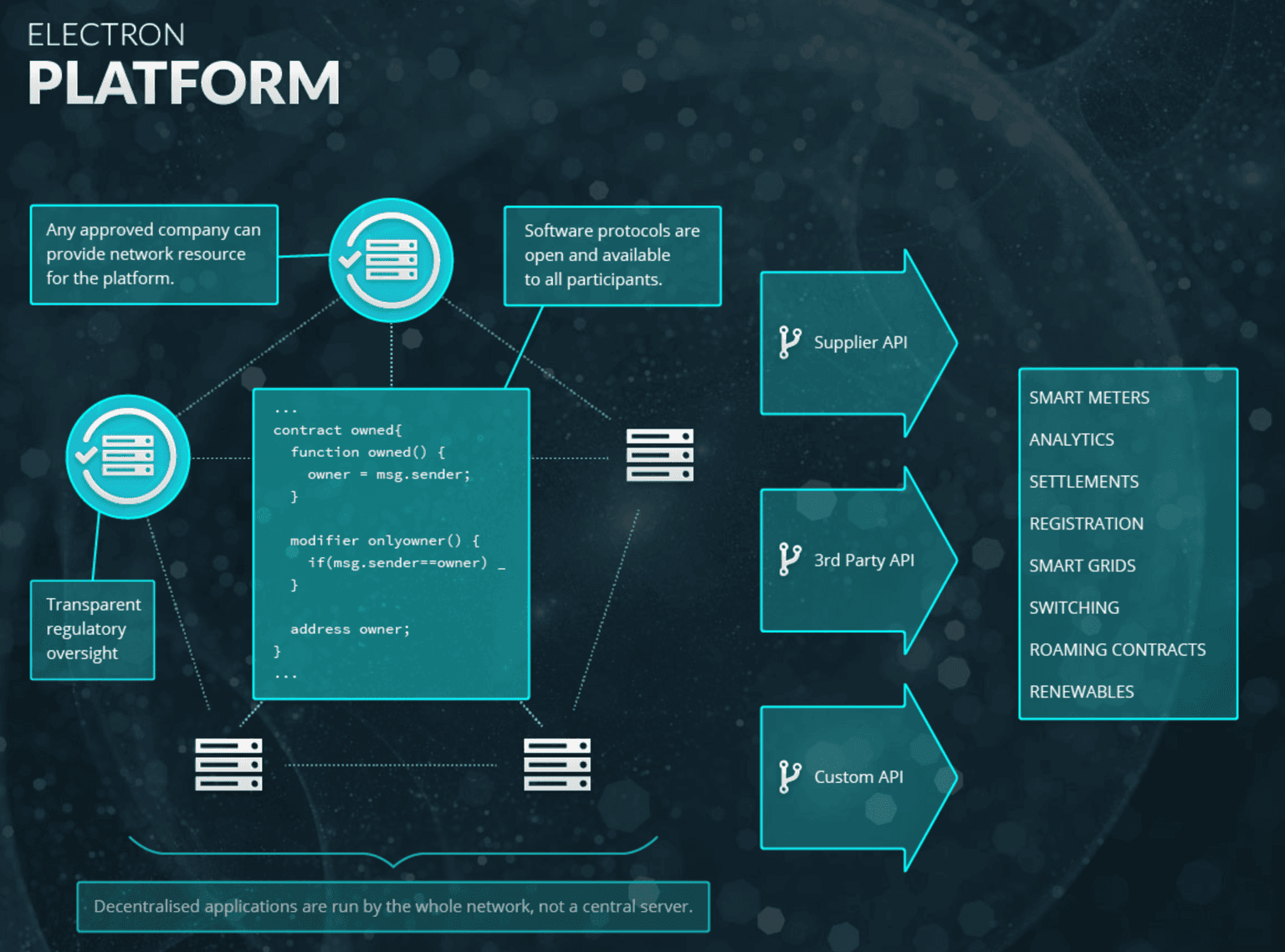
The central part of the entire platform is the so-called asset register, which provides an overview of assets directly connected to the system, including details of their characteristics and contractual commitments. The trading platform enables open application development, through which different trading products can be traded and subsequently resold depending on the type of asset being managed. This system will enable us to improve coordination among market participants and allow assets to realise the full value of their capabilities – in short, the platform enables the development of smart markets.
Could you elaborate on the benefits your platform brings to its users?
The platform gives small generators and consumers access to a market that was previously inaccessible to them for various reasons, such as the costs required to establish an identity, which can only be recouped by larger generators or consumers.
As we are an open platform, owners of generation and consumption assets can participate in product development, enabling them to disrupt the historically established system of energy products. In addition, our platform provides its participants with transparency in trading and clear fairness in product negotiations between participants.
Electron is known as an advocate of the transition to smart grids and new market rules based on decarbonisation, decentralisation, digitalisation and democratisation. What exactly do you mean by democratisation?
Europe's energy sector has traditionally been dominated by large generators and traders, while smaller market participants have not had the same opportunities to access the market, especially due to higher market entry and transaction costs. When we as a company speak about the democratisation of the energy market, we mean a trend towards giving consumers and owners of generation assets the greatest possible opportunity to participate in the market, both by creating their own products and pricing them.
In the first phase, democratisation will be enabled for participants through smart metering devices and time-of-use tariffs, but as the number of electric vehicles and household energy storage systems increases, the opportunities for small participants to become involved in the market will grow.
Households with their own renewable sources can generate electricity not only for themselves, but also sell it on the market. What is your view on peer-to-peer transactions? Will they become a common part of the electricity market?
It is clear why this issue receives so much attention, but it is necessary to remember that even according to the boldest forecasts, 35 % of generation capacity is still expected to be connected to the transmission system. Energy generation, particularly in urban areas, is even more constrained, and the global trend towards greater urbanisation suggests that electricity from large-scale sources will be crucial for most people. In such a diversified system, with a range of suppliers owning anything from small local solar installations to offshore wind farms with capacity exceeding 15 MW, it is clear that peer-to-peer trading will have its place in the market. However, the dominant mechanisms will still be those market mechanisms that most closely reflect the reality I have outlined here.
Demand Side Response is among the promising mechanisms with growth potential. However, this service is currently provided mainly by industrial consumers. Can demand-side response, particularly thanks to blockchain, also expand to other users, such as small businesses and households?
One of the objectives of our platform is to provide more accurate price signals for both operations and investment in new assets. Our technology ensures that every generator or consuming device, whether large or small, can participate in the market under transparent and fair rules and at the lowest possible cost. Demand-side response can be provided at a local level, but it will have to demonstrate that it is more advantageous than other forms of flexibility.
Translation disclaimer
This article is a machine translation of the Czech original and has not yet been fully reviewed. In case of any doubt, please refer to the Czech version.
Sdílejte článek prostřednictvím:
You might also like
23 October 2026, 11:01

23 October 2026, 06:34