
10 October 2026, 07:37
Loading...
Ask the expert: How can battery investors eliminate the biggest mistake that causes million-dollar losses?
oEnergetice.cz
7 October 2025, 09:30

Battery energy storage systems using LFP cells are highly efficient, but errors in SoC settings are costing investors a significant share of their returns. Why does this happen? How can it be prevented?
You can find the answers in a presentation by leading expert Ed Mulloy of ACCURE Battery Intelligence at the Smart Energy Forum in Prague on 15–16 October 2025.
Why did the investor in Texas get it wrong?
Last summer, the operator of a utility-scale battery energy storage system (BESS) in Texas was hugely frustrated when its BESS missed a great trading opportunity during a peak in demand. On paper, everything looked good: the system reported that the batteries were almost one-third full and had enough energy to sell. But when the right moment came, the energy wasn’t there.
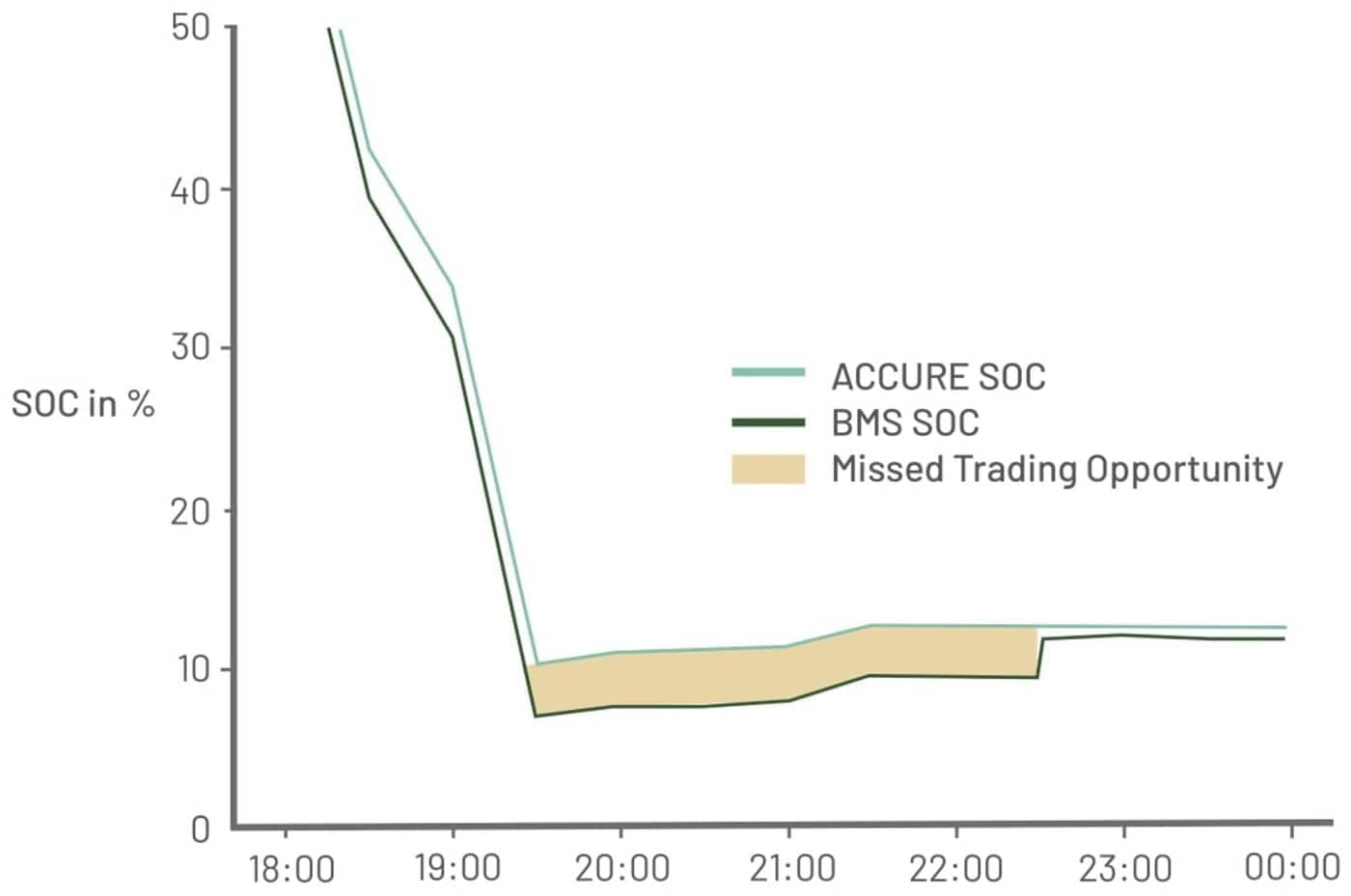
Source: SEF, Jaroslav Dorda
In reality, the BESS had much less energy than reported. The result was a failure to deliver services, a financial penalty and a major blow to the investor’s confidence in the system. And this was not the first time such a BESS failure had occurred.
What caused the repeated problems?
Inaccurate state-of-charge (SOC) data is often behind this type of problem—a growing and increasingly costly issue, especially for BESS using lithium iron phosphate (LFP) battery cells. The problem stems from how battery management systems (BMS) calculate SOC.
Most BMS rely on so-called “coulomb counting,” which tracks the energy flowing into and out of a BESS, and on voltage-based estimates, which map voltage readings to known charge levels. In LFP batteries, however, voltage remains relatively stable across a broad SOC range (20–85%), making this calculation unreliable.
The situation is further complicated by a phenomenon known as hysteresis, in which the voltage in a BESS depends not only on its current state but also on its recent charging or discharging history. This behaviour can lead to significant discrepancies when interpreting the BESS’s state.
For example, the same BESS voltage reading can correspond to different SOC values, ranging from 27% to 62%, depending on whether the battery cell was previously charging or discharging. Moreover, “coulomb counting relies on almost perfect current measurements over time, and even the smallest sensor errors accumulate. This ongoing loss of accuracy can cause the BMS to report SOC estimates that are as much as 30% off in real-world LFP battery deployments.”
A recent industry analysis by ACCURE found that a 20% error in state-of-charge (SOC) estimates can lead to revenue losses of up to 11% for BESS investors. This makes trading in the market significantly more uncertain for investors.
How can the risk be eliminated?
By using cloud-based analytics systems, BESS investors can reduce risk and optimise operations through:
✅ greater computing power, capable of accounting for aging and hysteresis
✅ adaptive models that learn from BESS operating data
✅ more accurate and reliable SoC estimates, even when the BESS is under load.
By using ACCURE Battery Intelligence’s cloud-based analytics systems, the Texas BESS operator was able to identify and correct hidden discrepancies in the SOC data reported by the BMS. This improvement enabled more accurate energy trading, fewer penalties and a measurable increase in revenue.
“Accurate SOC data is not just a matter of technical precision; it also affects financial performance. For the Texas BESS operator mentioned above, the move to predictive analytics delivered immediate results,” says leading expert Ed Mulloy of ACCURE Battery Intelligence, who will speak at the Smart Energy Forum in Prague on 15–16 October 2025.
Translation disclaimer
This article is a machine translation of the Czech original and has not yet been fully reviewed. In case of any doubt, please refer to the Czech version.
Sdílejte článek prostřednictvím:
You might also like

10 October 2026, 07:02


9 October 2026, 13:47