7 October 2026, 11:20
Loading...
Drone inspections in Czechia’s energy sector: when is the open category enough, and when is the specific category needed?
oEnergetice.cz
7 October 2026, 10:30
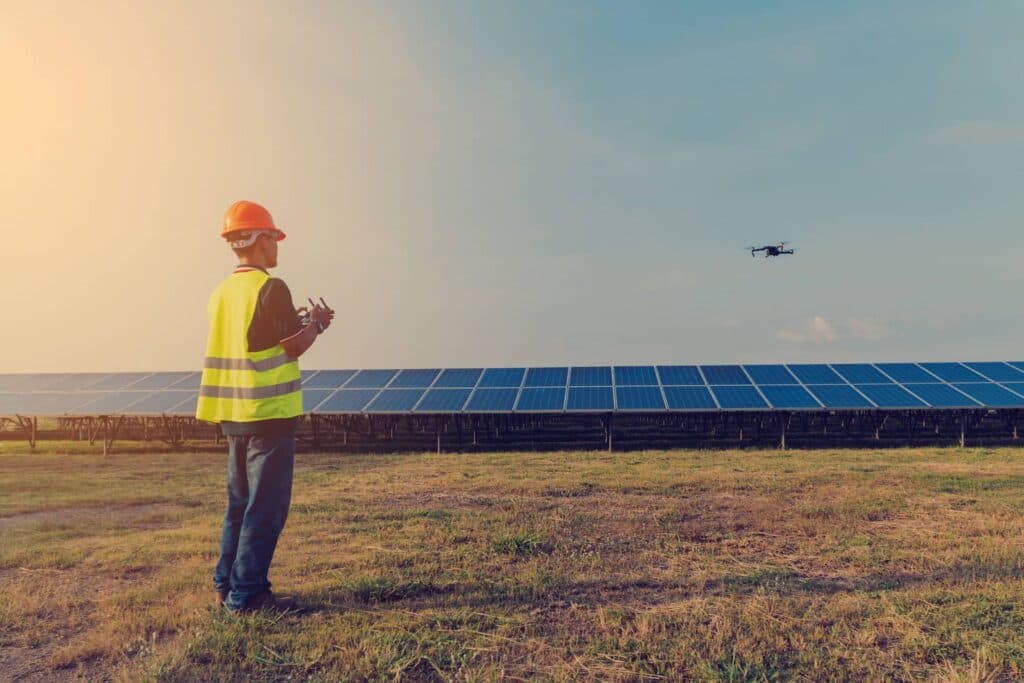
Remote inspections of power lines, pylons and photovoltaic panels are among the practical applications of unmanned aircraft systems in the energy sector. A drone flies a mission according to a predefined plan and returns to its docking station. But hardware alone does not determine whether it can be deployed in operation; legislation is just as important. The flight conditions determine the category of operation, which in turn defines what the operator must demonstrate before taking off.
Where the open category ends
European rules divide unmanned aircraft operations according to their level of risk. The open category covers low-risk operations and does not require operational authorisation from the Czech Civil Aviation Authority. However, operators must meet all the category’s conditions and comply with the geographical zones in force at the flight location.
When a planned operation does not meet the limits of the open category, it generally falls into the specific category. Depending on the nature of the operation, this may require an operational authorisation from the Czech Civil Aviation Authority. Some operations can also be carried out under a standard scenario (STS), where a declaration of the planned operation is sufficient as long as predefined conditions are met. For the energy sector, the key point is that many larger-scale inspection tasks no longer fit within the simple framework of the open category.
- Flying beyond the pilot’s visual line of sight. Inspecting a longer section of power line may mean that the drone flies behind an obstacle or to a distance at which the remote pilot can no longer keep it continuously in visual line of sight. This is a BVLOS flight, which is not permitted in the open category.
- A drone with a maximum take-off mass of 25 kg or more. The open category is intended for unmanned aircraft with an MTOM (maximum take-off mass) of less than 25 kg. Exceeding the mass limit therefore means that the operation falls into the specific category.
- Flying above the standard altitude limit. The open category is intended for unmanned operations up to 120 metres above the closest point on the earth’s surface, or lower
(depending on the location, proximity to airports, heliports, etc.). Exceeding these limits therefore generally means that the operation falls into the specific category. There is, however, an important exception for inspections of tall structures: close to an artificial obstacle higher than 105 metres, it is possible to fly up to 15 metres above the obstacle’s height under specified conditions and at the request of the entity responsible for it, without the flight altitude alone automatically taking the operation out of the open category.
There are other limits that do not necessarily mean an immediate move to the specific category. These include flights in a so-called densely populated area (HOP), which impose additional conditions on operations in subcategories A1 and A2. More specifically for the energy sector, zone LKR312 applies to electricity substations operating at 110 kV and above and power lines transmitting electricity at 220 kV and above. Depending on the type of flight and the UAS’s mass, operators may have obligations towards the infrastructure operator and may be required to mark the area of operation on a digital map. When planning a mission, it is therefore necessary to assess both the category of operation and the rules in force at the specific location—the so-called geographical zones.
The key question is therefore not just “Do I need authorisation?”, but above all “Which regulatory framework applies to this particular mission, and what documentation, consents or operating conditions must I meet before the flight?”
What can affect the length of the approval process
If the planned operation in the specific category requires operational authorisation, the process can be divided in practice into preparation by the operator, followed by an expert assessment by the Civil Aviation Authority.
For inspection flights typically conducted beyond the pilot’s visual line of sight, the operator must prepare operational documentation in accordance with the current methodology, currently SORA (Specific Operations Risk Assessment) 2.5. The quality of the operational documentation is one of the factors that can have a significant impact on the length of the approval process. If the concept of operations, risk assessment, operations manual and evidence of compliance with safety requirements form a coherent, high-quality package, there is a good chance that the application will be approved within a matter of days. Inconsistencies between these elements are a common reason for applications to be returned for further information.
Preparation is followed by an assessment by the Authority. Its scope and duration depend on the nature and risk level of the specific operation. However, high-quality operational documentation makes the subsequent expert assessment clearer and reduces the likelihood of further questions that could prolong the approval process by several days or, in some cases, weeks.
What to watch out for when preparing an application
When preparing an application, it is worth paying particular attention to three areas where questions may arise during the expert assessment:
- Incomplete or inconsistent operational documentation. The documentation may adequately describe what the operator intends to do, but it does not always explain in equal detail how each phase of the operation will be carried out. The difference between a general intention to “inspect power lines” and a specific, documented operating procedure is crucial during the assessment.
- Insufficient evidence for risk-mitigation measures. It is not enough simply to state that a particular technical or strategic measure will be used; the operator must also describe how it works and demonstrate that it meets the required level of safety.
- The proposed operation does not meet the required level of safety. Sometimes the mission concept itself needs to be adjusted—for example, its route, altitude, area of operation, technical equipment or strategic mitigation measure. High-quality documentation cannot replace a safety measure, but it can help identify such a problem before the application is submitted.
A common thread in these situations is that many uncertainties can be resolved during the design of the operation. Operational documentation should therefore not be an administrative attachment to a completed technical solution, but one of the inputs used to design a safe operation from the outset.
The drone as a regulated operational asset
Once operational authorisation has been issued, the focus shifts from preparing the application to maintaining compliance on an ongoing basis. Operators must keep the required operational records, monitor UAS servicing intervals and maintenance, keep track of staff qualifications and training validity, and handle occurrence reporting where required by applicable rules or the conditions of a particular operation. They must also be able to demonstrate that actual operations comply with the conditions under which they were approved.
This is similar to the procedures companies follow for inspections, deadlines and staff qualifications for other equipment. However, drones are often introduced into an organisation as a standalone technology project, and their operational administration may initially be split across unwieldy spreadsheets, separate documents and personal records. This can still be manageable with a few aircraft and one team, but as the fleet and the number of regional teams grow, the need for a unified, traceable system increases rapidly.
Fleetora: operational administration in one system
The Fleetora platform was created in response to precisely this situation. It brings flight-hour records, maintenance, pilot qualifications, mission planning and occurrence reporting together in one environment, where the data is linked and traceable. Operators no longer have to waste time searching for information across different people and spreadsheets.
“We’ve been preparing documentation for drone operators for years, and the same thing kept happening: data on the state of the fleet, pilots or flight hours often didn’t exist—and when it did, it was scattered across five spreadsheets, two email threads and one person’s memory. We built Fleetora to change that.” Ing. Jan Lenc, founder of Aeroway
The platform includes the CheckMate tool, which uses the inputs provided to support risk assessment under the SORA 2.5 methodology, including assessment of ground and air risk and determination of the resulting SAIL (Specific Assurance and Integrity Level). This gives operators a structured view of the risk profile of a planned operation before the documentation is complete, allowing them to adjust the mission design while changes are still least costly in technical and organisational terms.
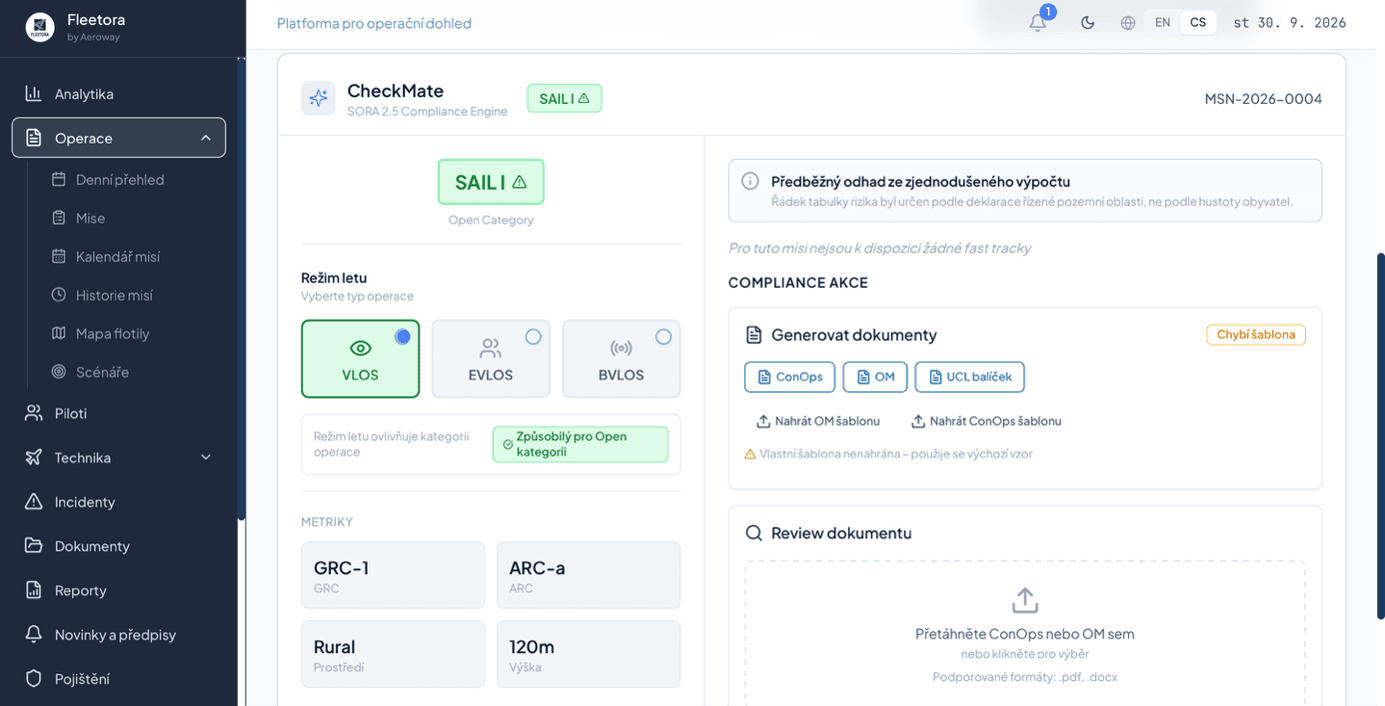
Source: Aeroway
In the energy sector, a single mission may involve several layers of requirements: for example, BVLOS operations, the conditions of geographical zone LKR312, operations in a densely populated area (HOP), the technical condition of a particular UAS and the validity of the crew’s qualifications. A unified system makes it possible to work with this information in a single operational context instead of checking each item separately before every mission. Looking ahead, the platform is designed to make it possible to reuse information entered during operational planning when preparing application materials, so operators do not have to repeatedly enter the same details into different documents.
Conclusion
The regulatory framework is not an administrative hurdle at the end of a project; like a drone’s battery life, it is an initial parameter that determines what is even feasible. Identifying it correctly is only the first step, however. Operations must then remain compliant over the long term with the conditions of the authorisation and the rules governing geographical zones. This requires systematic management of data, documentation and responsibilities. This work can perhaps be done in spreadsheets, but as the number of drones, pilots and missions grows, the difference quickly becomes apparent in both the administrative burden and the risk of errors.
For companies starting to use drones today, the recommendation is simple: assess the regulatory framework before purchasing equipment and planning the first missions.
Fleetora is backed by Aeroway, a company specialising in unmanned aircraft systems legislation. It prepares operational documentation for operators and guides them through the entire approval process with the Civil Aviation Authority.
Ing. Jan Lenc is co-founder and managing director of Aeroway, a company specialising in unmanned aircraft systems legislation. He focuses on business development and strategic partnerships, ensuring the smooth integration of our services into clients’ business processes.
Translation disclaimer
This article is a machine translation of the Czech original and has not yet been fully reviewed. In case of any doubt, please refer to the Czech version.
Sdílejte článek prostřednictvím:
You might also like
7 October 2026, 06:07