
10 October 2026, 13:19
Loading...
ETS schemes now cover a quarter of global emissions, with more to come
Vojtěch Kříž
21 April 2026, 16:21

Various emissions trading systems (ETS) generated a record $79 billion in 2025, according to the International Carbon Action Partnership, which published its annual Status Report on Tuesday. The head of the organization’s secretariat says it is clear that emissions trading has become the main tool for most governments to meet their climate commitments.
The International Carbon Action Partnership (ICAP) is a forum with 45 members that serves as a platform for sharing experience and knowledge about ETS schemes. Its members aim to share experience and learn from one another, support the development and improvement of carbon markets, and explore the role of ETS in decarbonization.
Its members include the European Commission, 13 European countries, including Germany and Spain, as well as Brazil, South Korea, India, several Canadian, Chinese and Japanese provinces and US states, and five Chinese cities. Other countries, such as Ukraine, Kazakhstan, Chile and Mexico, are observers. The Czech Republic is not a member.
ETS cover 26% of global greenhouse gas emissions
According to the report, there are currently 41 operational ETS schemes worldwide, covering around 26% of global greenhouse gas emissions. Total revenues from these schemes reached $79 billion last year. Fourteen G20 countries currently have an ETS or are covered by one as part of a broader system.
Jurisdictions with ETS cover 63% of global GDP and more than half of the world’s population. International cooperation and dialogue between jurisdictions are also deepening, helping them better understand how to design their systems effectively. According to the report, ETS are no longer officially a secondary tool in the fight against climate change, but have become “mainstream.” Most new schemes and expansion are coming from middle-income countries in Asia and South America.
More ETS schemes on the horizon
In addition to the 41 schemes already in operation, another 16 are at various stages of preparation and consideration. Many countries are reportedly considering comprehensive packages that would implement ETS, offset crediting and carbon taxes together as a single architecture.
Three major countries—Vietnam, Japan and India—are set to launch their schemes in 2026. In Latin America, Brazil, Chile and Colombia have also approved legislation and are preparing to implement their systems.
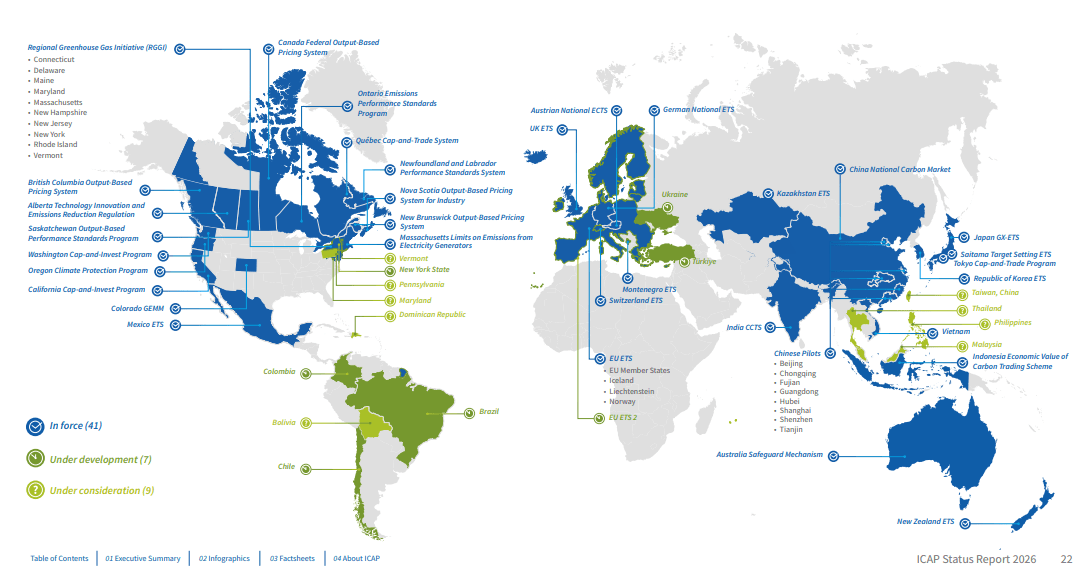
Existing ETS schemes at various stages. Source: ICAP Status Report 2025, page 22
Meanwhile, existing schemes are being strengthened. The EU ETS 2 is not the only one moving forward. China is preparing to introduce an absolute emissions cap next year. South Korea has strengthened its system by holding more auctions and establishing a new reserve. California’s system is in place through 2045, while Turkey, for example, is preparing a pilot ETS program.
How the proceeds are used
How revenues from allowance auctions are invested depends on each country. The report divides investment by different schemes into several categories, with schemes often funding more than one.
These categories include general budgets and development objectives, as well as other areas related to climate. The main area receiving ETS revenues is climate change mitigation, for example through reforestation or other forms of CO₂ capture.
Funding also goes to low-carbon technologies and innovation in the sector. Some countries also allocate part of the proceeds to help people or businesses affected by energy poverty, or those who may be negatively affected by the implementation of ETS.
What types of ETS are there?
The basic difference is whether a scheme is based on emissions intensity (73%) or an absolute cap (27%). Absolute-cap schemes (such as the EU ETS or the system China now plans to adopt) are simpler but stricter. They work by capping emissions—that is, setting the number of tonnes of CO₂ that can be released into the atmosphere and issuing the corresponding number of allowances. Any emissions released without an allowance are penalized.
This type of scheme therefore allows for a largely precise reduction in CO₂ emissions. The number of allowances can increase if, for example, the scheme is extended to another sector. In the EU, a market stability mechanism aims to keep the carbon price within a certain range—by withdrawing allowances if the price falls too far and releasing additional ones into circulation if it rises too far. The number of allowances in the system is also gradually reduced.
An intensity-based scheme limits emissions relative to economic activity. Companies receive allowances based on their output, which is subject to efficiency standards. The total volume of emissions can therefore actually rise under this type of scheme if overall production increases. Its aim is to reduce emissions as the economy grows and make existing production more efficient. For this reason, developing countries and countries concerned about constraints on industry tend to favor this type of scheme.
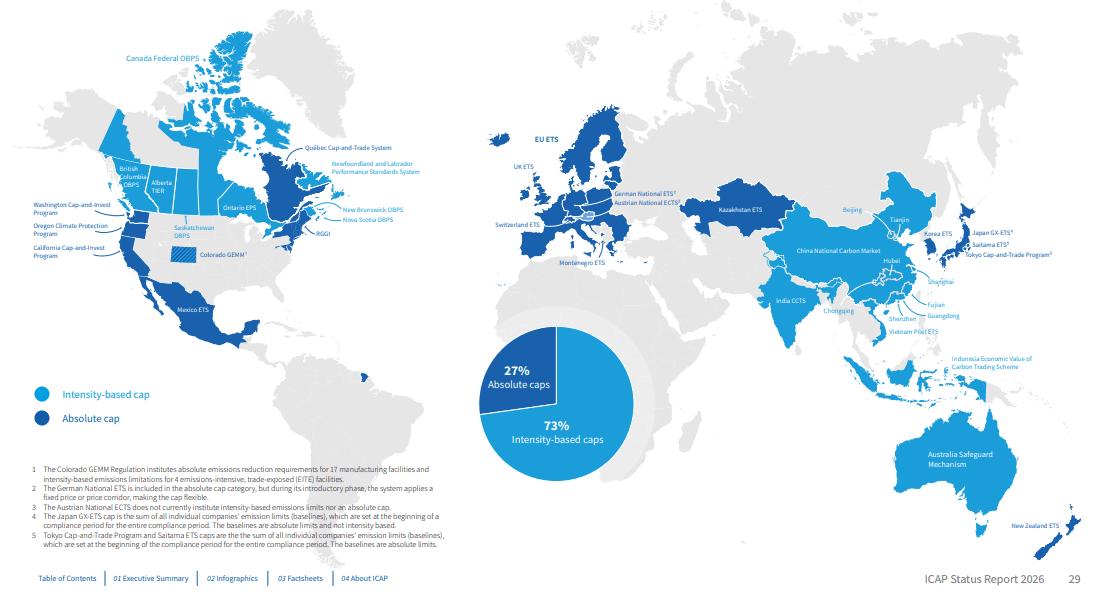
Types of ETS in operation. Source: ICAP Status Report 2025, page 29.
Translation disclaimer
This article is a machine translation of the Czech original and has not yet been fully reviewed. In case of any doubt, please refer to the Czech version.
Sdílejte článek prostřednictvím:
You might also like

10 October 2026, 07:37

10 October 2026, 07:02

9 October 2026, 13:47