
23 October 2026, 14:38
Loading...
Large heat pumps to play a key role in Czech energy sector
oEnergetice.cz
13 October 2022, 15:41
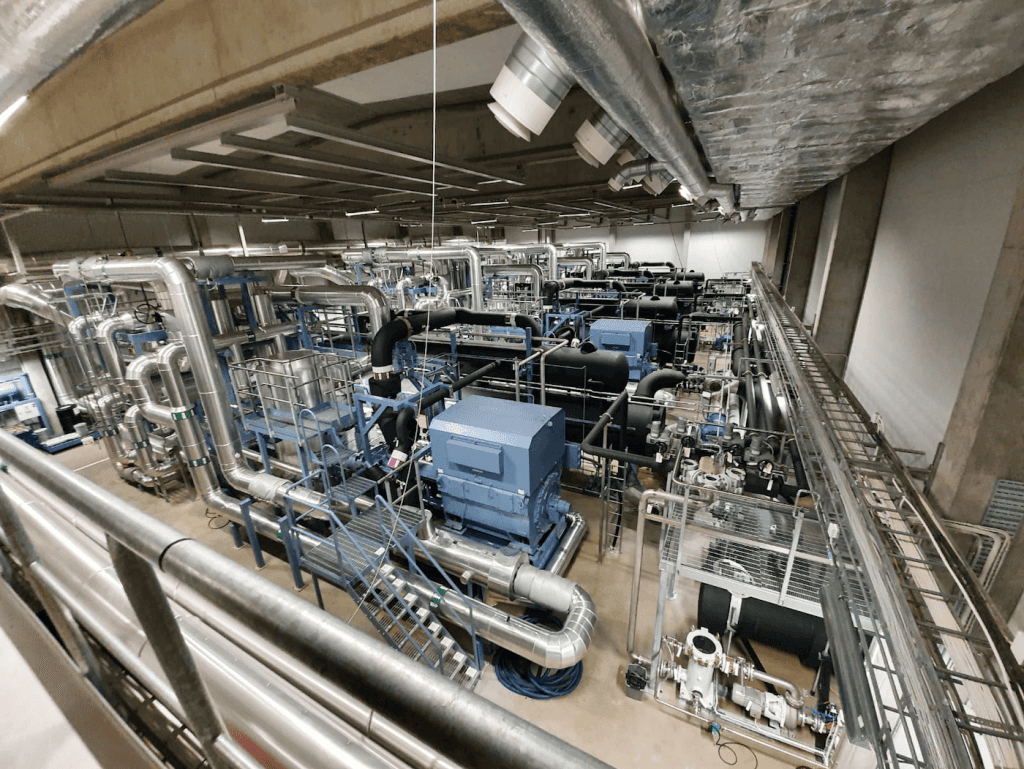
The ambitions that the EU is currently placing in heat pumps are enormous. The drive for more efficient energy use, lower CO2 emissions and the effort to rapidly replace natural gas have one synonym – heat pumps. In Czechia, nearly 30 % of total energy is consumed for heating buildings, with heat generation currently based predominantly on coal and natural gas.
The Green Deal, Fit for 55 and, more recently, REPowerEU strategies are shaping the market towards greater EU energy security and sustainable energy production. Thanks to their operating principle, large heat pumps are thus moving into the spotlight, while also adding one key capability – providing distribution grid flexibility, leading to lower balancing energy costs. This is creating a fairly clear preference for the development of this segment across the EU, to which virtually all manufacturers are responding with massive investments (totalling more than EUR 3 billion) in expanding manufacturing capacity and supporting research and development in this area.
Although residential units have long been established in Czechia, industrial machines with capacities above 100 kW have virtually no track record here despite their enormous potential. This is mainly because natural gas and other fuels for heat generation were historically so cheap that it made no sense to invest in a technology that was environmentally friendly but costly. However, this is changing rapidly. It is currently estimated that half of existing generation in district heating systems can be rationally replaced by large heat pumps with a combined capacity of up to 4GW. In its forecasts, ČEPS projects electricity consumption by heat pumps at 10 TWh in 2050. Heat pumps are relatively often used in district heating to utilise heat from cooling CHP unit engine mixtures, but standalone units operating as a baseload or flexible heat source are virtually absent in Czechia.
Surprisingly, existing wastewater treatment plants have significant waste heat potential in the Czech Republic. Wastewater treatment plant effluent has a relatively constant temperature throughout the year and, in winter months, when heat demand is highest, temperatures are typically 12-15°C. Combined with high flow rates, this represents an abundant, year-round and locally available energy source that virtually every municipality or city in Czechia has at its disposal. To illustrate the potential, one can look at the planned project at Prague's Central Wastewater Treatment Plant, which could reach a capacity of up to 200 MW and cover more than 20% of the capital's heat consumption. A similar project is already being implemented in Vienna, where 110 MW of heat pumps are planned to be installed at the local wastewater treatment plant in two stages. This project has one particular feature – Wien Energie will obtain electricity to power the heat pumps directly from a nearby hydropower plant on the Danube, making it 100 % emission-free heat generation. Similar projects have also been announced by other cities in neighbouring countries, including Hamburg, Mannheim, Berlin and Krakow in Poland.
Denmark, which is considered a model for the development of low-emission heat generation with a significant share of district heating (around 65 % compared with 40 % in Czechia), is several steps further ahead. A legislative change requiring the use of waste heat from energy processes while providing tax incentives to heat producers that deliberately use waste heat has triggered a boom in the development of this technology. The Danish government's goal is to install approximately 500MW of new heat pump-based capacity every year until 2028, with the aim of decarbonising the heating grid and, above all, increasing distribution grid flexibility as mentioned above.
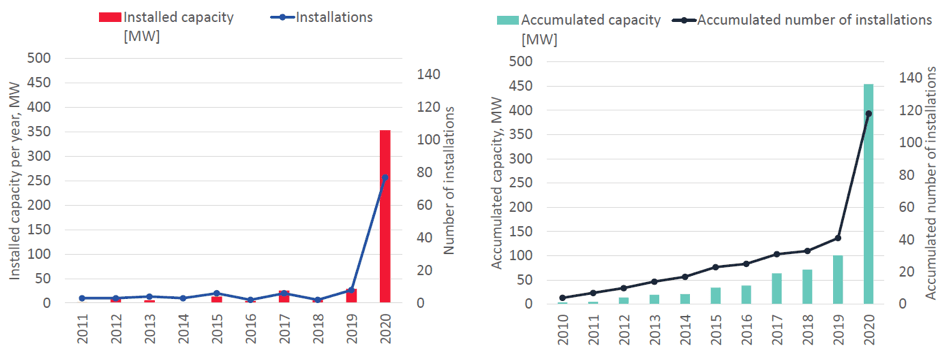
Development of heat pumps for industry in Denmark following the legislative change Source: Benjamin Zühlsdorf, Danish Technological Institute
The EU is expected to deploy 60 million heat pumps by 2030, while the end of sales of fossil fuel-based heating sources (especially natural gas) is planned for 2029, and even earlier in some countries. This therefore represents essentially exponential growth and, in principle, the replacement of the gas-based heating fleet. To support this modern technology, the European Commission recently approved EUR 3 billion in investment and operating aid for Germany for so-called low-energy district heating systems. Thanks to this support, roughly 680 MW of heat pump capacity per year is expected to be deployed over a 10-year period, often in combination with seasonal storage and so-called solar thermal.
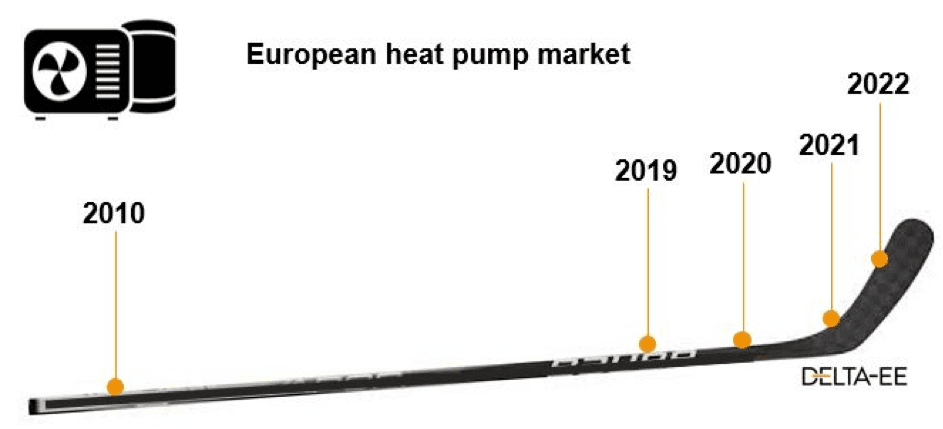
Expected development of heat pump technology in the EU. Source: Delta-EE
Industry is another equally important consumer of heat. High-temperature heat pumps, which will be launched on the market in the near future, will make it possible to raise outlet temperatures to as much as 200 °C, opening up significant scope for decarbonising many industrial processes, for example in paper mills, breweries, dairies, meat production and others.
Ambition requires action
This is the current motto of the European Heat Pump Association. A coincidence? Certainly not.
“The heat pump segment is now at the same starting point as photovoltaics were ten years ago. Legislative barriers to city-scale heat pumps must be removed and appropriate financing methods must be ensured for these projects.”
Odile Renaud-Basso (President of the European Bank for Reconstruction and Development, EBRD):
Many difficult tasks lie ahead, but Czechia cannot afford to miss the boat in this segment as it did in the case of photovoltaics. Our competitiveness depends to a large extent on affordable energy, and these local projects can make a significant contribution to the overall balance. Our country's advantage is that district heating systems are well established here, while investment in related infrastructure and the implementation timeframe need not pose a major obstacle to the development of this promising technology.
Large heat pumps also represent a key heat generation technology within community energy.
If you are interested in this emerging segment with multi-billion potential in greater depth, we would like to warmly invite you to an international conference that will be the only one in Czechia fully dedicated to industrial units and their applications. At the event, you will gain unique insights into the complex field of large heat pumps from renowned international speakers (such as the president of EHPA), and can also look forward to presentations of the most significant ongoing projects not only from the EU, but also from Prague and Vienna.
The future is electrified, be prepared.
More information and conference registration: www.exergie.cz

Translation disclaimer
This article is a machine translation of the Czech original and has not yet been fully reviewed. In case of any doubt, please refer to the Czech version.
Sdílejte článek prostřednictvím:
You might also like
23 October 2026, 11:01

23 October 2026, 06:34