
28 October 2026, 15:10
Loading...
LNG terminal to be built at German port of Stade, project gets final green light

oEnergetice.cz, ČTK
21 March 2024, 18:06
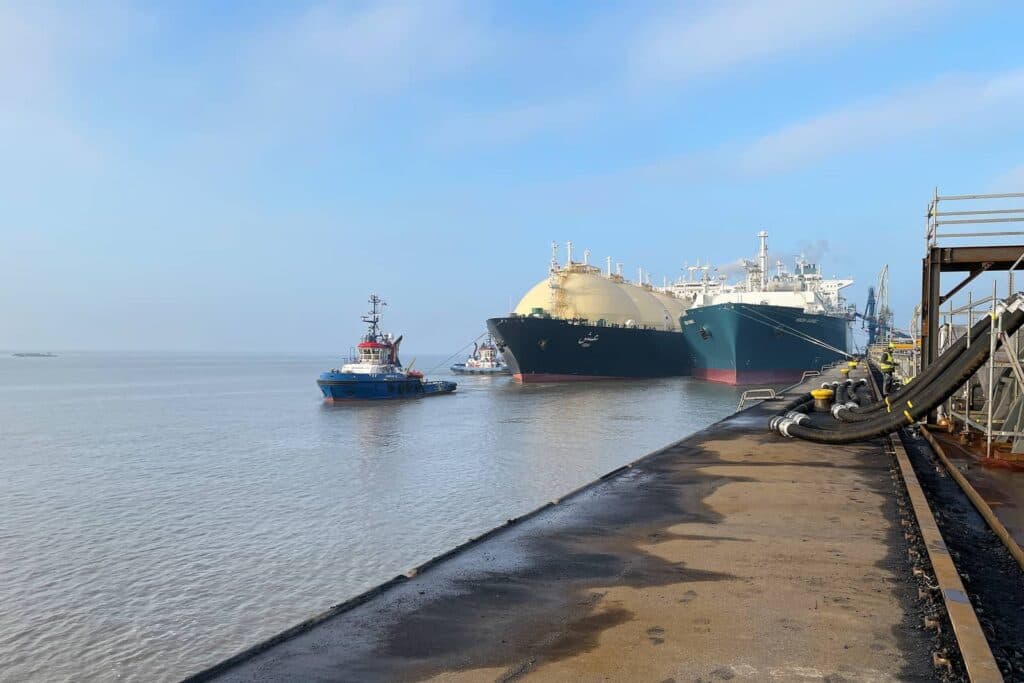
An onshore terminal for liquefied natural gas (LNG) will be built by 2027 at the German port of Stade, on the Elbe near Hamburg. Project company Hanseatic Energy Hub (HEH) said this today in a press release. Construction of the facility, which has been in the works for some time, will cost around one billion euros (CZK 25 billion). The project's backers have now taken a final investment decision, giving it the green light.
Capacity at the planned terminal has been fully booked since last year. The Czech Republic has secured two billion cubic metres of gas per year there, more than a quarter of current domestic consumption. EnBW and SEFE, formerly Gazprom Germania, secured the other two long-term offtake agreements last year. According to HEH, it will be Germany's first onshore LNG terminal.
Reuters said this was a significant step, as it is part of Germany's long-term effort to increase its LNG import capacity. Since February 2022, when Russia launched its military invasion of Ukraine, Germany has been forced to look more quickly for alternatives to its former gas supplies from Russia.
„After successfully completing the commercial and permitting phases at the end of 2023, shareholders Partners Group, Enagás, Dow and Buss Group have now successfully secured financing for this infrastructure project,“ the project company said. Partners Group is acting on behalf of its clients, according to the company.
Enagás is a Spanish gas transmission system operator and Buss is a logistics company. Dow Chemicals has a site near the planned project. An official ceremony ahead of the start of construction is expected in the coming weeks.
The first specialised vessel, used to store LNG and regasify it, arrived in Stade this month. It will initially operate on a trial basis. Three other vessels of this kind are located in Wilhelmshaven, Brunsbüttel and Lubmin, one in each port. Together with the vessel in Stade, they will be used for regasification until 2027. These facilities are known by the English acronym FSRU (Floating Storage and Regasification Unit).
Czechia currently has access to LNG capacity at Eemshaven in the Netherlands, where it has around three billion cubic metres of gas per year until 2027. According to the government, this capacity has helped significantly reduce Czechia's dependence on gas supplies from Russia. The Czech government is also interested in the emerging LNG terminal on the German island of Rügen in the Baltic Sea, which is well connected to gas infrastructure. The region is linked to Saxony by the OPAL gas pipeline, which connects to Czechia via the Gazela pipeline.
Floating FSRU units have been installed since 2022, when gas imports from Russia began to fall sharply because of the war in Ukraine. However, the installation of these regasification units was considered a temporary solution from the outset, pending the construction of onshore terminals that would support the transition to decarbonisation under the climate protection strategy pursued by the German government.
The Stade terminal will be equipped to handle liquefied natural gas, synthetic natural gas and liquefied biomethane. Ammonia, which can be used as a hydrogen carrier because hydrogen's low density can complicate its transportation, will be added later. Czech energy company ČEZ, Germany's EnBW and gas importer SEFE have committed to purchasing 90 percent of the Stade terminal's annual capacity of 13.3 billion cubic metres.
Translation disclaimer
This article is a machine translation of the Czech original and has not yet been fully reviewed. In case of any doubt, please refer to the Czech version.
Sdílejte článek prostřednictvím:
You might also like

28 October 2026, 13:08

28 October 2026, 11:10

28 October 2026, 09:08
