World's oldest commercially operating nuclear reactor restarted
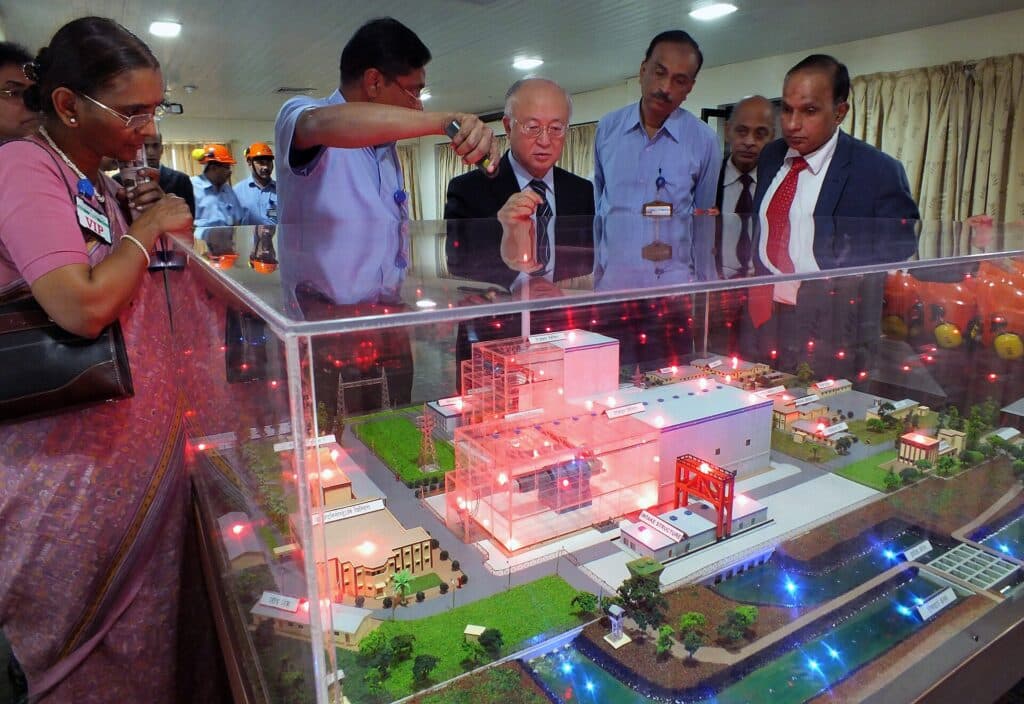
Unit 2 of India’s Tarapur nuclear power plant has been reconnected to the grid. One of the world’s oldest commercial reactors still in operation has been authorised to operate for another decade. This was reported by the Indian government’s official press agency.
India’s nuclear fleet reached a significant milestone in February this year, when the new Rajasthan nuclear power plant unit first reached full-power operation. Another milestone is the restart of Unit 2 at the Tarapur nuclear power plant. In June, this was approved by the Atomic Energy Regulatory Board (AERB), along with authorisation to operate for a further 10 years.
Four units, two technologies
The four-unit Tarapur nuclear power plant is located in the state of Maharashtra, on India’s west coast by the Arabian Sea. The older pair, dating from the late 1960s, consists of boiling water reactors (BWRs), each with a designed installed capacity of 200 megawatts electric.
During operation, their operator reduced the gross electrical output of each unit to 160 MWe. Two further units were added at Tarapur in the new millennium. These are heavy-water reactors, each with a gross installed capacity of 540 MWe. The government intends to deploy planned small modular reactors at this very site, specifically the 200 MWe BSMR-200 and the 55 MWe SMR-55.
“TAPS Units 1 and 2, commissioned in 1969, were Asia’s first nuclear reactors outside the former Soviet Union. After more than five decades of safe operation, they were shut down for refurbishment, modernisation and ageing-management activities, which were carried out under strict regulatory oversight. The life-extension programme was implemented in line with global nuclear safety standards, increased safety margins and strengthened long-term operational reliability,” The Nuclear Power Corporation of India Limited (NPCIL) said in a press release this February.
NPCIL falls under the Department of Atomic Energy and is responsible for building and operating nuclear power plants in India. Unit 1 at Tarapur had previously undergone similar refurbishment and overhaul work. This included replacing reactor recirculation piping with an advanced corrosion-resistant material, 3D laser scanning, refurbishment of the turbine-generator system, and upgrades to electrical systems. Subsequently, the AERB authorised its restart at the end of December 2025.
Which reactor is the oldest? It depends on the criterion
Tarapur 1 and 2 (also known as TAPS 1 and 2) share the title of the world’s oldest commercial reactors with Switzerland’s Beznau nuclear power plant. TAPS 1, TAPS 2 and Beznau 1 were commissioned in 1969. Based on the date of first grid connection and the start of commercial operation, the Indian units take precedence. The International Atomic Energy Agency’s PRIS database records that Tarapur Unit 1 was first connected to the grid on 1 April 1969, followed by Unit 2, which was connected on 5 May. They jointly began commercial operation on 28 October 1969.
By contrast, Beznau 1 was connected to the grid on 17 July 1969 and entered commercial operation on 9 December 1969. Based on their commissioning date, TAPS 1 and 2 can therefore be described as the world’s oldest commercial nuclear reactors still in operation. However, this is not the case in terms of years of operation. The two Indian reactors underwent the aforementioned multi-year outages between 2020 and 2026 for refurbishment and life extension. Unlike them, the Swiss reactor has operated virtually continuously since 1969.
Major nuclear plans
The Indian government states that the country’s installed nuclear capacity stands at around 8.78 gigawatts (GW). Planned expansion envisages almost tripling capacity in the coming years. It targets 22.38 GW by 2031–2032. Its long-term plans set out a target of 100 GW by 2047.
Nuclear power still plays only a very marginal role in the overall electricity mix. It accounts for 3.2% of electricity generation, while more than two-thirds comes from coal-fired power plants, whose combined installed capacity reaches 230.12 GW.
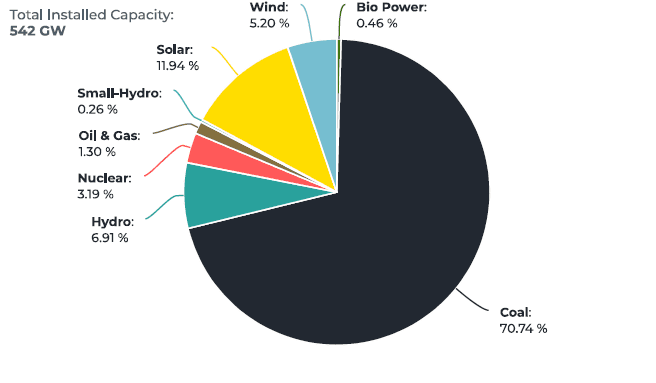
Source: India Climate & Energy Dashboard (ICED), NITI Aayog, Government of India
Translation disclaimer
This article is a machine translation of the Czech original and has not yet been fully reviewed. In case of any doubt, please refer to the Czech version.