20 October 2026, 15:34
Loading...
Before ordering a Czech solar power system for your family home or business (part 2)
Michal Klečka
17 March 2021, 20:45
or another instalment in a mini-series on what to consider before investing in building your own solar power system. The previous article outlined the pitfalls hidden in offers from suppliers of rooftop photovoltaic systems, as well as the basic facts about the amount of electricity panels generate and their efficiency. Today’s article will look, among other things, at the significance of solar roof tiles, the viability of battery storage combined with a rooftop solar system, and other storage options.
Does it make sense to consider solar roof tiles?
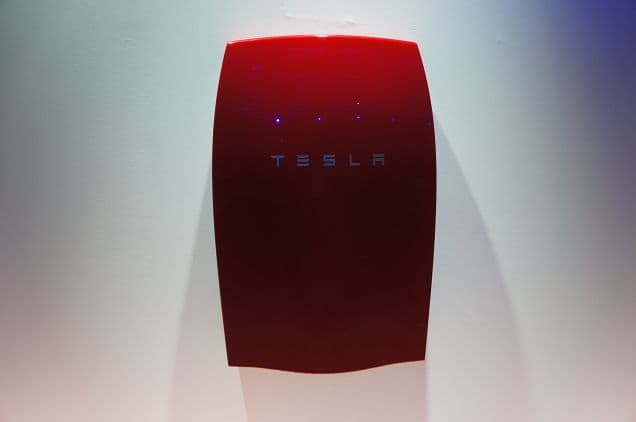
Solar roof tiles are today’s hit on social media and in the media, largely thanks to Elon Musk and his company TESLA. In practice, however, they are used very rarely compared with conventional solar panels, primarily because they cost roughly six times as much: 1 kWp costs around CZK 50,000, while conventional solar panels can be bought for about CZK 8,000. Another complication is that there is no standard for PV tiles. So if one tile breaks 5 years after installation and you do not have an original spare in stock, you will probably no longer be able to find the same type and size. On the other hand, solar tiles also have major advantages:
- They can directly form the sole layer of roof covering, just like fired clay tiles.
- They are very light compared with conventional fired clay or concrete roof tiles, weighing around 12 kg / m2. This is approximately the same as a solar panel, which, however, still requires conventional roof covering underneath.
- They closely resemble conventional roofing in appearance, which is why they are often permitted in heritage zones and on protected buildings.
- Unlike solar panels, they are available in many sizes, shapes and colour variants according to the investor’s requirements (black, red, grey, silver, green, orange…).
- They can be combined well with conventional roofing materials on a single roof
So what is crucial when choosing solar panels or tiles?
It is simpler than one might expect. If panels or tiles are purchased from an established specialist company with a track record, tradition and good references, it is enough to choose according to current availability, price per Wp, dimensions and the desired appearance.
Even a few millimetres in the width of a solar panel can ultimately determine how many will fit on the roof. More aesthetically pleasing all-black panel variants, which are not much more expensive than black-white-silver chequerboard designs, are also worth considering.
If appearance and elegance are key factors in the selection, or if the installation is on a roof with a highly complex layout, then it makes sense to consider buying solar tiles. In that case, however, sufficient financial resources must be available and no economic return on the investment should be expected. Solar tiles guarantee a beautiful, lightweight roof, and their installation is usually significantly simpler and faster than mounting panels.
Why can electrical appliances not be connected directly to a solar panel?
The components that can adapt voltage from solar panels to the voltage used by batteries and household sockets are called a charge controller and an inverter. Some manufacturers integrate the inverter, controller and battery into a single user device. These central all-in-one devices, which integrate one or two controllers and an inverter and operate with high input voltage in the order of hundreds of volts, are the most popular on the market. In general, however, products based on this concept cannot be recommended for the reasons described at the beginning of this series.
Therefore, require your supplier to design a solar power system using separate low-frequency, low-voltage transformer inverters or microinverters. The transfer of electricity from the panels to the batteries and inverter should be handled separately by one or more controllers. Separate controllers make it easier to eliminate the problem of uneven shading, as solar panels/tiles can be divided into any number of separate strings according to orientation, tilt and position.
Three-phase asymmetric inverters are also available on the market and can distribute electricity from solar panels unevenly across all three phases according to their actual loads. This appears to be an excellent solution; however, always ask the supplier how asymmetric a specific inverter is—in other words, how much of its rated output (usually only 1/3) it can direct to a single phase. In the case of a 5 kW inverter, this means only 1.7 kW to one phase, which is again less than the power draw of an electric kettle.
Batteries, or how best to store electrical energy from solar panels?
Let us set aside the differences between individual battery types for now; these are sufficiently explained and described in a publication on batteries available on the www.gwl.eu website in Czech and English (https://shop.gwl.eu/battery-guide/). Let us focus on what a battery should be able to do when it is used as part of a domestic solar power system.
- Batteries should use non-flammable, non-explosive cell types of known origin and specifications,
- provide high instantaneous power of at least 3 kW even at small capacities of up to 3 kWh,
- retain at least 80% of their original capacity after 3,000 cycles at 80% DoD (Depth of Discharge),
- be supplied with documentation and a service manual enabling the battery to be repaired, refurbished or used in another way in the future.
What is less important, but is often unnecessarily emphasised:
- A 5- or 10-year warranty that must be claimed against entities in third countries—typically in Shenzhen, China. Such a warranty is unenforceable for a Czech consumer and therefore worthless.
- Smart battery management system electronics, known as a BMS, which constantly monitors how much energy is in the battery and continuously communicates with the inverter. Such a solution enables various operating-state visualisations on touchscreens and connects the battery to other smart devices in the home. However, it is worth remembering that solar power systems and batteries are not usually purchased as technological toys, but as industrial products. Above all, they should save the environment and money, work reliably and require no attention from the owner. All this, however, conflicts with the complex electronics and software these smart systems contain. Monitoring the battery will cease to be fun after a while, and the battery’s smart features may eventually become more of a nuisance.
What battery size should you choose?
It depends on whether the battery is planned for off-grid operation (the property will not be connected to the 230 V distribution grid), in which case it will be the sole energy reserve, or whether the battery will merely be an aid and the distribution grid can be relied on for support.
Off-grid operation
Here, the battery is always designed based on consumption, so that the available energy lasts during periods when it cannot be recharged. Start by listing all appliances in the property, their outputs and their expected operating time during the day. Multiply the resulting energy requirement by the period for which you want to remain independent of charging. For an off-grid house, this may be a week of overcast skies; for a caravan, two days spent away from a campsite without the engine running.
Grid-connected installation
Here, in contrast, the battery is designed according to generation, because the primary motivation is to consume all the energy produced at the property rather than let it flow into the distributor’s grid virtually for free.
Based on the installed capacity of solar panels/tiles, calculate average daily generation. This naturally varies by season. November to February can be disregarded in central and northern Europe, as the sun is low above the horizon during these months and the number of sunshine hours is low. Most sunshine hours occur from March to October, when the sun is already high above the horizon.
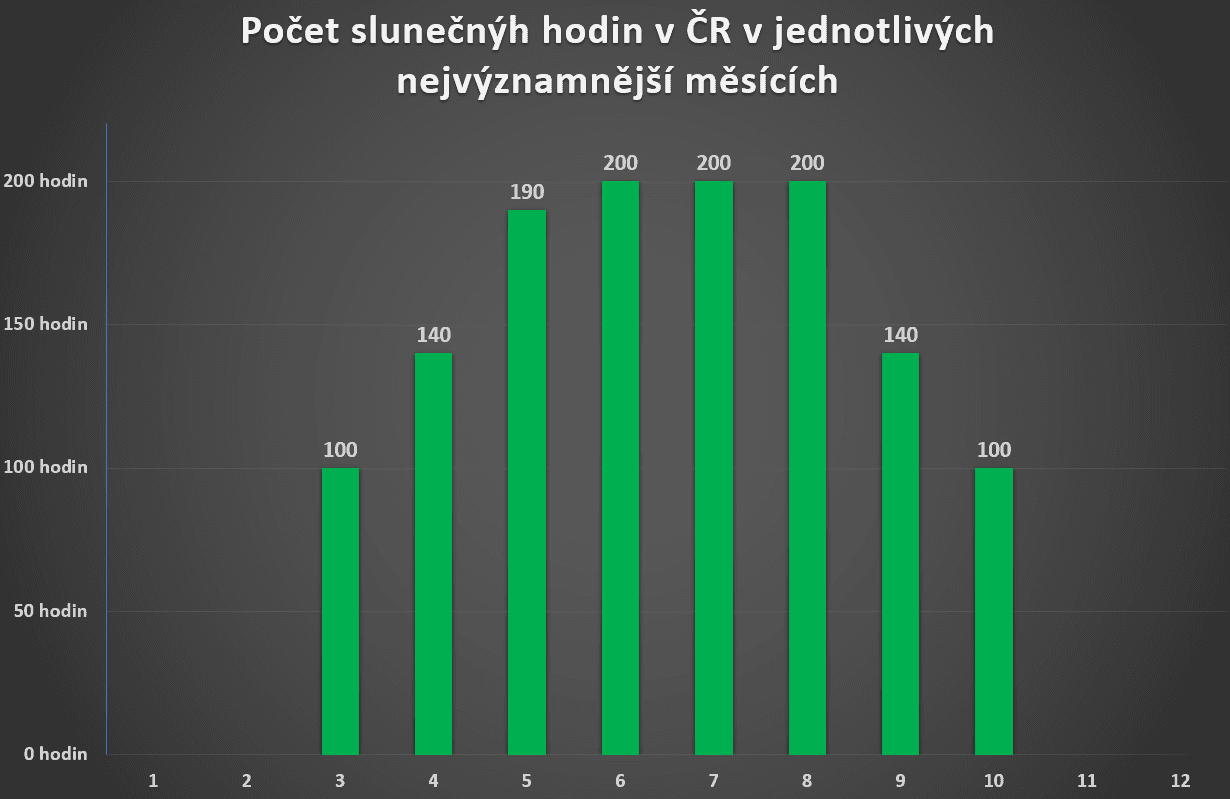
With installed capacity of 1 kWp, one hour of sunshine means approximately 0.5 to 0.8 kWh of electricity generated. This depends greatly on the tilt angle of the panels—it is not always possible to install panels at the ideal 45° angle and facing precisely south. If we divide the monthly number of sunshine hours by the average number of days in a month (30) and multiply it by a coefficient of 0.5 to 0.8, we obtain average daily generation. In spring and autumn, this is around 4–5 kWh per day; in summer, it is more like 6–7 kWh.
Part of this output is, of course, consumed immediately at the property and does not reach the battery—it depends on the daily routine. A business that is most active during the day will need a smaller battery, while a family house that is empty during the day would benefit more from a larger battery. More information on battery sizing can be found in this video:
In conclusion, every installation is different and no precise yet simple rule can be defined. However, you will rarely go wrong if you design a LiFePO4 battery with a capacity of 2–3 kWh for every 1 kWp of installed PV capacity. Choose the lower end for a property with high daytime consumption. Choose a larger battery for properties where most consumption occurs early in the morning and late in the afternoon (family homes).
Using these principles in combination with water heating can achieve sufficient storage capacity to almost eliminate electricity exports to the distribution system.
Other ways to store electrical energy
Besides batteries based on chemical conversion (i.e. lithium, gel, VRLA, lead-acid, etc.), energy can also be stored using batteries based on a much simpler principle. The most widely used is hot water. Solar panels can be connected directly to certain water heaters (solar water heaters from DZD Dražice), thus making it possible to manage with almost no electronics. The disadvantage is the low efficiency of this solution, meaning such a setup works well only in direct sunlight.
To increase efficiency and enable panels to heat water even under partly or fully overcast skies, or in winter, a voltage stabiliser (also known as a controller) must be added between the panels and the heater. This adapts the current-source characteristics of a solar panel to the characteristics of the heating element’s constant resistive load.
The advantages of this solution are certainly its price and simplicity. Water is the cheapest battery in the world. Heating 160 litres of water from 55 to 75 °C stores more than 3.5 kWh of electricity. A battery of such capacity and an inverter would cost at least CZK 120,000, whereas a 160-litre boiler with a controller costs less than a quarter of that.
The disadvantage is that electricity cannot subsequently be generated again from hot water. In summer, you may have a full boiler or hot-water storage tank, but have no use for it, while air conditioning or pool filtration is running next door and electricity for it must be bought from the grid.
How can the overall electricity balance be ensured?
Energy flows in a property should be managed to avoid obvious inefficiencies. A battery helps somewhat, but it is not a cure-all: it is capital-intensive, has limited capacity and can usually charge from only one phase.
If you are only now planning a new build or a complete renovation, we strongly recommend combining the solar power system design with the high-voltage electrical installation design for the entire property. Separate solutions by different, uncoordinated suppliers will create huge complications that may be difficult and very expensive to resolve in the future.
Above all, require the project to manage electrical energy between individual grid phases. Carefully consider whether a single-phase installation will suffice or whether you truly need a three-phase power system and wiring, which will make everything three times more expensive.
It is therefore advisable to install a PLC (Programmable Logic Controller) component in the property that knows current consumption separately on all phases and, accordingly (and according to the property’s known time pattern), optimises individual loads and sends energy where it is most advantageous at the time. One such PLC is the WattRouter Mx from Czech company Solar Controls.
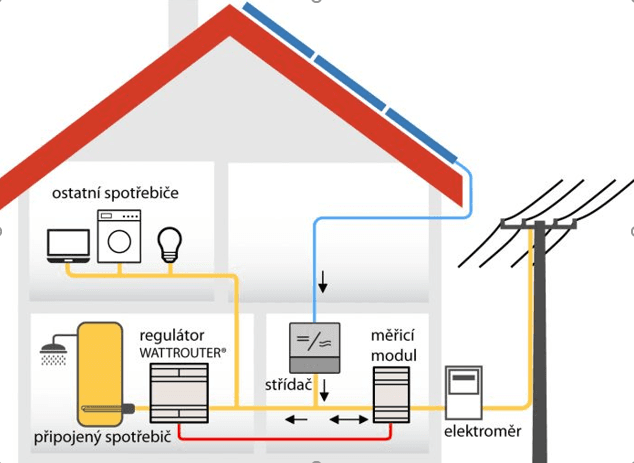
Another option is to use a high-quality asymmetric three-phase inverter. However, in the vast majority of cases this will make the installation more expensive, while very few installations genuinely require a three-phase rotating field connected to the solar power system. Apart from heat pumps, which operate only minimally from spring to autumn, three-phase appliances are not common in ordinary households and small businesses.
Conclusion and summary
Investors who want to consume as much energy as possible from their rooftop solar power system at the place where it is generated should certainly not forget:
- appropriate distribution of appliance connections among individual phases,
- modern high-performance LiFePO4 batteries of adequate capacity,
- a PLC module (for example, WattRouter),
- hot-water storage
- controlled switching of other appliances (cooling, pool filtration and heating, electric vehicle charger, etc.)
Combining these measures can ensure that (almost) all energy generated by the solar power system is always consumed at the property, with virtually no exports to the distribution system.
For most family homes or office buildings in central Europe, even a small solar power system can achieve electrical self-sufficiency for at least 6 months of the year. This is because average daily solar generation is approximately equal to average daily consumption. A project with daily storage (though unfortunately not seasonal storage) can usually be delivered within the bounds of economic rationality.
- As a basic parameter for such a project, require your supplier to ensure that at least 75% of generated electricity is consumed at the place of generation. The supplier should be able to demonstrate this ratio through daily calculations, not merely an annual or monthly aggregate.
- If the project includes a battery of significant capacity, an economic return cannot be achieved without subsidies and support. Without a battery, payback most often begins from the fifth year of operation.
- Prefer a supplier that uses separate controllers with strings up to 150 V and a low-voltage transformer inverter (Studer, Victron, Steca…) in the project.
- If you decide on a battery, prefer a low-voltage (<100 V), modular, easily repairable battery with a service manual.
- The battery must be able to charge at least 70% of the nominal output of the solar panels and handle discharge at a power of at least 3 kW (an electric kettle and something extra).
- It is always better to assume that the supplier will no longer exist in 5 years and that the power system and battery will require some repair or servicing by a third company. Therefore, require the supplier to provide all drawings, wiring diagrams, the service manual, backup configuration files, firmware versions used, etc.
- The cheapest storage is hot water, and it is always needed. Require it to be used to the maximum extent in the project.
A well-designed solar power system is always worthwhile for the environment because it saves fossil fuels at power plants, and that is invaluable. Did you know that one larger coal-fired power plant burns 8–10 full freight trains of coal in a single day? That is 16–20 thousand tonnes. And every solar panel on a roof saves around 150 kg of coal annually at a thermal power plant (Czechia 2020, 50% electricity mix from coal).
About the author
Michal Klečka is one of the founders of GWL a.s., currently Europe’s largest importer and seller of prismatic lithium iron phosphate cells. After leaving executive roles at the company in 2020, he has focused on education in renewables, publishing and interesting industry projects. He still represents GWL a.s. in the AKU-BAT association, serves on the jury of the Czech Self-Sufficient House architectural competition, and is co-author of the energy system for the Czech Off-Grid House and the iBATT.energy concept.

Translation disclaimer
This article is a machine translation of the Czech original and has not yet been fully reviewed. In case of any doubt, please refer to the Czech version.
Sdílejte článek prostřednictvím:
You might also like
20 October 2026, 12:55
20 October 2026, 10:49
20 October 2026, 06:13