20 October 2026, 15:34
Loading...
Before ordering a solar power plant for your Czech family home or business (Part 1)
Michal Klečka
22 February 2021, 07:22
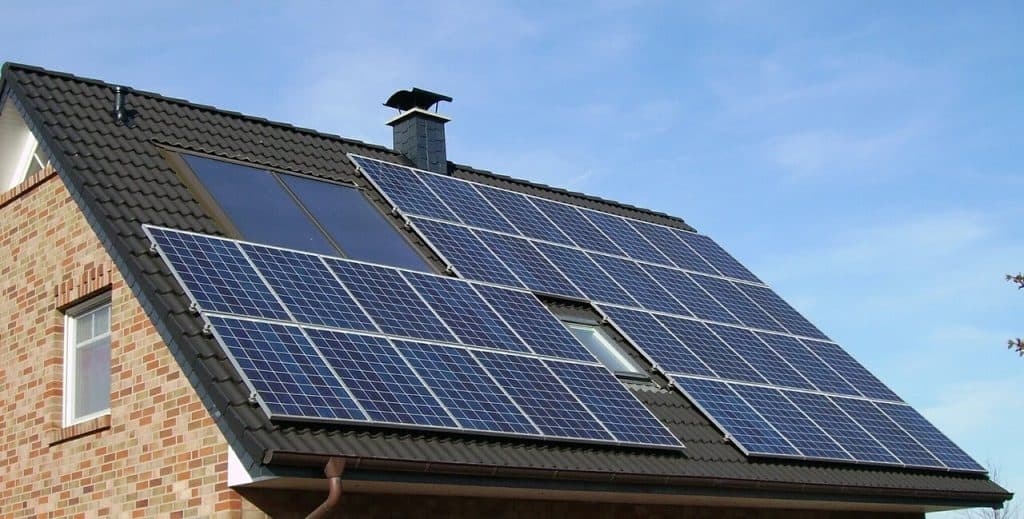
Or, a miniseries on what needs to be considered before investing in the construction of your own solar power plant. Ideally, such a project should reduce electricity consumption from the grid and thereby cut the use of energy from fossil sources.
By reducing grid consumption, substantial financial savings can be achieved on electricity suppliers’ bills. A solar power plant also contributes to energy self-sufficiency and, especially when combined with a battery, serves as backup against a blackout. Many years of reliable photovoltaic power plant operation are then often (mistakenly) taken for granted. However, if the right approach is taken to this investment, after every sunrise you will be warmed not only by the sun’s rays but also by the good feeling that your money has been spent wisely.
Bad practices in solar power plant projects
Before we move on to the considerations themselves, let us first look at the common practice currently seen in the market for photovoltaic power plants and battery storage systems. A number of large companies operate in the turnkey solar power plant supply market and, in order to reduce installation labour, standardise their projects and maximise profits, do not always choose the most advantageous option for the customer.
Typical examples of where these bad practices show up include:
- The installation of a less reliable and poorly serviceable type of inverter (the plant’s central, key component), which requires costly replacement after 5–10 years. An inverter failure then takes the entire plant out of operation until a new inverter is purchased and installed.
Designs incorporating three-phase power plants, even though an ordinary family home or small business cannot make use of the benefits of a generation source connected to three phases. On the contrary, such a concept extends the payback period. - An inefficient method of storing generated energy. Some installations use it to heat water in a boiler or swimming pool by first converting the generated direct current into alternating current via an inverter, only for it then to be “burned” in a heating element. This approach causes faster wear of the inverter (and thus shortens its service life), which can be avoided through a better thought-out design of the entire system.
- Unsuitable interconnection of individual solar power plant panels. A fault in or shading of a single panel may take the entire power plant out of operation. The wiring method also significantly affects the security requirements for the entire plant and thus its total acquisition cost.
- Where batteries are used to store electricity, the battery system is supplied as a so-called “black box”. If such a battery system fails, repair is virtually impossible and a new battery system must be purchased for storage purposes, substantially reducing the efficiency of the funds spent.
Conversely, an example of a good designer and supplier that would never allow the above-mentioned bad practices is Asolar s.r.o., with designer Ing. Tomáš Vocílka. GWL has long cooperated with this company on high-quality projects which, thanks in part to GWL batteries and Tomáš’s precision, are guaranteed to operate for decades to the investor’s satisfaction.
Catch in the offers
The offers of large companies may also contain several catches that distort the overall picture of the benefits of acquiring solar electricity. Presented this way, an investment in a rooftop solar power plant appears highly lucrative, although the reality may be considerably different. The most insidious, and often hidden, detail in such offers is the failure to consider the simultaneity of generation and consumption. Put simply, plant generation does not equal savings.
The monthly total generation of a power plant shown in offers is by no means necessarily equivalent to an equally large monthly reduction in electricity consumption from the distribution grid. Therefore, if we multiply the amount of electricity generated in a month by the electricity price, we will usually not arrive at the actual monthly savings. The amount of electricity from the solar power plant consumed on site is typically lower (especially without suitable use of storage) than the plant’s generation. Surplus generation is then fed into the distribution grid either free of charge or at a very low price (around 0.5 Kč/kWh).
The specific ratio of electricity generated and consumed on site depends on:
- the consumption profile of the property on typical working days and weekends in individual seasons
- the sizing of the solar power plant’s capacity
- storage options
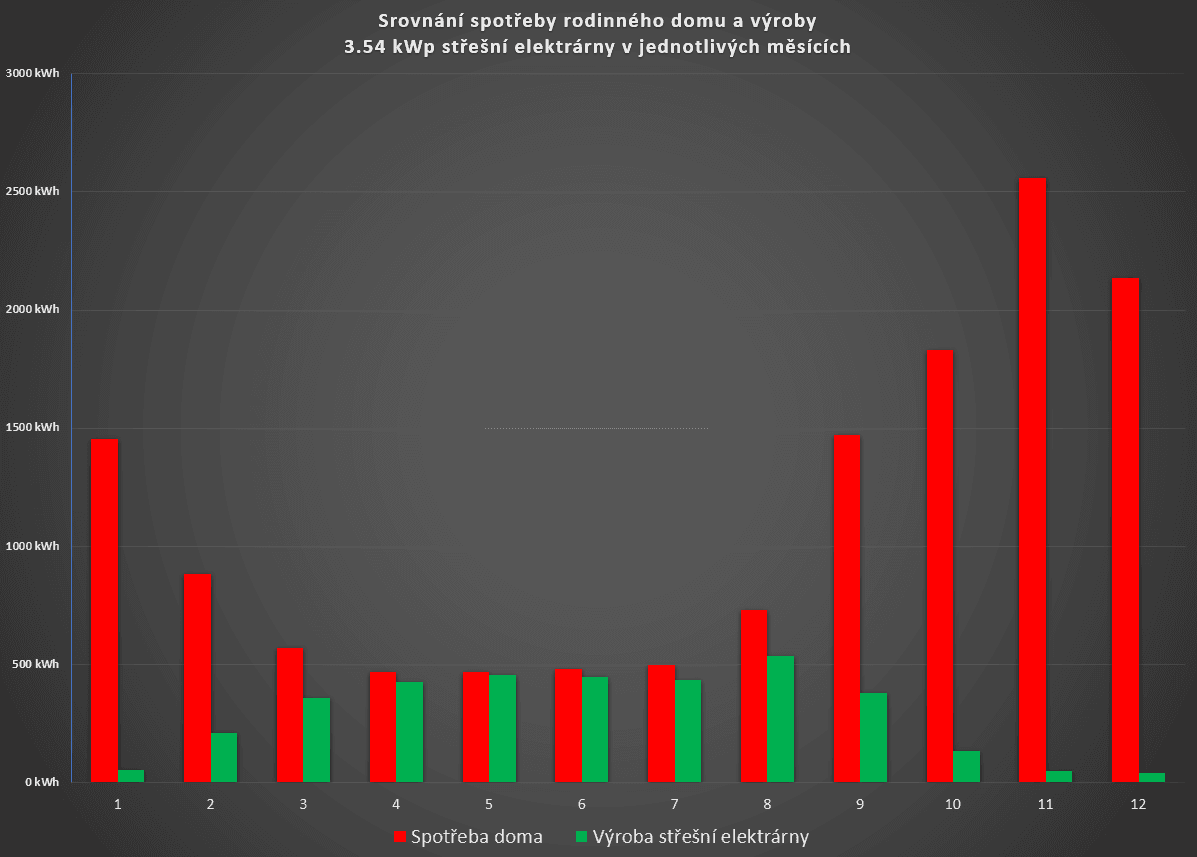
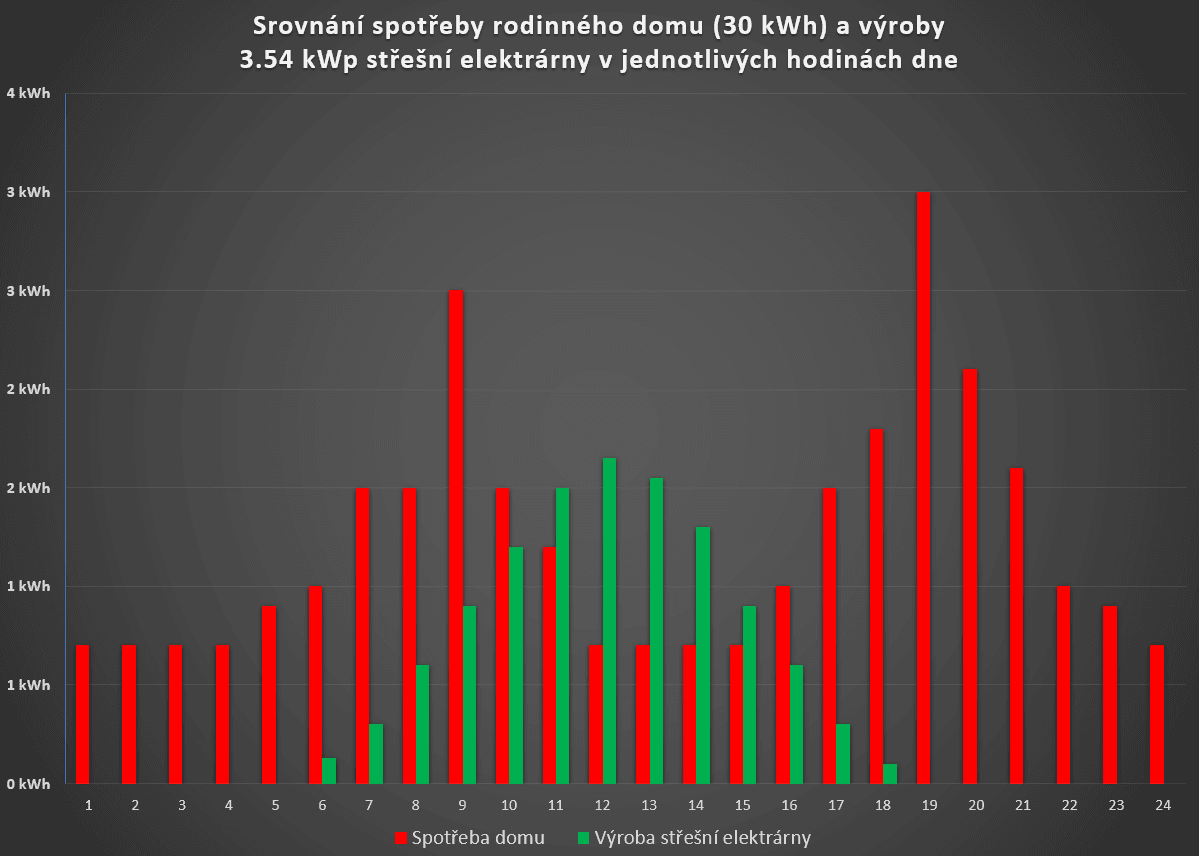
A graph of total monthly household consumption (without a battery) and monthly plant generation may suggest that, if consumption is always higher than generation in every month, all electricity from the plant will be used to cover consumption. However, this need not be the case at all, as shown by a graph of daily household consumption and daily generation, where solar power plant output considerably exceeds household consumption around midday. If storage is not available, some of the electricity generated around noon cannot be consumed at the point of generation. This must be considered when determining the amount of financial savings that a photovoltaic power plant will deliver.
What lies behind the mantra of rising electricity prices?
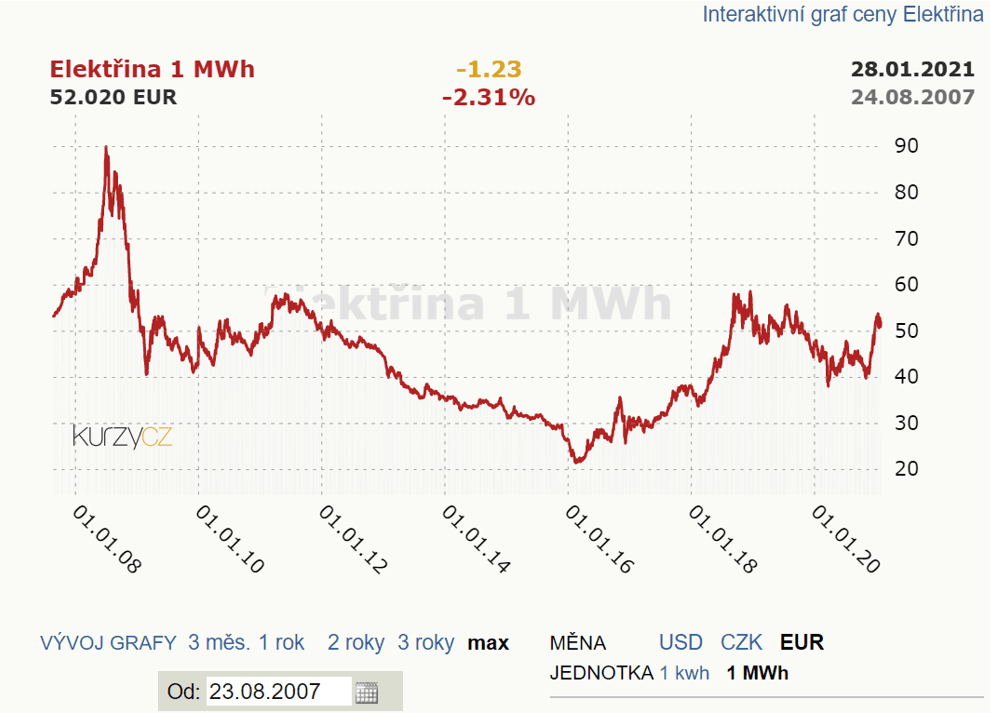
The second catch is that growth in the price of electricity purchased from the grid is the only economic factor included in the calculation for a solar power plant installation offer. This visibly inflates the assumed long-term savings. However, the calculation does not take account of growth in the population’s purchasing power or the time value of money. While electricity price growth itself is possible and likely, over a 30-year horizon it amounts to reading a crystal ball. For comparison, let us look at the development of the wholesale electricity price on the Prague Commodity Exchange: electricity now costs, in nominal terms, virtually the same as it did 13 years ago. But the real value of one crown is approximately 30% lower, meaning the price of electricity has fallen by around a third! Talking about stable long-term growth of, for example, 2% is therefore questionable at best.
Can a solar power plant and battery make sense at all?
Now let us look at the issue from the opposite perspective and consider what the proper approach should actually look like. Is there any meaningful route today? If we accept certain limitations, a suitable solution can be found.
It is necessary to realise that, with very few exceptions, a combination of a solar power plant and home battery does not pay off economically without subsidies and state support. Other justifications must therefore be sought, such as energy self-sufficiency, independence, reducing greenhouse gas emissions or the personal satisfaction of being able to use clean electricity from a renewable source for most of the day.
A solar power plant without a battery, on the other hand, pays off relatively quickly, with payback periods of around 4 years possible; after that time, you are genuinely saving money, or rather “earning” it. Other forms of energy storage significantly help to speed up payback, for example into hot water in a boiler or swimming pool, or the option of powering air conditioning with electricity from solar panels.
If an investor wants to find an economic rationale for a power plant with a battery, they must accept drawing state subsidies, which may not suit everyone. Moreover, a solar power plant that fits subsidy requirements well is usually poor backup against grid outages and also does not perform particularly well from the perspective of reducing CO2 emissions.
But now let us move on to the promised considerations that should precede an investment in a solar power plant.
How much electricity will solar cells actually generate for me?
Very roughly and simply put, 1 kWp of installed capacity (read kilowatt-peak) generates around 1 MWh (megawatt-hour) of electricity per year in Czechia. At current wholesale electricity prices (Czechia, 2020), this amounts to approximately 1500 to 2000 Kč. For a clearer picture, these figures can also be converted into square metres or individual units:
- 1 m2 of solar panels or tiles generates around 200 kWh of electricity per year, worth 300 to 400 Kč, and costs around 1500 Kč (panels) or 12 000 Kč (tiles) as an investment.
- i.e., 1 solar panel with an average capacity of 330 Wp generates around 330 kWh of electricity per year, worth 500–650 Kč.
To put solar power plant generation into context, a family home’s annual electricity consumption can roughly range from 3 000 kWh to 15 000 kWh (3-15 MWh), depending on whether electricity is used only to operate standard appliances and lighting, or also for cooking and possibly heating the house.
Does generation equal savings?
Unfortunately, it does not, and not only because of the already mentioned simultaneity of generation and consumption. Another reason is that a house is most often connected to the distribution grid via three phases, which in Czechia, as the only country in the EU, are measured and billed separately (a detailed explanation of this punitive measure can be found, for example, in this article). Thus, while there may be photovoltaic surpluses on one phase, the house may be consuming electricity from the grid on the other two. The result is that electricity on those two phases must be paid for to the distributor, while surpluses on the third phase are sent to the distributor’s grid free of charge or for a very low price.
Is solar panel efficiency important?
For an industrial power plant with a capacity of many megawatts, certainly. For a household with units or low tens of panels on the roof, there is no point chasing every tenth of a percentage point in higher efficiency. Whether a solar panel or solar roof tile has a stated efficiency of 18% or 20% is about as important as whether a car’s standard fuel consumption in the manufacturer’s brochure is 5.5 l or 5.7 l / 100 km. The actual difference (result) cannot be identified because its significance is overshadowed by other, more important factors. Standard solar panels measuring approximately 1600 x 1000 mm today offer peak output of 300 to 360 Wp. Similarly, 1 m2 of solar tiles generates around 180 to 220 Wp at peak, i.e. 0.18 – 0.22 kWh per hour. Differences within this range need not be addressed. The choice of battery, inverter or connection method for the entire power plant will have a far greater impact on overall system efficiency.
Does country of origin matter, and are Chinese panels or solar tiles poor quality?
Whether panels/tiles are made in China, Korea, Japan or Europe is not important. Country of origin may be considered for ideological reasons, if you want to support the industrial production of a particular country. Only if all other parameters of the panels/tiles are comparable does it make sense to consider country of origin as a selection criterion. Differences in quality and service life are entirely negligible, and it is often the opposite of what might intuitively be expected. Based on GWL’s experience of more than 10 years of cooperation with two Chinese factories producing top-quality products for reasonable prices, it can be said that even panels supplied 10 years ago still operate (unlike many others) practically like new. Nor has it ever been necessary to address any safety defect at a customer’s site in this connection, particularly concerning overheating, imperfect connector connections, sparking and so on.
About the author
Michal Klečka is one of the founders of GWL a.s., currently Europe’s largest importer and seller of prismatic lithium iron phosphate cells. After leaving the company’s executive roles in 2020, he has focused on education in the field of renewable energy, publishing and interesting industry projects. He still represents GWL a.s. in the AKU-BAT association, is a member of the jury for the Czech Self-Sufficient House architectural competition, and is co-author of the energy system for the Czech Island House and the iBATT.energy concept.

Translation disclaimer
This article is a machine translation of the Czech original and has not yet been fully reviewed. In case of any doubt, please refer to the Czech version.
Sdílejte článek prostřednictvím:
You might also like
20 October 2026, 12:55
20 October 2026, 10:49
20 October 2026, 06:13