
23 October 2026, 14:38
Loading...
Intersolar: AIKO panels dominate, microinverters emerge and building-integrated photovoltaics
Petr Pávek
9 July 2024, 15:19
While agrivoltaics has been the photovoltaic topic of recent days in Czechia, entirely different topics resonated in Munich. But what was happening across the completely (probably for the first time) full exhibition grounds, in halls A1 to C6, including the outdoor area?
Halls A1, A2 and A3 belonged to module manufacturers. The traditional contest for the highest-output panel in production or pre-production versions was in full swing here. Virtually all module manufacturers presented the largest possible (in terms of size) TopCon or HJT (heterojunction) modules. They competed on the highest efficiency (up to 24 %) and reductions in the expected loss of output due to panel ageing.
However, manufacturer AIKO stood well apart from the entire pack. Its production modules based on ABC (all-back-contact) technology offer efficiency of more than 25 %. At the same time, placing all connections on the rear of the panel gives it a completely black front surface, which reveals its fine structure only upon close inspection. This provides an additional advantage when installed in architecturally prominent locations.
BIPV (building-integrated photovoltaics), or photovoltaics integrated into buildings, form a separate category. Essentially, this field is divided into two main parts: roof and façade components. Roof modules were represented primarily by differently sized tiles imitating diamond-shaped or classic roof tiles, or beaver-tail tiles.
The façade category is more interesting. It ranges from exposed panels in an all-glass design to modules that imitate coloured surfaces in virtually any colour. Variants imitating concrete, stone, clinker brick or other façade materials are also available. So-called terracotta panels, meaning fully red panels, are already a relatively common part of panel manufacturers' portfolios. They can be used as a compromise solution in heritage-protected areas or in locations visible only from greater distances.
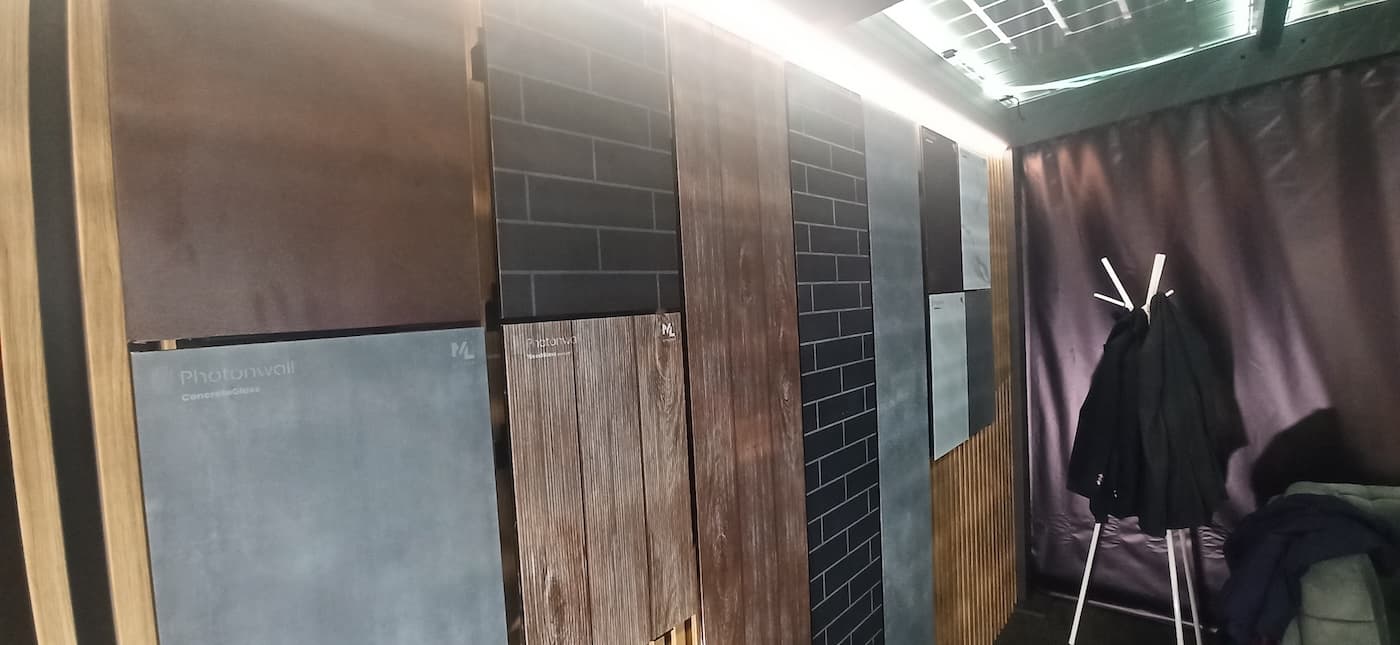
BIPV modules can imitate virtually any surface. Source: Petr Pávek
In halls A5 and A6, major installation companies presented turnkey delivery of conventional ground-mounted and rooftop power plants, as well as agrivoltaic installations and, of course, floating power plants. With the exception of ČEZ's pilot installation, these are virtually unknown in Czechia, but abroad there is more than 15 years of experience with them (for example in Japan and Benelux).
This section also included manufacturers of mounting structures for ground-mounted installations, which come in various shapes depending on manufacturing processes. Particularly interesting are thin-walled metal structures from manufacturers whose main product line is punched sheet metal and for whom photovoltaic structures are a secondary product line. This section also contained structural materials for “standard” rooftop installations, including various hooks, combination screws and all accessories.
Battery systems
Halls B0 to B2 and C2, C3 were dedicated to the Electrical Energy Storage sub-exhibition, which, as its name suggests, focused on electricity storage. Apart from still marginal hydrogen solutions and flow batteries, the vast majority of exhibitors focused on battery solutions.
The Ecoflow stand stood out in hall B1. The company entered the Czech market two years ago with a major billboard campaign for portable power stations. It now offers a full range, from all-in-one solutions through conventional high-voltage batteries to other commonly offered variants. However, this range was available only at Intersolar; its Czech website still offers “only” power stations in countless variants and foldable solar panels.
The second notable Czech/Slovak representative in hall B1 was Tesla Energy Storage, or rather Tesla Group. Its offering is dominated by liquid-cooled industrial battery storage solutions. As is almost a matter of course today, it offers peak shaving (reducing peak demand) as well as the option to use a battery to gain an advantage when purchasing or supplying electricity on the day-ahead market.
The emergence of microinverters
Halls C1, B3, B4 and C4 belonged predominantly to inverter manufacturers. From a Czech perspective, the biggest news came from Fronius and SolarEdge, which presented new asymmetric inverters capable of supplying different outputs on individual phases, and thus able to operate under the operating conditions of ČEZ Distribuce, EG.D or PRE Distribuce.
Another trend at this year's Intersolar is the emergence of microinverters. In Czechia, E.GD is furthest ahead in their use: they only need to be “notified”, but must be operated without exports to the grid. And far from all microinverters can ensure this parameter, as it is not a standard requirement in other countries. But setting aside conditions in Czechia, microinverters offering output of up to 5 or 6 kW are an interesting solution where there are multiple different orientations and tilts, or where there is nowhere to place an inverter (a large car park with PV installed on a carport).
Industrial automation, electric vehicle charging and more
EMPower Europe was also a separate sub-fair, held in halls B5 and C5. Here, visitors encountered mainly installation materials (Czech surge protection manufacturer Saltek also exhibited), but also industrial automation and power electronics – for example, transformers. The northern part of hall C5 was occupied by a huge shared stand for small but innovative German companies, and there was also an entire section dedicated to start-ups.
Attentive readers will surely have noticed that exhibition halls B6 and C6 remain. These hosted the sub-fair called Power 2 Drive Europe, where the main topic was charging electrically powered vehicles, the related infrastructure and, among other things, carport installations. Czech companies Alukov Solar and Carporio drew attention here, offering portfolios extending beyond carport solutions – in Western markets, new large-capacity car parks are required to be fitted with photovoltaics, and this is the target market for this pairing.
This was followed by a relatively limited outdoor exhibition, where visitors could see various mounting solutions, several agrivoltaic installations and an interesting structure from France, in which massive wooden elements were used as the supporting structure beneath the panels – all manufactured using modern CNC machines. Another option available to visitors outdoors was rides in several electric vehicles.
More Czech representation
And the dark horses of Intersolar from our country? PV Logic (listed among exhibitors as Rychloservis), which targets remote management of installations, including intelligent monitoring and thus precise fault detection before a service technician is dispatched. According to its representatives, it can, for example, detect up to five different module faults from monitoring data (from the inverter) alone.
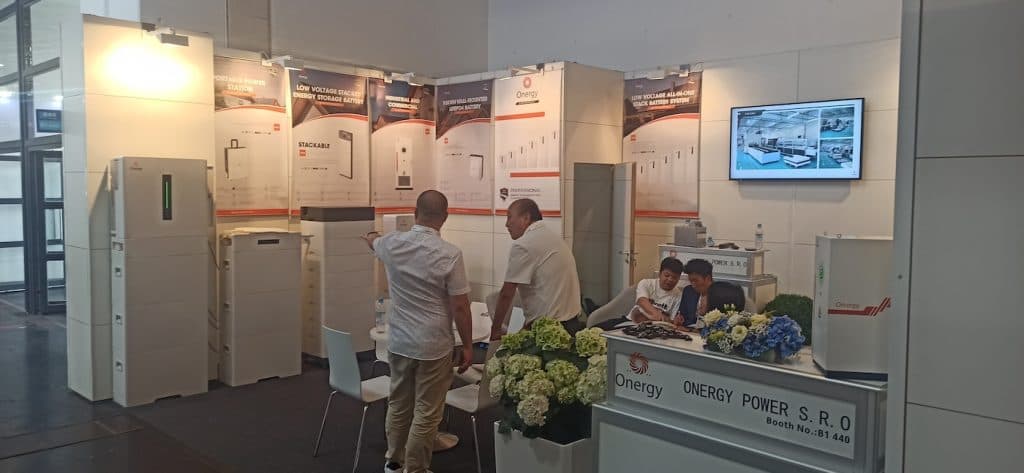
The other standout representative is Onergy Power, a Prague-based company supplying an entire portfolio consisting largely of residential battery solutions – LV, HV and an all-in-one system with an inverter. It is building production facilities in Ústí nad Labem, with the ambition of manufacturing battery solutions in Czechia, albeit from globally sourced components (battery cells).
Translation disclaimer
This article is a machine translation of the Czech original and has not yet been fully reviewed. In case of any doubt, please refer to the Czech version.
Sdílejte článek prostřednictvím:
You might also like
23 October 2026, 11:01

23 October 2026, 06:34