
23 October 2026, 14:38
Loading...
LONGi unveils TaiRay silicon wafers for TOPCon, heterojunction and back-contact cells
oEnergetice.cz
5 December 2024, 17:26
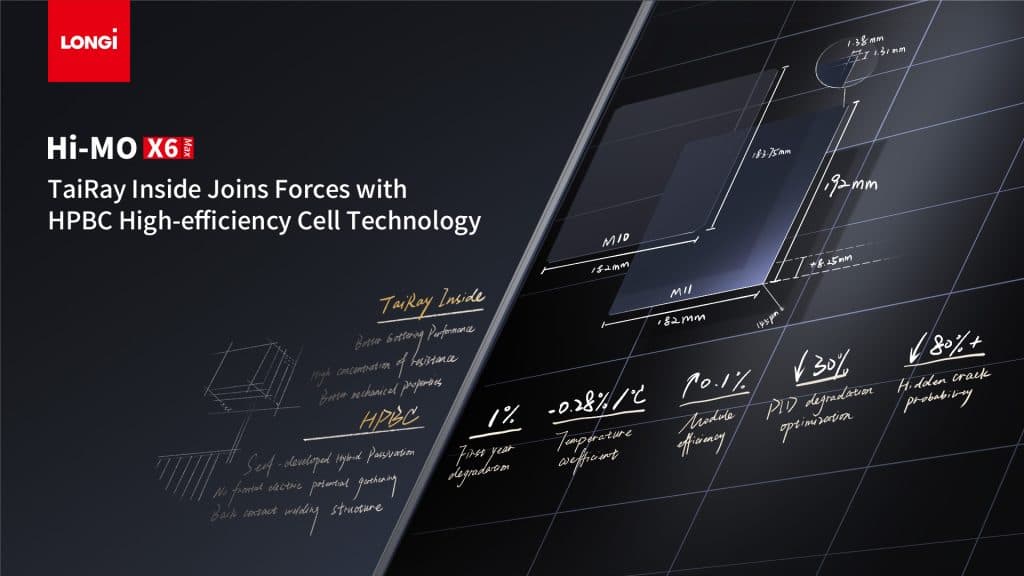
LONGi recently unveiled its newly developed TaiRay silicon wafers, which are suitable for the solar technologies currently in widespread use, including TOPCon, heterojunction (HJT) and back-contact (BC) cells. They deliver an efficiency increase of around 0.1% for these cell technologies. The new wafers are the result of three years of intensive research and development by LONGi’s R&D team, which numbers several hundred employees. LONGi has thus achieved a breakthrough in silicon wafers, a field that has seen no significant innovations in the past decade.
TaiRay silicon wafers have three main advantages:
- High compatibility with different platforms (TOPCon, heterojunction and back-contact).
- More uniform resistivity distribution.
- Effective removal of impurities.
TaiRay wafers will be available in various sizes and thicknesses to meet different needs.
16% higher flexural strength
In addition to their technological advantages, TaiRay wafers also have better mechanical properties. The tested flexural strength of LONGi TaiRay silicon wafers is 16% higher than that of conventional wafers, making them more resistant to breakage and enabling the production of thinner wafers with a lower risk of cell breakage during manufacturing.
Monocrystalline silicon wafers have always been a flagship product for LONGi, and the manufacturer has had the world’s largest shipment volume for nine consecutive years. In recent years, the wafer segment has shifted towards monocrystalline, large-format and thin wafers, and LONGi has made a significant contribution to every technological change.
Silicon ingots have better and more uniform resistivity distribution
The new TaiRay wafers and their advantages are the result of an improved Recharge Czochralski (RCz) process used to produce monocrystalline silicon ingots.
The longer conventional silicon ingots are, the greater the difference in resistivity throughout the ingot. Thanks to the improved RCz process, LONGi TaiRay silicon wafers can achieve a more uniform axial resistivity distribution without shortening the ingot. For an ingot of the same length, the resistivity ratio between its ends is halved, resulting in more efficient cells.
In addition, metallic impurities can be removed more easily from LONGi TaiRay silicon wafers. Compared with conventional products, there is also greater potential to improve efficiency. The more impurities that can be removed, the greater the potential to improve cell efficiency.
Improving silicon wafers is essential to improving solar cells
Over the past decade, the solar industry has made significant technological and cost breakthroughs. As a result, solar power has become the world’s fastest-growing renewable energy source. In 2023, global solar power entered the “terawatt era”. Zhenguo Li, founder and president of LONGi, said the rapid development of the photovoltaic industry is driven mainly by the continued reduction in the cost of electricity. Cutting costs and increasing power generation efficiency have always been key drivers of the photovoltaic industry.
The accelerated development of the photovoltaic industry has also driven the development of silicon wafers, which are essential to improving solar cells. The quality of silicon wafers determines a cell’s conversion efficiency. In recent years, however, the steady refinement of silicon wafer manufacturing technology has slowed progress in improving wafer performance. Products in the silicon wafer market are becoming increasingly homogeneous.
LONGi continues to focus on ongoing research and development to further improve silicon wafer performance and meet demand for high-quality wafers as the need for high-performance solar cells grows.
President Zhenguo Li said:
“We believe in the importance of science, technology and innovation in the photovoltaic industry, and are directing our resources towards improvements to develop more efficient and reliable products focused on increasing solar power productivity.”
Translation disclaimer
This article is a machine translation of the Czech original and has not yet been fully reviewed. In case of any doubt, please refer to the Czech version.
Sdílejte článek prostřednictvím:
You might also like


23 October 2026, 11:01


23 October 2026, 06:34