23 October 2026, 14:38
Loading...
Wind power yesterday, today and tomorrow (part 2)
Vladimír Wagner
13 December 2017, 18:46
This is the second part of an article on the present and future use of wind energy and its potential worldwide and in Czechia. The first part can be found here.
What are the conditions for using wind energy?
The use of wind turbines requires suitable geographical conditions. It is therefore very important to understand an area's wind conditions in as much detail as possible. These provide the basis for planning the location of wind power plants. For the Czech Republic, maps of wind conditions are produced by the Institute of Atmospheric Physics of the Czech Academy of Sciences.
The starting parameter for assessing wind energy potential at a given location is wind power density, i.e. the power that would be obtained by harnessing all the kinetic energy of wind flowing through a unit area perpendicular to the direction of flow. Wind speed is of crucial importance because it appears to the third power in the power calculation. The relevant speed is that at the rotor axis. Several concepts are used in assessing the suitability of individual locations for wind power generation. The first is the climatological (theoretical) wind energy potential. This is determined solely by wind power density at a height typical for a turbine rotor axis. Areas where power density exceeds a threshold are generally considered suitable for use. A simpler suitable criterion is exceeding the threshold for average annual wind speed at a given height; 100 m is very often used, as this is the rotor-axis height of today's large turbines. For efficient power generation, an average wind speed above 6 m/s is desirable. This does not mean locations with lower speeds cannot be used, but they face far worse conditions when competing on the grid with wind sources in locations with higher wind speeds and with other sources.
![Average wind speeds in the Czech Republic. According to the map's authors, from the current perspective it has a slight tendency to overestimate them, especially in the Bohemian-Moravian Highlands area [2] (Source: Institute of Atmospheric Physics of the Czech Academy of Sciences).](/_next/image?url=https%3A%2F%2Foenergetice.cz%2Fwp-content%2Fuploads%2F2017%2F12%2F15prumerne-rychlosti-vetru-v-ceske-republice.gif&w=1024&q=75)
Even more important is the technical wind energy potential, which is determined by the total rated capacity and total annual electricity generation of wind turbines corresponding to the current state of technology and using the climatological potential. This must also respect legal and other conditions for their construction and operation. These include maintaining distances from residential buildings and infrastructure, and complying with environmental, conservation and heritage restrictions. Technological development is reflected here, as it may for example make it possible to use locations with lower wind speeds. Technical potential therefore changes over time. For a more realistic estimate, feasible wind potential is introduced; it is obtained by reducing the technical potential by a correction factor that cannot, however, be determined exactly. The correction seeks to include the impact of distribution grid capacity, public and municipal council attitudes, EIA proceedings, zoning procedures, building permits and many other circumstances.
If we look at Czechia's wind map, we see a relatively very small and fragmented area with average wind speeds above 6 m/s. Locations with average wind speeds above 7 m/s are rare and located on mountain ridges.
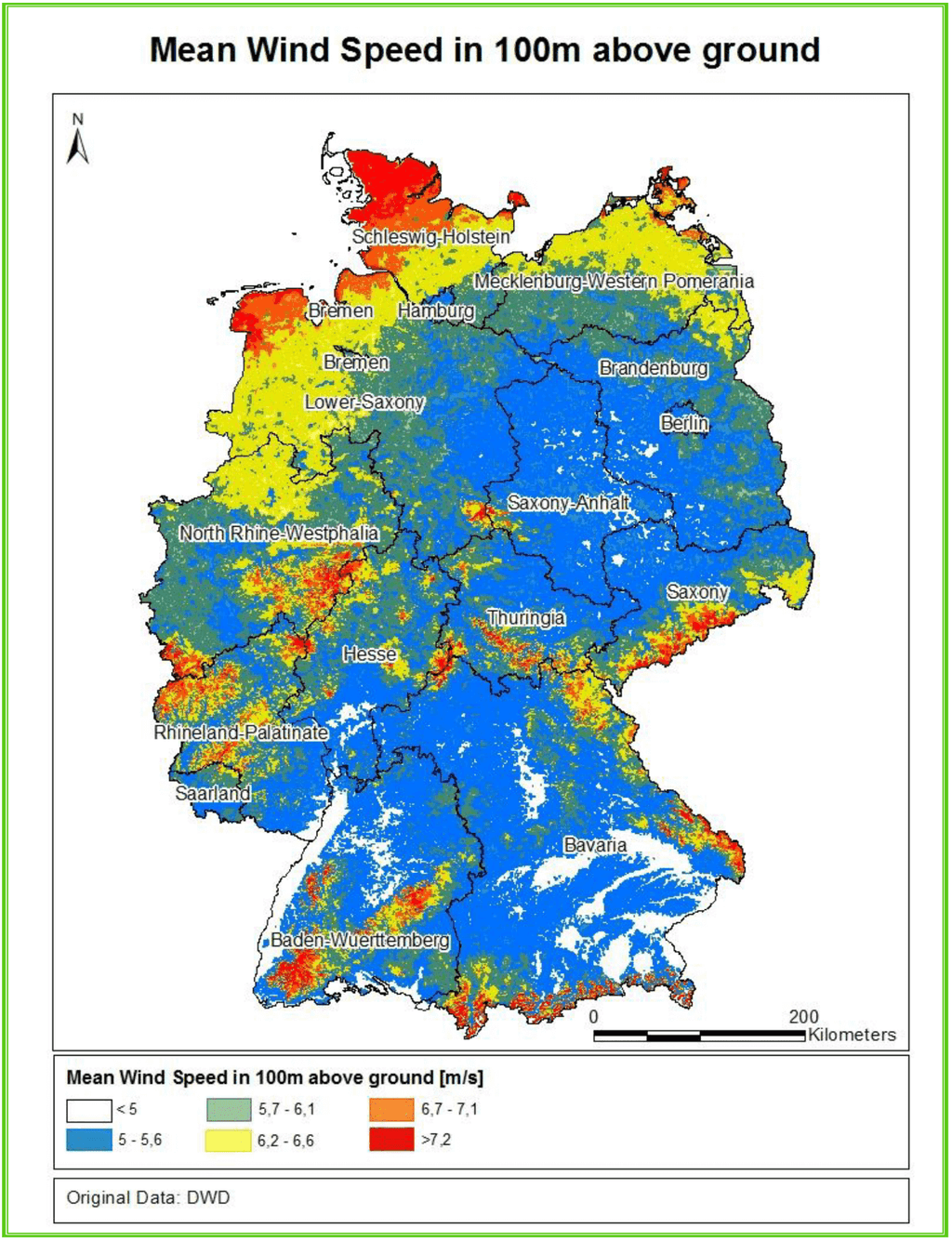
If we look at Germany's wind map, it is clear that our situation differs from that in northern Germany, where areas with average wind speeds above 6 m/s, and even exceeding 7 m/s, cover extensive continuous areas. Instead, our situation resembles that in Bavaria, which is a very good reference for how wind deployment in Czechia might develop under conditions of intensive support for this source.
Conditions similar to those in northern Germany prevail along the entire North Sea and Baltic Sea coast, as well as in some other European coastal areas. Conditions are substantially better, for example, on windy plains and mountain ridges in the US and China. This is one reason why China, the US, Germany and the UK are at the forefront of wind deployment.
The current state of wind power
After decades of Danish dominance, China, the US, Germany and the UK now have the largest installed capacities. In Europe, installed capacity reached 153.7 GW at the beginning of 2017, while 12.5 GW of new turbines were installed during 2016. Of this, 10.9 GW was installed onshore and 1.6 GW offshore. Let us look at several examples of countries with highly developed wind power generation.
China is becoming the largest producer of wind power and its installed wind turbine capacity is also growing the fastest. It installed 19.3 GW in 2016 and reached total capacity of 149 GW at the beginning of 2017. In 2016, it generated a total of 241 TWh of electricity. China has enormous wind potential; its extensive, windy and sparsely populated areas are ideal for building large wind farms. Its large hydropower capacity makes it possible to respond to fluctuations in wind output. The problem lies in interconnection and the power grid needed to transport electricity to distant industrial areas. Transport problems significantly reduce the annual capacity factor, which is now only slightly above 20%. China urgently needs to reduce pollutant emissions in cities, especially on its industrial eastern coast. It therefore intensively supports the construction of low-emission sources. After hydropower, wind together with nuclear power is the main component in greening China's electricity sector.
The United States was already building huge wind farms in passes between the Pacific coast and the interior in the 1980s and 1990s. At the end of 2016, installed capacity stood at around 82.2 GW, and wind turbines generated 226.5 TWh in 2016, or 5.55% of electricity generated in the US. Windy Texas, the second-largest and second-most populous US state, has the largest installed capacity. In 2016, more than 18 states had surpassed 1 GW of installed wind capacity. In 14 states, wind produces more than 10% of electricity. In Iowa, it was 36.6%. The average annual capacity factor in the US is around 32%. The largest wind farm is the Alta Wind Energy Center in California, with capacity of 1548 MW. Due to its natural conditions, the US has very high potential, particularly onshore but also in coastal waters, as does China off its densely populated eastern coast. The development of offshore wind farms in the US may be slowed by extensive opportunities to build cheaper onshore systems.
Denmark is an example of a country where wind generates the largest share of electricity. In the very windy year of 2015, it accounted for 42% of consumption (49% of Danish electricity generation), when Denmark generated 14.1 TWh from wind. Total installed capacity at the time was 5.1 GW. This represents an average annual capacity factor of 32%. It was one of the first countries to develop wind power. Denmark's advantage is that the entire country lies on the coast and a large part of it is a peninsula. It therefore has very stable and strong winds. It has very good onshore conditions, but even better conditions in coastal waters. The exhaustion of suitable onshore sites contributed to Denmark becoming a pioneer in the intensive development of wind turbines in coastal waters. In 1985, Denmark legally banned the development of nuclear power. Conditions for photovoltaic development are limited by its geographical location, as are opportunities to generate electricity from domestic biomass. Wind is therefore its only low-emission source with significant potential. Denmark thus intends to continue developing wind power. Two large offshore wind farms have been approved: Horns Rev 3, with capacity of 400 MW in the North Sea, and Kriegers Flak, with capacity of 600 MW in the Baltic Sea near the German border. The latter will also have a 400 MW interconnector with Germany via the German Baltik 2 wind farm, strengthening interconnection with Germany.
Denmark can benefit from electricity exchanges with its neighbours. Danish installed wind capacity therefore greatly exceeds its needs. In windy weather, Denmark exports large volumes of wind power, while during periods of low wind it imports large quantities of electricity. An advantage is Denmark's good interconnection with Scandinavia, which, thanks to its large hydropower capacity, partly acts as a large battery to balance deviations in wind generation, as well as with a number of other neighbours. However, it should be mentioned that Denmark still has a fairly substantial share of generation from fossil fuel combustion and imported wood biomass, currently exceeding 40% of generation. It also has a strongly fluctuating but relatively very high level of net electricity imports. A problem may be that periods with very good wind conditions generally bring a regional electricity surplus and low prices. The average unit price of exported wind power is therefore lower than the price of imported electricity. This situation is gradually worsening as Denmark's neighbours also increase their wind capacity. In future, this could become a major problem that would erase the effect of falling wind installation costs.
Denmark is one of the largest producers of wind turbines, and this sector is an important part of its exports. Vestas and Siemens have the largest share of manufacturing there, with Vestas having long been the world's largest wind turbine manufacturer. Investments made when Denmark was a wind power pioneer are now paying off handsomely for its economy.
One of the main instruments of the German Energiewende was support for connecting renewable sources to the grid, setting guaranteed electricity purchase prices, known as feed-in tariffs, and requiring their electricity to be purchased. This brought very rapid growth in wind power generation, particularly in the flat coastal north of Germany. By the end of 2016, installed capacity had reached 50.0 GW. Generation that year was somewhat lower than in the very windy year of 2015, but still reached nearly 78 TWh, representing 17.8% of total German electricity generation. This corresponds to an average annual capacity factor of roughly 18.2%. For offshore installations, the average annual capacity factor is close to 30%. Wind is the main low-emission source on which Germany's Energiewende is based. Wind turbine construction therefore receives very intensive support, which is gradually shifting to auction-based support. This helps reduce subsidised wind power prices. It is the only renewable source whose installed capacity and generation in Germany are still growing rapidly. In the first half of 2017, capacity increased by 3.2 GW. Installed wind capacity is thus approaching the level of average instantaneous electricity generation capacity required.
In the near future, this development may encounter two major problems. The first is a major shortage of transmission lines to transport electricity from the windy north to the industrial south. There is a large and growing surplus of wind capacity in the north, not only in Germany. In contrast, electricity is lacking in the south and cannot be transported there. This causes considerable instability. The second, related problem will affect turbines that lose support. It is set for 20 years. It began in 2000, including for turbines built before that date. In 2020, turbines with total capacity of roughly 4.5 GW will therefore lose support. By 2002, Germany already had nearly 12 GW of installed wind capacity. The same amount of capacity will thus lose generation support no later than 2022. Unless conditions change, these sources will have to compete in the electricity market, where prices are low, especially during ideal wind conditions. It is therefore possible that these sources will be shut down, and newly built capacity will then have to partly replace retired capacity.
For Czechia, the most interesting situation is in Bavaria, which is closest to us in terms of location, geography, high population density and industrial character. At the end of 2016, this German federal state had 2.2 GW of installed wind capacity and more than a thousand turbines in total. In 2016, 124 turbines with capacity of around 340 MW were installed. Bavaria has worse conditions for wind use than northern Germany. It also has a high population density and relatively strong public opposition to construction. This led to the adoption of the so-called 10H law, which does not allow turbines to be built within a distance equivalent to ten times their height from residential buildings without residents' consent. Such a rule rather radically limited potential construction sites unless residents' consent can be negotiated.
What about the Czech Republic?
The oldest wind power plant for which references have been found dates from 1910. In the 1930s and 1940s, small plants appeared here to serve buildings without access to the electricity grid. They gradually disappeared as electrification and the grid expanded. Later, too, they were very exceptional and small projects. The first plant with rated capacity above 10 kW appeared near Bánov, on the border between Moravia and Slovakia, in 1988. The Windane 12/35 unit with a two-blade rotor could reach 35 kW, but did not reach this output at that location due to wind conditions.
The oldest wind power plant currently operating in Czechia is a VESTAS V27 turbine with rated capacity of 225 kW, installed in 1994 on a secondary peak of Mount Hostýn next to the observation tower, at an altitude of 735 m. The average wind speed at the turbine's height at the site is 5.9 m/s. The plant reaches its rated output at a wind speed of 14.4 m/s. The minimum wind speed needed to start the plant is 3.5 m/s. The tower is 30 m high and the rotor diameter is 27 m. Annual electricity generation ranges from 300 to 400 MWh (a capacity factor of between 15 and 20%). It supplies electricity to the church complex on Svatý Hostýn, which is also heated using this energy.
It is the only wind power plant in the Zlín Region. The region is relatively small and considerably hilly, with fairly sharp forested peaks. This is not particularly suitable terrain for wind systems. Extensive windy plains or rounded bare hills are suitable. Another problem is that the most favourable conditions are in protected areas, while public attitudes towards construction relatively close to homes are negative.
The largest Czech wind park currently is the Kryštofovy Hamry Wind Farm on the ridge of the Ore Mountains, which makes use of a rounded bare mountain ridge. The complex, owned by German company Ecoenerg Windkraft GmbH, entered service in 2007 and at that time had 21 turbines with total capacity of 42 MW; four more machines were later added at the Dolina and Rusová sites. The farm is at an altitude of 800 to 850 m, where the average wind speed at the height of the turbines used is 7.2 to 7.5 m/s. The installed turbines have a nacelle height of 78 m, a rotor diameter of 82 m and a total plant height of 119 m. The cut-out wind speed is 28 to 34 m/s. Rated capacity is 2 MW.
Most large wind power plants in Czechia use units with rated capacity of around 2 MW. The largest turbines are used by the Pchery wind power plant, which entered operation in 2008. It has two WinWinD WWD3 units with capacity of 3 MW, a rotor-axis height of 88 m and a rotor diameter of 100 m.
Total installed wind capacity in Czechia is close to 300 MW (2014 – 283 MW), while annual generation reached 0.5 TWh, roughly 0.6% of electricity generation and 0.7% of domestic consumption. In 2015, wind generation in Czechia exceeded this figure for the first time thanks to the very windy course of the year in this part of Europe. The capacity factor of Czech wind sources is therefore around 20%. It is evident that the relative contribution of wind power generation in Czechia is very small. A study by the Institute of Atmospheric Physics of the Czech Academy of Sciences, which will be discussed in more detail, identifies further potential for wind development. However, it is quite limited. A significant part of it is also on the ridges of border mountains in protected areas.
The example of Bavaria also points to limited opportunities. It has very similar geographical and other conditions for this type of source, and is part of Germany's Energiewende, which creates very strong pressure to build renewable sources. Yet wind turbine generation there reaches around 4% of total electricity demand. It is true that there has been strong public opposition to construction of large turbines near settlements. However, it cannot be expected that Czech residents would take a more favourable view of wind development.
Another limiting factor for wind energy use in Czechia is the high installed capacity of these sources in neighbouring Germany. When wind conditions are good here, the situation in Germany is usually very similar. Large wind power surpluses are then generated there, which also affect the Czech market, making electricity market prices very low at such times. Czech installations can hardly compete with farms built on the windy seacoast of northern Germany. This problem will have to be addressed for any Czech wind installations supplying electricity to the grid. Only decentralised installations close to consumption, meeting local demand, will remain advantageous; for example, together with a source using local waste biomass, they can complement each other to create an almost islanded system.
The reasons mentioned, chiefly opposition from residents and local authorities, as well as the abolition of subsidies in wind power prices, have caused construction of new installations to practically stop and total capacity to stabilise in recent years at the aforementioned roughly 280 MW. One possible sign of change is the Václavovice farm near Hrádek nad Nisou, which was nearing completion and was due to be finished in October 2017. It will have 13 turbines with total capacity of 26 MW, and installed capacity in the Czech Republic should exceed 300 MW.
As it is the newest installed turbine system in Czechia, it is interesting to look at its parameters. Expected average annual generation is 52 GWh, which at 26 MW of capacity implies an average annual capacity factor of 22.8%. This is a figure that corresponds very well to realistic domestic possibilities. Investment costs are reported at CZK 1.1 billion. Expected lifetime is 20 years. Based on investment costs alone, the cost per MWh is therefore CZK 1058.
Although the number of installed facilities in Czechia will most likely remain limited in future, it is very important for Czech companies to operate and find applications in this sector. Fortunately, several of them can bring their products to markets in Germany and the Nordic countries. These include Wikov, which makes gearboxes for wind power plants. CEBES a.s. is also a significant subcontractor. Towers and frames for large wind power plants are made by SIAG CZ s.r.o. in Chrudim, the Czech subsidiary of German company SIAG. Small wind power plants are also made by AERPLAST s.r.o., which focuses on hybrid and islanded systems. These are just examples of several successful businesses.
Technical and feasible wind potential in Czechia
A highly detailed study of wind potential was prepared by experts from the Institute of Atmospheric Physics of the Czech Academy of Sciences. In their 2007 study, they estimated Czech technical wind potential at 29 GW and 71 TWh. It is based on the wind map shown in the figure. It should be noted that, according to their statement in a 2012 update of the study, this map slightly overestimates wind speeds, especially in the Bohemian-Moravian Highlands area. The areas with the greatest wind potential are the Bohemian-Moravian Highlands, the Nízký Jeseník and the Ore Mountains. Even after accounting for corrections resulting from turbine technological development and the stated correction of the map, the estimate of technical potential in the 2012 update remained roughly the same: total capacity decreased slightly, but expected annual generation remained unchanged.
It should be recalled that technical potential indicates the maximum possible development of wind power using current technical capabilities in full and respecting valid legislative restrictions. Full use is, however, largely unrealistic, and feasible potential must therefore be determined. This determination is not exact; the result may fall within a fairly broad range and is very strongly affected by estimates of future social and economic conditions in the sector.
Highly expert estimates of realistic domestic wind potential were made by the same authors in a 2008 analysis and updated in the already mentioned 2012 study. They assessed three scenarios. The low scenario assumes unfavourable conditions in the sector. In this case, realistic wind potential was 991 MW of installed capacity and annual electricity generation of 2.4 TWh. The annual capacity factor was estimated at 27.6%. The medium scenario assumes public and state support for wind energy, with no fundamental obstacles placed in the way of installing wind sources. In this realistic scenario, capacity reached 2.5 GW and annual generation 5.6 TWh. The high scenario assumes very strong support and demand for these sources. In this case, the authors obtained 6.0 GW of capacity and annual generation of 14.7 TWh. In the update, the authors focused on the medium scenario, which they considered the most likely. Their updated figures were 2.3 GW of capacity and annual generation of 5.9 TWh. This represents a wind turbine annual capacity factor of 29.3%. It should be recalled that the average capacity factor of current wind sources in Czechia is around 20%. It is clear that larger turbine models and further technological progress will push it higher, while the need to use less favourable sites will work in the opposite direction. The question is therefore whether the estimated capacity factor is too optimistic.
In 2015, the Chamber of Renewable Energy Sources prepared its own interpretation of the described studies, with the participation of their lead author. It derives two scenarios from them. The first, called conservative, corresponds to the medium scenario in the study but with some reduction factors lowered. It arrives at installed capacity of 3.1 GW and annual electricity generation of 9.8 TWh. The second, optimistic scenario corresponds to the high scenario in the study by Institute of Atmospheric Physics of the Czech Academy of Sciences researchers, with higher annual generation. It has installed capacity of 5.8 GW and annual generation of 18.29 TWh.
If we take the scenarios in the current update of the State Energy Policy, the green scenario assumes annual generation of 4.5 TWh in 2050, while the selected scenario assumes 2.3 TWh. The green scenario thus approaches the medium scenario in the studies described, and the selected scenario the low one.
The 2007 and 2012 studies also included estimates of wind power development in subsequent years. If we compare them with the actual course described in the previous section, it must be said that even those considered pessimistic by the authors ultimately proved too optimistic. In 2017, installed capacity is at 0.3 GW and annual generation at around 0.5 TWh.
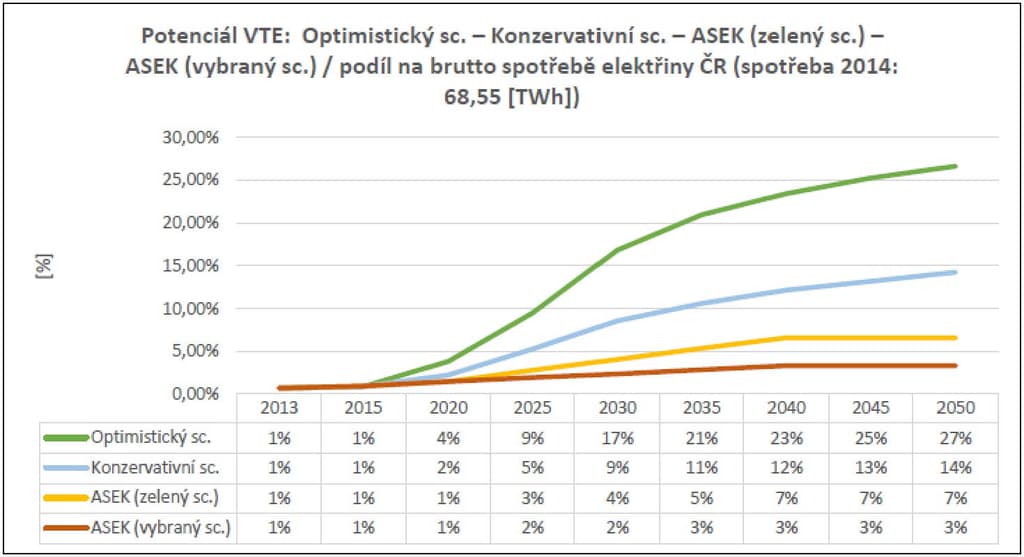
Is it possible for wind conditions to change positively so that at least the medium scenario in the study can be achieved? The fundamental problem lies in the fact emphasised in the study: “The fundamental reason for building wind power plants is the revenue from selling generated electricity to the power grid. This revenue depends both on the wind conditions at the site and the technology used, and on the sale (purchase) price per unit of electricity generated.” Current unsubsidised prices for electricity supplied to the grid are much lower than those needed to pay for investment in a wind turbine. Turbine prices may fall and their efficiency may rise, but this is unlikely to be particularly dramatic for inland systems. Especially given that generation costs fall as turbine size increases. However, the larger the installation, the more likely it is to be unwelcome to residents in the landscape.
At the same time, the economic conditions for Czech wind sources will deteriorate further as installed capacity in Germany grows. More and more often, precisely at times most suitable for wind generation, wholesale electricity prices will be very low or even negative. Without a guaranteed price exceeding the market electricity price, and payment even when electricity from the source is not needed, Czech wind power plants cannot compete with those on Germany's seacoast. No cost reduction or turbine improvement will change this, because such improvements will also take place in turbines used in northern Germany. Most likely, the medium scenario among the analyses presented is now the most optimistic feasible one. Locations with suitable conditions near electricity consumers, where the advantages of decentralisation and proximity between source and consumer can be used, are very limited for wind in Czechia and most likely insufficient even to fulfil the low scenario.
While we cannot influence the economic conditions for Czech wind sources created by our economically powerful neighbour, it is possible to reduce the bureaucratic obstacles hindering wind development. A reasonable system should also be created to support effective projects in this field under distorted electricity market conditions. The wider public must also be informed about both the benefits and problems of wind use in order to create a rational view of the issue. It would certainly be a shame not to use the potential that exists in this area. The current State Energy Policy takes this into account, and it would be good for something finally to be done in practice in this area.
Acknowledgements: I thank my colleague David Hanslian for a very stimulating discussion and comments on the article.
Note: This article is the first in a series that will examine the possibilities of individual energy sources in Czechia, with the aim of initiating a discussion on the future development of the Czech electricity sector, its pitfalls and opportunities. This is particularly important because several years have passed since the last update of the energy policy and, in practice, not much has been done in the Czech energy sector. At the same time, a number of risks are emerging, so it is very important to gain an overview of energy developments and the state of the sector worldwide and in Czechia.
The article was originally published on the OSEL.CZ website.
Works examining wind potential in Czechia:
[1] Hanslian D., Hošek J., Chládová Z., Pop L., Svoboda J., Štekl J. (2007): Determination of the technical potential of wind energy in the territory of the Czech Republic. Research report. Institute of Atmospheric Physics of the Czech Academy of Sciences, Prague, 78 pp. + appendices.
[2] Hanslian, D., Hošek, J., & Štekl, J. (2008). Estimate of feasible wind energy potential in the territory of the Czech Republic. Institute of Atmospheric Physics of the Czech Academy of Sciences, Prague, 32 pp.
[3] Hanslian, D., & Hošek, J. (2012): Updated estimate of feasible wind energy potential from the perspective of 2012. Institute of Atmospheric Physics of the Czech Academy of Sciences, Prague, 23 pp.
[4] Štěpán CHALUPA and David HANSLIAN. Analysis of wind power in the Czech Republic. Chamber of Renewable Energy Sources, March 2015.
Recommended reading:
A very good series of articles on wind energy by Břetislav Koča on the TZB website.
David Vobořil: Wind power plants – principle, classification, plants in the Czech Republic
Website of the Czech Wind Energy Association
Translation disclaimer
This article is a machine translation of the Czech original and has not yet been fully reviewed. In case of any doubt, please refer to the Czech version.
Sdílejte článek prostřednictvím:
You might also like
23 October 2026, 11:01

23 October 2026, 06:34