
23 October 2026, 14:38
Loading...
New North Sea project will investigate interactions between offshore wind farms

Eduard Majling
11 June 2025, 16:46
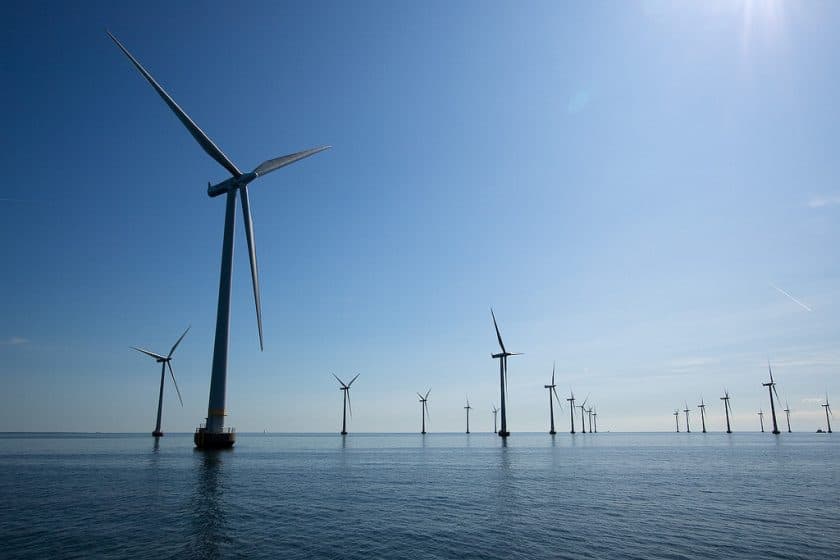
Building wind farms relatively close to one another has long raised questions about their potential negative impact on each other’s overall output. This uncertainty can have a significant effect on the economics of operating individual farms, as actual generation may fall short of initial estimates. An international project involving institutions from three European countries will run for three years.
The North Sea offers significant potential for wind farm construction, with these farms expected to become one of the pillars of the energy sector’s transformation. However, farms with total installed capacity reaching hundreds of GW could cast wakes over one another, meaning turbines downwind of other farms could theoretically generate less electricity.
The EuroWindWakes project aims to investigate this phenomenon in greater depth. It brings together institutions from Germany, the Netherlands and Denmark. Detailed research into interactions between wind farms is particularly critical in light of an initiative by nine European countries to build wind farms with an installed capacity of 260 GW in the North Sea.
"All three participating countries have already conducted extensive research into wakes on a smaller scale. The EuroWindWakes project reduces uncertainty in assessing wake effects at the scale of the North Sea, enabling optimal placement of installations in areas such as maritime spatial planning," Dr Bernhard Stoevesandt, the project coordinator at Fraunhofer IWES, told Renewables Now.
The three-year project is coordinated by the Fraunhofer Institute for Wind Energy Systems (Fraunhofer IWES). This research initiative began to take shape last year, with the consortium’s first meeting held in February this year. Current models for calculating the impact of wake effects are subject to considerable uncertainty, according to Renewables Now. This can result in uncertainty of 20 to 30%. The EuroWindWakes research project aims to reduce this uncertainty to as little as 10%.
"Predictions of the wake effects that neighbouring wind farms have on the energy yield of an offshore wind farm vary significantly depending on the model used. This variation creates considerable uncertainty in the financial planning of offshore wind farms," said Anja Schoennebeck, the project’s national coordinator at Dutch company Pondera Consult.
Translation disclaimer
This article is a machine translation of the Czech original and has not yet been fully reviewed. In case of any doubt, please refer to the Czech version.
Sdílejte článek prostřednictvím:
You might also like


23 October 2026, 11:01


23 October 2026, 06:34