23 October 2026, 14:38
Loading...
Wind turbines yesterday, today and tomorrow (part 1)
Vladimír Wagner
11 December 2017, 20:24
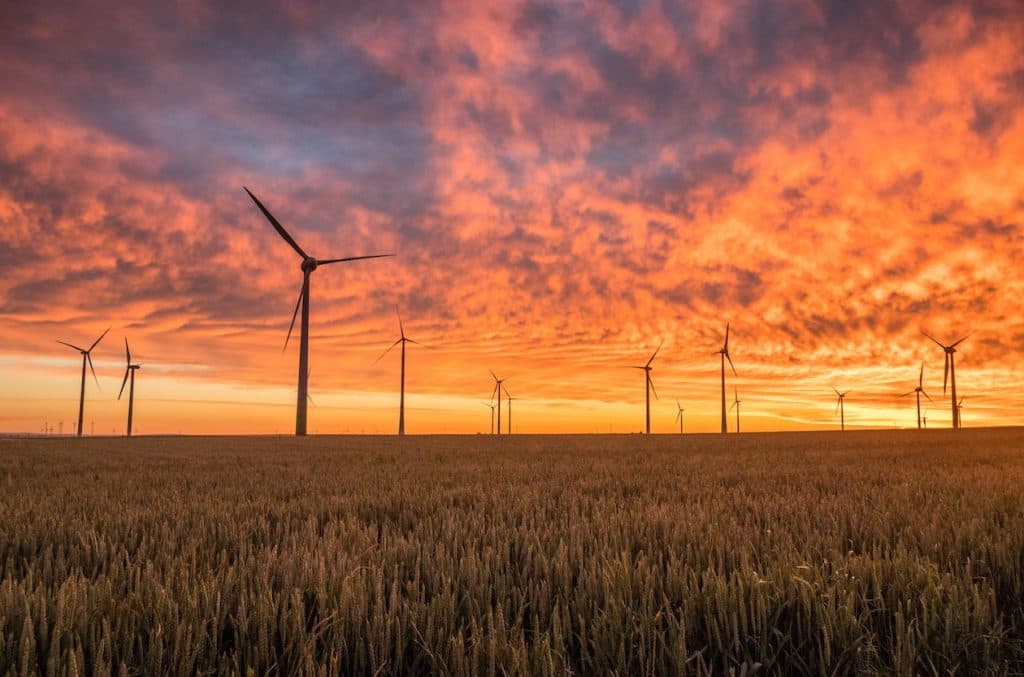
Wind turbines have become the source of electricity with the fastest growth in both installed capacity and power generation. Let us look at the present and future of wind energy use and its potential worldwide and in Czechia.
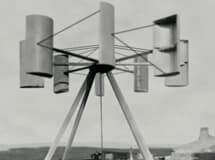
Human civilisation has been harnessing wind energy since time immemorial. In recent decades, wind turbines have become the second most widely used renewable energy source after hydropower. The first wind turbine for generating electricity was built in 1887 by Professor James Blyth in Scotland. His ten-metre-high device charged batteries used to light his cottage. At roughly the same time, Charles F. Brush also built a wind turbine in Cleveland, Ohio. It was a classic multi-bladed “American” wind wheel. During the winter of 1887–1888, he installed a turbine with a rotor diameter of 17 m, mounted on an 18 m-high tower. It consisted of 144 radially arranged blades made of cedar wood. The unit’s 12 kW output at 500 revolutions per minute was used either to charge a battery system or for lighting and powering various equipment in Brush’s laboratory.
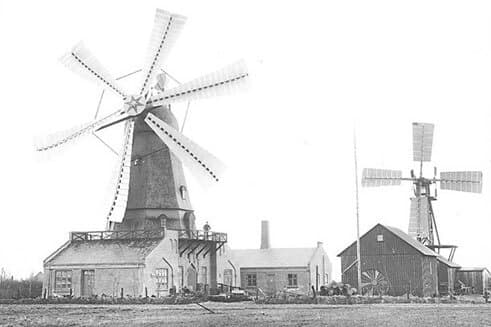
Three years later, in 1891, Poul la Cour, an inventor and teacher in the Danish town of Askov, installed his wind turbine. It more closely resembled a traditional mill, with fewer blades. He measured and studied the system’s efficiency and characteristics with different numbers of blades and under different conditions. He even addressed energy storage using an electrolyser and hydrogen production, using the hydrogen in lamps of his own design.
Over the following period, different types of wind turbines were gradually developed alongside the expansion of electrification and the electricity grid, meeting different needs. Denmark was at the forefront of this development, where Poul la Cour had many followers. A turning point in development and wider deployment can be dated to the 1940s. At that time, two- and three-bladed turbines competed with each other. Turbine capacities were mostly between 50 and 70 kW. However, as early as 1941, a unique 1,000 kW turbine was built in Vermont, USA.
On the one hand, these were smaller models which, using a battery or in combination with another electricity source, could supply isolated off-grid locations. On the other, increasingly large models supplied electricity to the expanding grid. Today, turbines range from very small capacities to several megawatts.
The main turning point in the intensity of their deployment came as a result of the oil crisis in the 1970s and the gradual shift towards modern lightweight but highly durable materials. Progress in this field significantly improved the efficiency and economics of these units. Truly rapid development then took place in the 1980s and especially the 1990s. Very large wind farms also began to be built. They were constructed not only on land but also in coastal waters, at ever greater depths. While this increases installation costs and, due to corrosion from seawater, maintenance costs, it also delivers a much better capacity factor.
Even at the beginning of the 1990s, the aggregate capacity of wind turbines was very small; it only reached 6.1 GW in 1996, but by the end of 2015 it had reached 432.4 GW. A total of 54.8 GW was installed in 2016, bringing global installed capacity to 486.7 GW at the beginning of 2017.
At the start of the 21st century, wind power became the technology with the fastest-growing installed capacity. Its enormous advantage is the wide range of possible capacities. It can be used as a decentralised local source, but also as a large centralised source that can nevertheless be built incrementally, turbine by turbine, reducing investment risk.
Characteristics of wind turbines
With the exception of very small units, modern wind turbines are generally horizontal-axis machines and usually have three rotor blades. A wind power plant thus consists of a steel tubular tower, which may include a lower reinforced-concrete section. At its top is a nacelle mounted to rotate, containing the rotor shaft and bearing and the nacelle and blade control system. Large wind turbines currently being manufactured have pitch control, allowing continuous blade adjustment by changing the angle of attack. This makes it possible to respond to changing wind conditions and required turbine operating parameters.
Rotational speed is usually between 10 and 22 revolutions per minute, and tip speed can reach up to 320 km/h. The three-bladed design is the structural optimum for larger turbines. With more blades, the weight of the nacelle carrying a multi-bladed rotor would be too high. Wind pressure acting on the blades of a multi-bladed rotor would also be very high, requiring the tubular tower to be designed to much greater strength. In addition to greater loading, the equipment would also be noisier. Multi-bladed rotors are therefore used only on very small machines.
Lightweight and durable materials are used for rotor blades, including fibreglass, epoxy resins and various composite materials. Turbine size is determined by its intended use. These may include:
- micro power plants with capacity of up to 2 kW and a rotor diameter of up to 2 m. These are typically used to supply power to, or charge batteries at, remote facilities or as a supplementary energy source for smaller buildings, and can be installed, for example, on buildings or masts primarily serving other purposes,
- small wind power plants with capacity of up to 50 kW and a rotor diameter of up to 15 m. They are useful as a local energy source, for example for remote locations without grid connection, typically combined with other sources and/or a battery. Given their dimensions, they are generally installed on a standalone mast, and only exceptionally on buildings,
- medium-sized wind power plants with capacity of up to 300 kW and a rotor diameter of approximately up to 35 m. Their use is relatively limited, for example as a supplementary source for supplying remote locations such as smaller islands and similar areas,
- large wind power plants with capacity above 300 kW. These currently form the overwhelmingly dominant segment of the wind power industry and serve as energy sources within large electricity grids.
The efficiency of turbine operation is limited by Betz’s law, which, based on fundamental physical principles, states that a wind turbine can ideally capture 59.3 % of wind energy. Real-world, even state-of-the-art turbines have various additional losses, and current equipment can achieve between 70 and 80 % of the Betz limit.
A turbine rotor usually starts turning at wind speeds above 2 to 5 m/s (7 to 18 km/h). Output then rises with wind speed, initially very rapidly. At wind speeds of roughly 10 to 14 m/s (36 to 50 km/h), output reaches its maximum and no longer increases. At wind speeds of 20 to 25 m/s (75 to 90 km/h), the turbine is usually shut down and positioned to minimise the risk of damage. Even so, it can only withstand strong winds up to a certain limit, which for individual types ranges from 40 to 72 m/s (144 to 259 km/h).
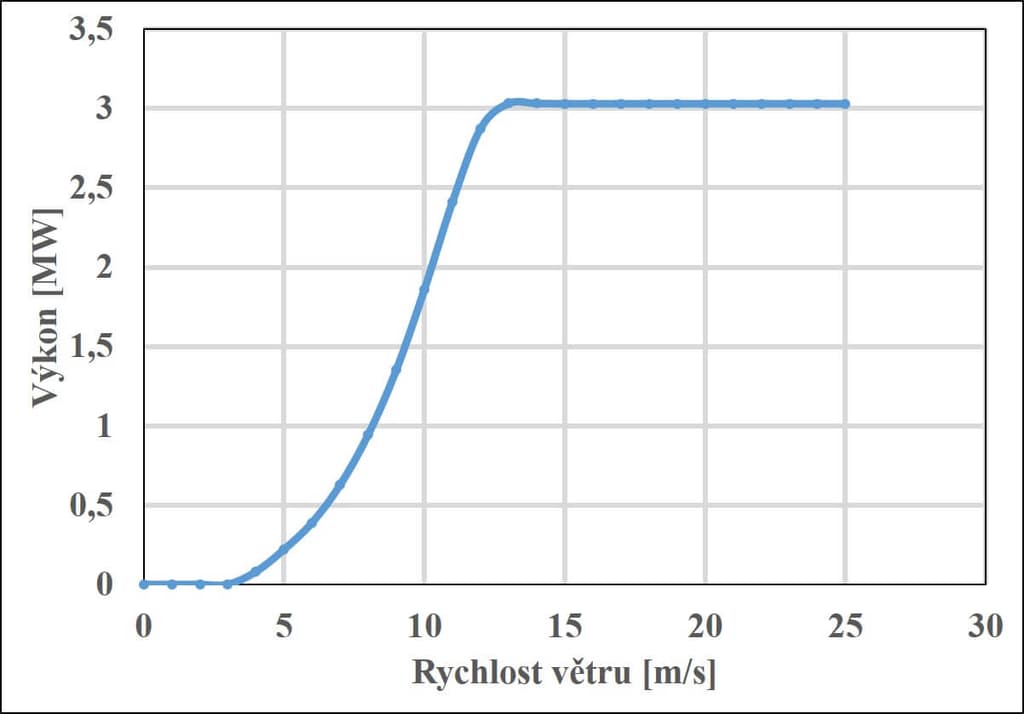
Blade geometry is gradually being optimised to achieve maximum efficiency and reduce noise. Modern turbines incorporate software optimisation of their control and operating settings. Lasers are beginning to be used to measure wind parameters several hundred metres ahead of the nacelle, with the measurements used to optimise nacelle and blade settings.
The capacity factor, which indicates the extent to which installed capacity is used during the year, ranges from 15 to 50 %, but depends very strongly on geographical conditions. Conditions tend to be very good on open plains, seacoasts or rounded bare mountain ridges. Turbines installed at sea generally perform even better.
Optimal geographical conditions are therefore found in specific locations. If wind energy is to be used to the greatest possible extent, as many wind turbines as possible must be built in these areas. They are then supplemented by turbines in less favourable wind conditions but close to demand centres. Large wind farms containing dozens, hundreds and perhaps thousands of turbines in the future are therefore now being built. Spacing in wind parks fully covering an area should be between six and ten times rotor diameter. For truly large farms, the economically optimal spacing is said to be up to 15 rotor diameters. Conversely, at smaller wind farms, especially where available land is limited, turbine spacing is smaller, typically five rotor diameters. Where turbines are placed in a row perpendicular to the prevailing wind, optimal spacing is often only around three rotor diameters.
Especially at offshore wind farms, the optimal export of output from all turbines must be addressed. In this case, individual turbines are generally connected by cables to a transformer substation, which is also located at sea as part of the farm. There, the lower voltage produced by wind turbines, for example 34.5 kV, is converted to higher values, generally between 132 kV and 400 kV, suitable for transmission over longer distances; direct current is often used for this purpose at farms far from the coast. Electricity is then brought ashore by submarine cables. Special platforms or even artificial islands are built for these purposes. They can be connected by several lines to different locations and, as needed, supply electricity alternately to different areas.
Ever larger turbines
Increasingly large turbines are now being commissioned for large onshore and offshore farms. Between 2014 and 2017, Innogy installed twelve new Enercon wind turbines at its Zuidwester wind farm in the Netherlands, which are the largest onshore units. They replaced old turbines that had generated electricity there since the early 1980s. Each has a capacity of 7.5 MW and a height of 200 m. The nacelle is at a height of 135 m, carrying a 220-tonne generator and rotor blades with a diameter of 127 m. For onshore installations, plant size is often limited by permits or difficulties in transporting extremely large components, particularly to less accessible locations where neither sea nor river transport can be used.
Nevertheless, the trend towards larger wind power plants is still evident on land. Especially in less windy or forested areas, substantially greater efficiency can be achieved by increasing turbine height. In Germany, for example, the typical height of power plants planned for the coming years is therefore between 200 and 250 m, with rotor diameters between 120 and 160 m. Their capacity is not increasing as markedly, with typical values around 3 to 4 MW. This makes it possible to achieve capacity factors of around 30 % even in relatively low-wind areas.
Turbines at offshore wind farms have even greater capacities. Until now, typical projects used turbines with a capacity of 3.6 MW and a height of 145 m. The current largest is the 8 MW Vestas V164-8.0 MW turbine, with an overall height of 195 m. A number of companies are working on even larger units, mainly for offshore farms. They expect offshore projects to use 13 to 15 MW turbines in the near future. According to the results of the five-year European UpWind research project, which examined aspects related to developing extremely large wind turbines, a capacity of up to 20 MW is technically achievable with a rotor diameter of around 250 m.
A model with two rotors on a common shaft could further improve the efficiency of large wind turbines. One rotor is placed conventionally at the front of the nacelle, while the other is at the rear. The rotors rotate in the same direction and are offset by 30˚, the angle enabling the highest possible utilisation of wind at the rear as well. Airgenesis is developing a prototype of such a power plant. It aims to have a prototype 11 MW turbine by 2020.
Onshore wind farms
The first wind farm was Crotched Mountain in the south of the US state of New Hampshire. It operated from 1980 to 2008. Its total capacity was 0.6 MW and it consisted of 20 turbines, 18 m high and with a capacity of 30 kW each.
Over less than four decades, a large number of wind farms with increasing numbers of ever more powerful turbines have been built in suitable locations. Although they occupy extensive areas, up to hundreds of square kilometres, the land between them can be used for agriculture. Site selection is very important: for onshore farms, terrain profile and vegetation cover affect the amount of available wind energy.
Currently, the largest onshore farms are in China, India and the USA. The largest of all is China’s Gansu farm, with current capacity of 6,800 MW, which was expected to reach 20,000 MW in 2020. The next in the ranking are also Chinese. Zhang Jiakou wind farm has capacity of 3,000 MW, Urat Zhongqi (Bayannur City) has 2,100 MW, Hami has 2,000 MW and Damao Qi (Baotou City) has 1,600 MW. Another five wind farms have capacity of 1,000 MW or more. One of these is in the USA, another in India and the remaining three in China. This overview alone shows that China currently dominates large wind installations. It should be noted, however, that this raises the issue of how a single farm is defined. Particularly in China, it is often more a matter of an entire regional system with several connected farms.
The problem, which is especially dramatic in China, is that suitable wind conditions are often found far from populated and industrial areas. Building transmission lines between farms and population and industrial centres is therefore important. A large share of wind-generated electricity is currently curtailed because existing transmission capacity is insufficient.
Offshore wind farms
The possibilities for developing coastal onshore wind farms may be limited, so an increasing number are being built in water offshore. Offshore farms in shallow coastal waters benefit from better wind conditions. Their annual capacity factor is therefore generally higher than that of onshore systems, with typical values ranging between 30 and 45 %. Construction is also not limited by the need to reduce impacts on nearby settlements. There are no residents nearby to protest against turbines. Development is thus not hindered by the NIMBY principle (Not In My Back Yard). One constraint, however, may be interference with navigation and shipping operations.
Another advantage is that the very large components of large turbines can be transported by water. Their transport on land is often highly problematic. The disadvantage is the need to effectively protect both the turbines themselves and the components used to transmit electricity to shore from aggressive salt water. Estimates of offshore wind farm lifetimes range from 20 to 40 years. Experience to date from the oldest facilities built in the 1990s suggests that the higher end of that range—30 years or more—can be expected.
Denmark led the construction of onshore wind turbines and soon began to experience a shortage of suitable vacant sites. The first offshore farm, Vindeby, was therefore built near the Danish coast off the island of Lolland and began supplying electricity to the grid in 1991. Eleven 450 kW turbines were installed on foundations already fully assembled. Its total capacity was 5 MW. They demonstrated that offshore turbines produce roughly 20 % more electricity than identical machines on land. At the beginning of 2017, after more than a quarter of a century of operation, this wind farm ceased operations as continued operation proved uneconomic. It generated a total of 243 GWh of electricity, corresponding to a capacity factor of roughly 22 %.
The first decommissioning of an offshore farm began at the start of 2016. Vattenfall then began dismantling the Yttre Stengrund power plant in the Baltic Sea off Sweden’s south-eastern coast. The five 2 MW NEG Micon NM 72/2000 wind turbines had total capacity of 10 MW. They began supplying electricity in 2001, and after 15 years a decision was made to close the facility. The reasons were both economic and technical. The wind turbine type was one of the oldest, and only 50 units were manufactured in total. Difficulty sourcing spare parts and the high cost of potential upgrades led to its closure. In this case, Vattenfall tested methods for dismantling offshore turbines. This involved complete removal, including the concrete foundations and the connecting cables.
Offshore wind farms are being intensively built along Europe’s Baltic and North Sea coasts. The UK and Germany have the largest installed capacities of offshore wind turbines. The largest wind farm is London Array in the UK, with 175 Siemens SWT-3.6-120 turbines and total capacity of 630 MW. It has supplied electricity since 2012. Second is Gemini Wind Farm in the Netherlands, with total capacity of 600 MW, comprising 150 Siemens SWT-4.0 turbines and commissioned in 2017. Third is Gode Wind in Germany, with total capacity of 582 MW and 97 Siemens SWT-6.0-154 turbines. It also entered operation in 2017.
Other farms with total capacity above 500 MW include the UK’s Gwynt y Môr, with 160 SWT-3.6-107 turbines and total capacity of 576 MW, commissioned in 2015. The UK also has Greater Gabbard, with capacity of 504 MW, 140 turbines of the same type and commissioning in 2012. In future, all of these were expected to be surpassed by DONG Energy’s offshore Hornsea Project ONE, built off the Yorkshire coast in water depths of 20 to 40 m. It was expected to have 174 7 MW turbines and total nominal capacity of up to 1.2 GW. However, intensive offshore wind development has also begun in China.
A number of companies have started specialising in offshore installations. These include companies with experience in subsea extraction, which therefore have equipment and personnel suited to offshore work. In turbines for this purpose, Siemens, Vestas, Senvion and Adwen—a joint venture between AREVA and Gamesa for offshore installations—dominate.
Entirely new concepts
Floating turbines are a further extension of the possibilities for offshore wind turbine construction. The first such installation was a Siemens plant with capacity of 2.3 MW, a rotor diameter of 82 m and a nacelle height of 65 m above sea level. It was built in the North Sea between Stavanger, Norway, and Aberdeen, Scotland, in 2009, and achieved an annual capacity factor of 36 % in its first full year of operation. Water depth at the site is 220 m.
In 2017, Norwegian oil company Statoil began building the first floating wind farm, Hywind, in this area off the coast of Peterhead in Aberdeenshire, Scotland. While the optimal depth for fixed-bottom wind turbines is between 20 and 50 metres, floating turbines can also be installed in waters 100 to 700 metres deep. Even greater depths are also being considered.
The project comprises five 6 MW turbines, occupying an area of 4 km2 and located 25 km from the Peterhead coast. Average wind speed in this part of the North Sea is around 10 m/s. The pilot project will test the potential of such installations, which significantly expand the areas where wind turbines can be built. As suitable sites on land and in shallow coastal waters are gradually filled, interest in these technologies is expected to grow.
Non-standard and, for now, exotic installations are also planned for land. One particularly interesting future option could be airborne wind turbines raised to heights above 600 m, where winds are more stable and stronger. Wind power density there could be several times higher than even at the tallest land-based turbines.
Real projects began to be considered in the 1980s, and several prototype machines have been tested so far. However, most testing has taken place only on the ground, with airborne trials limited to technology demonstrations. One possible system initially uses the rotor as a propeller to reach high altitudes, after which it is switched off and begins operating as a wind turbine. Balloons or a kite- or parachute-like system can also be used for lifting. The generated electricity is transmitted to the ground via a tethering cable. Potential risks to air traffic and the consequences of a crash could be significant problems. These systems are therefore more likely to be deployed at sea.
Perhaps the furthest advanced so far is Boston-based Altaeros Energies, which focuses on developing airborne platforms for telecommunications, remote sensing, research into atmospheric development and wind power generation. In 2012, it used a helium-filled balloon to lift a standard Skystream turbine with a 3.7 m rotor and capacity of 2.5 kW.
A number of companies are intensively involved in development in this field, including well-known companies Google and E.ON. It forms part of their renewable energy activities. Their current aim is to complete and test a fully functional prototype.
The article will continue in the second part…
Acknowledgements: I would like to thank my colleague David Hanslian for a highly stimulating discussion and comments on the article.
Note: This article is the first in a series that will examine the potential of individual energy sources in Czechia, with the aim of initiating discussion about the future development of the Czech power sector, its challenges and its opportunities. This is particularly relevant given that several years have passed since the last update of the energy strategy and little has actually been done in the energy sector here. At the same time, a number of risks are emerging, so it is very important to gain an overview of energy developments and the state of the sector globally and in Czechia.
The article was originally published on the OSEL.CZ website
Studies examining wind potential in Czechia:
[1] Hanslian D., Hošek J., Chládová Z., Pop L., Svoboda J., Štekl J. (2007): Determination of the technical potential of wind energy in the territory of the Czech Republic. Research report. Institute of Atmospheric Physics of the Czech Academy of Sciences, Prague, 78 pp. + appendices.
[2] Hanslian, D., Hošek, J., & Štekl, J. (2008). Estimate of the deployable potential of wind energy in the territory of the Czech Republic. Institute of Atmospheric Physics of the Czech Academy of Sciences, Prague, 32 pp.
[3] Hanslian, D., & Hošek, J. (2012): Updated estimate of the deployable potential of wind energy from the perspective of 2012. Institute of Atmospheric Physics of the Czech Academy of Sciences, Prague, 23 pp.
[4] Štěpán CHALUPA and David HANSLIAN. Analysis of wind power in the Czech Republic. Chamber of Renewable Energy Sources, March 2015.
Recommended reading:
A very good series of articles on wind energy by Břetislav Koča on the TZB website.
David Vobořil: Wind power plants – principle, classification, power plants in the Czech Republic
Website of the Czech Wind Energy Association
Translation disclaimer
This article is a machine translation of the Czech original and has not yet been fully reviewed. In case of any doubt, please refer to the Czech version.
Sdílejte článek prostřednictvím:
You might also like
23 October 2026, 11:01

23 October 2026, 06:34