23 October 2026, 14:38
Loading...
Emissions allowances traded below EUR 15/t as COVID-19 forces sales of freely allocated allowances

Martin Voříšek
24 March 2020, 16:50
The price of emissions allowances fell below EUR 15/t CO2 during Monday. The benchmark contract for delivery in December this year last traded at these levels in mid-2018. The current situation and the ongoing allocation of free allowances likely also contributed to the decline.
The current situation on equity and commodity markets has already significantly affected emissions allowance prices. While they had long resisted pressure from negative sentiment and were still trading steadily above EUR 24/t CO2 on 10 March this year, they have fallen by more than a third of their value over the past two weeks.
On Monday alone, the price of the main benchmark contract fell by more than 7 % during the day. The reasons for the decline are primarily linked to expectations of weaker economic performance and the associated lower industrial output and energy consumption. Given that measures to contain the spread of COVID-19 are already beginning to have a significant impact on electricity consumption, it was only a matter of time before allowances joined shares in falling.
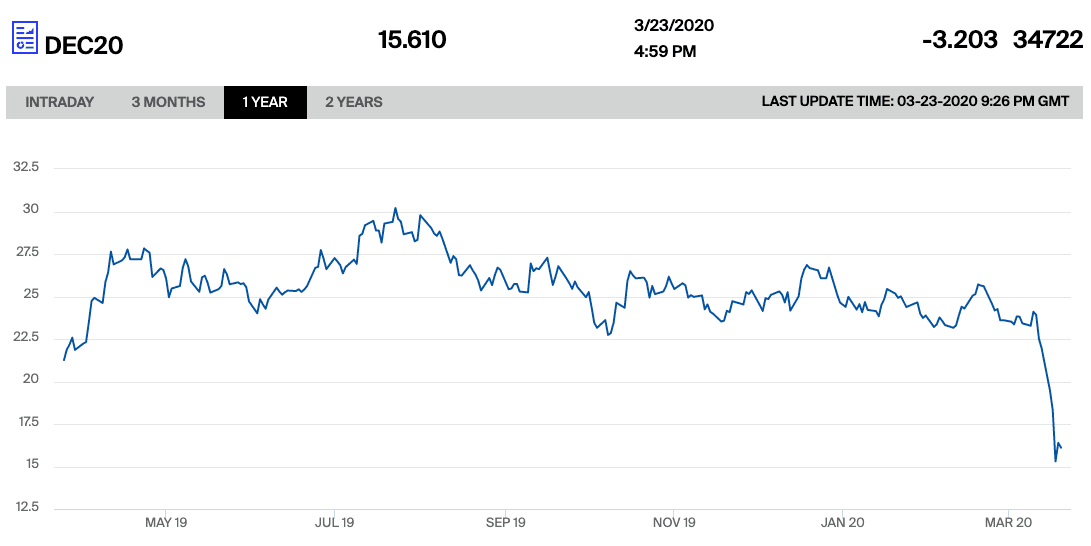
Emissions allowance price development over the past year (Dec 2020 contract).
However, another negative factor may be behind the current price decline: member states have already distributed approximately 3/4 of the planned annual allocation of free allowances for selected industrial sectors. Both Germany and France have allocated more than 84 % of emissions allowances free of charge. By contrast, Finland and Spain have not yet distributed any emissions allowances.
Sales of freely allocated allowances put pressure on prices
Some emissions allowance traders cited by foreign online portal Montelnews.com say that some allowance recipients have taken advantage of this situation. In the current difficult circumstances, when some businesses may be experiencing problems with current cash flows, these companies have decided to sell part of their free allowances on the market, thereby obtaining funds but also creating further pressure on the market price of allowances.
This situation could lead to a paradoxical scenario: if the same companies have to cover part of their needs at the end of the year, their price could rise again towards year-end. Given that the December contract is the most traded contract, these companies may buy additional allowances at the end of the year and, conversely, push the allowance price to higher levels.
This year should also be notable because operators of installations for which allowances are allocated free of charge will not be able to use the 2021 free allocation to cover their 2020 emissions. Retrospective use of the free allocation is normally possible because allowances are allocated free of charge as early as February, while allowances for the previous year are surrendered only towards the end of April. However, this approach of using allowances from the current period for the previous period (also known as borrowing) is not possible during the transition between trading phases (the fourth phase begins on 1 January 2021).
Translation disclaimer
This article is a machine translation of the Czech original and has not yet been fully reviewed. In case of any doubt, please refer to the Czech version.
Sdílejte článek prostřednictvím:
You might also like
23 October 2026, 11:01
23 October 2026, 06:34