The Strait of Hormuz: The world's most important chokepoint amid fighting in the Middle East


Fighting between Israel and Hamas has been ongoing for more than a month. A conflict of this scale in the Middle East has a significant impact on global affairs, and further escalation and the involvement of other actors, such as Iran, cannot be ruled out. From an energy and geopolitical perspective, attention is focused on the Strait of Hormuz, through which one fifth of the world's oil consumption passes every day and whose northern side falls under Iranian sovereignty. Any disruption to stability at this strategic geographic location would certainly be felt across the rest of the world in the form of a massive rise in oil prices.
The Strait of Hormuz is described as the world's most important chokepoint. It is a narrow passage separating the Persian Gulf and the Gulf of Oman, just 33 kilometres wide at its narrowest point. The world's largest oil tankers pass through it every day, carrying more than 20 million barrels daily—around a third of all oil transported by sea and a fifth of global supplies.
As for natural gas, more than 80 million metric tons a year are transported along this route in liquefied form, representing around a quarter of the global total. The strait thus connects Middle Eastern producer countries with key markets in Asia, Europe and North America, with Asia now the dominant destination. Last but not least, there is no alternative route capable of handling volumes on this scale.
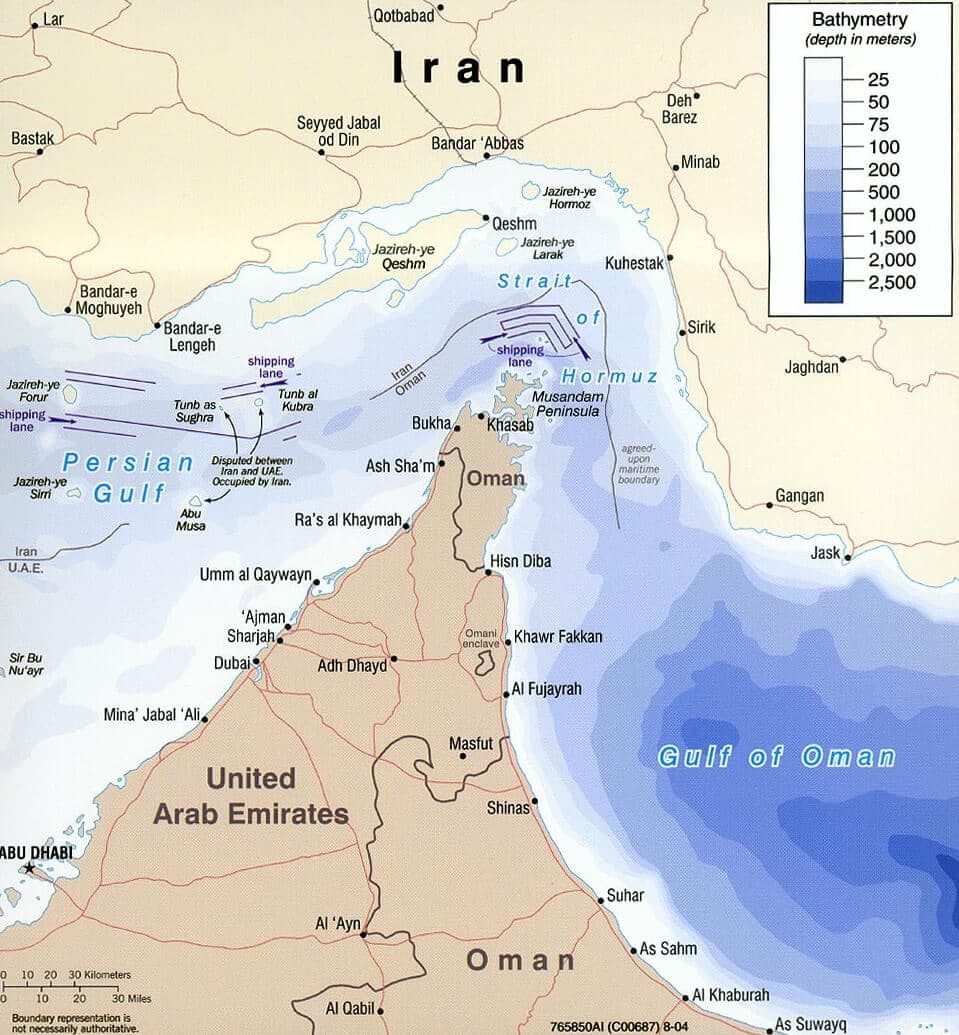
It is therefore clear that disrupting traffic or even closing the strait could be a powerful geopolitical lever, especially for Iran. A faint historical parallel can perhaps be drawn with the 1973 oil shock, which significantly crippled the world and came, more or less, as a “reward” for supporting Israel. The Organization of the Petroleum Exporting Countries (OPEC) then imposed an oil export embargo on Canada, Japan, the Netherlands, the United Kingdom and the United States.
Bank of America warns that if stability in the strait were disrupted, oil prices would climb above $250 per barrel. However, according to the latest reports and experts, such a scenario is unlikely. One commentator told CNBC: “Times are completely different today than they were 50 years ago, because you have these Middle Eastern countries (Saudi Arabia, Iran, Iraq and Kuwait) that simply need the revenue from [oil].”
Although nothing currently points to such a scenario, it is very difficult to predict how the conflict will develop and to what extent Iran will be drawn into it. If that happens, the United States could also be expected to step up its involvement by tightening sanctions on Tehran, which could lead to instability in the strait. After all, it would not be the first time that passing tankers have been at least in danger.
Iranian forces have threatened shipping in the area several times in the past. Rather than reflecting a genuine intention to close the strait, these actions have always been demonstrations intended to convince the rest of the world that Iran has the credible operational capabilities to carry out its threat in the event of a conflict. An actual closure would have immense economic consequences for everyone, including Iran itself. Nevertheless, Tehran will retain this threat as a tool of strategic deterrence, drawing on its unique geography and the global sensitivity to any shock in the international energy commodities market.
Translation disclaimer
This article is a machine translation of the Czech original and has not yet been fully reviewed. In case of any doubt, please refer to the Czech version.




