10 September 2026, 15:21
Loading...
Czech Energy Congress – second session: energy transition
Daniel Grecman
25 April 2024, 14:26
The second session of the Energy Congress drew the audience’s interest, focusing on the ongoing energy transition. Pavel Řežábek, chief economist at ČEZ, spoke about the European Green Deal and its impact on electricity prices. He subsequently also discussed the economics of coal-fired power plants and the prerequisites for ensuring secure, affordable and sustainable electricity.
The assumptions were highly ambitious for the current Czech environment, and some conference participants were surprised for the second time. Other speakers included Svatopluk Vnouček of ČEPS, who presented its outlook for changes in the generation mix and the impact on ancillary services (SVR), and Pavel Zámyslický of the Ministry of the Environment (MŽP), with updates from the emissions allowance market.
Pavel Řežábek (ČEZ)
At the very beginning of his presentation, Pavel Řežábek said that the Green Deal (also known as the European Green Deal) had reduced electricity prices for Europeans. He illustrated his claim using 2024, stating that prices were/are around EUR 30/MWh lower thanks to renewable energy sources (RES). ČEZ put/puts the price without the Green Deal at EUR 110/MWh. However, new RES reduce the price by EUR 45-65/MWh, while energy savings contribute a further EUR 5-10/MWh reduction. Conversely, the cost of emissions allowances increases the electricity price by EUR 35-45/MWh. The result should be a price of EUR 90/MWh, i.e. savings of EUR 30/MWh. It should be noted that this claim is based on a number of assumptions and that the price includes the impact of Russia’s invasion of Ukraine.
The next part of the presentation addressed the operation of coal-fired power plants. According to ČEZ’s chief economist, this is expected to cease being economically viable in the foreseeable future – probably from 2027. However, a distinction needs to be made between heat plants and power plants. Heat plants can be expected to operate slightly longer – by one or two years. Peak demand in Czechia stands at 12 GW, while dispatchable capacity is around 18 GW. The task for Czechia in the coming years will be to continue ensuring that dispatchable capacity is sufficient to cover peak demand.
However, the situation is particularly critical in the heating sector – the systems are inherently local in nature and, according to Tomáš Hüner of Siemens, a participant in the subsequent panel discussion, Czechia has fallen badly behind. Neighbouring countries are also addressing the transition and, for example, the manufacturing capacity of turbine suppliers (for potential new gas-fired power plants) is limited; there are waiting times and further available slots are quickly disappearing. Once operating heat plants ceases to be economically viable, companies will, by the very nature of business, have no interest in continuing to operate them.
District heating (CZT) is therefore under threat, although many saw it as a competitive advantage for Czechia. Among other things, heat plants currently contribute significantly to power system security – they are important providers of ancillary services for ČEPS. In any case, ČEZ sees the lignite spread reaching EUR 0/MWh as early as 2027; for 2025, it is still at EUR 22/MWh. This spread must cover the operating costs of a power plant/heat plant.
ČEZ further sees a need to develop solar PV to around 15 GW by 2030 and wind power to 3 GW in order to ensure affordable and sustainable energy. These are very high figures, even compared with the ambitious plans in the State Energy Policy (SEK). In the case of wind power, state documents refer to capacity of around 1.5-1.7 GW. Naturally, this would also require building storage or new gas-fired power plants. The discussion of the combination of nuclear and photovoltaic power plant operation under these assumed values was also interesting.
According to Řežábek, the flexibility of nuclear power plants needs to be increased in view of the development of RES. For example, France expects to limit the output of nuclear sources during the summer months. However, Řežábek said that the impact on economics is negative. René Neděla added that hydrogen production could help the situation – although this remains an uncertain prospect.
Svatopluk Vnouček (ČEPS)
The market is changing completely, and the ancillary services market will not escape this. An important amendment is known as LEX RES III. Lower-voltage sources and the demand side – for example heat pumps or electric vehicles – also need to be involved in flexibility and aggregation. From ČEPS’s perspective, the RES development figures cited by Pavel Řežábek are too high, and ČEPS is working with lower figures.
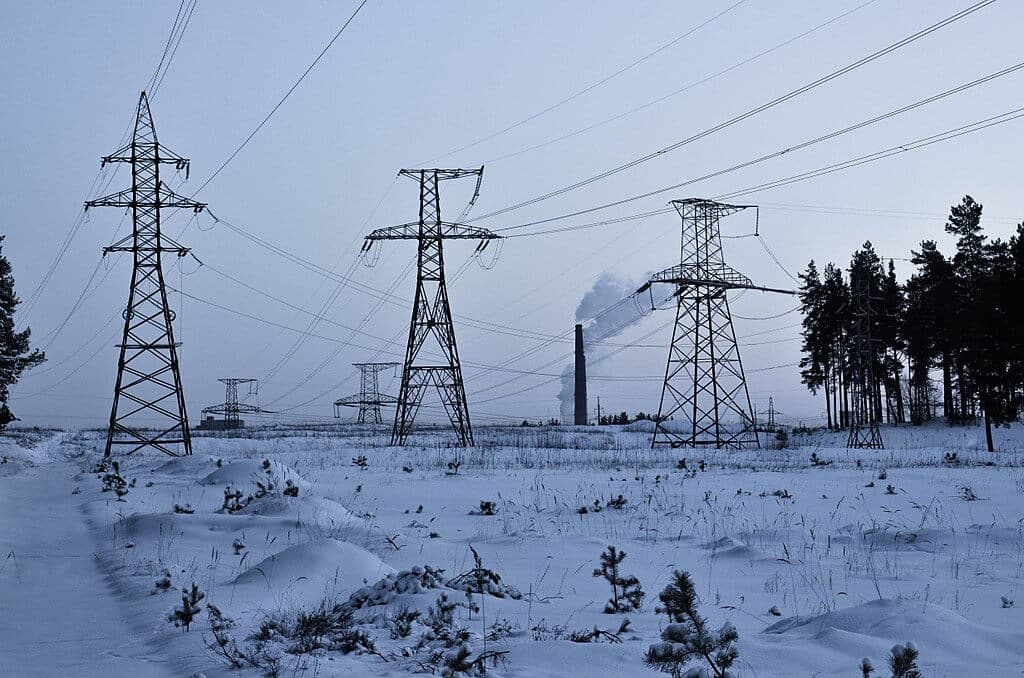
Power lines in a snow-covered landscape. Source: Vadik_01 / Creative Commons / CC BY 2.0
Distribution and transmission system operators will be forced to invest around CZK 39.6 billion annually in the power system over the next 10 years as a result of RES development. Current average annual investment stands at CZK 28.7 billion. Higher demands are being placed on distribution and transmission systems, and their management must become “more intelligent”. This refers, for example, to the installation of smart meters. The power system must also be significantly reinforced in order to connect more RES and make use of their generation.
Pavel Zámyslický (MŽP)
The revision of the emissions trading system has three important aspects – maintaining competitiveness, reducing emissions and preventing negative social impacts.
However, the introduction of the second EU ETS 2 system will essentially amount to taxing fossil fuels and will cover the transport and buildings sectors. Fuel suppliers will pay this “tax”. Naturally, they will pass it on into prices. Revenues from emissions allowances will be used to finance the energy transition and compensate low-income households for the impacts. However, revenues, or rather projected revenues, change depending on the highly volatile price of emissions allowances.
Translation disclaimer
This article is a machine translation of the Czech original and has not yet been fully reviewed. In case of any doubt, please refer to the Czech version.
Sdílejte článek prostřednictvím:
You might also like
10 September 2026, 10:37

9 September 2026, 15:05
9 September 2026, 13:24