22 September 2026, 14:20
Loading...
Czechia remains a net electricity exporter to Germany for the fifth consecutive month

Eduard Majling
17 August 2023, 11:49
In recent months, more electricity has flowed on average from Czechia to neighbouring Germany than has flowed into the Czech grid. According to Argus, net exports to Germany even rose sharply during the first half of August, reaching this year’s high. Since the start of the month, the largest volumes of electricity have flowed from Czechia to Germany during the evening and night hours, while in the afternoon, strong generation from solar power plants means that flows in the opposite direction prevail.
On the Czech-German border profile, westward flows have prevailed in recent months. While in winter, more electricity flowed on average from Germany to Czechia, the situation has been reversed since April. According to Argus, the main reason is the seasonal decline in generation from wind and coal-fired power plants, as a result of which Germany imports electricity mainly outside peak demand periods, i.e. between 8 pm and 8 am.
While during the first quarter, around 200 MW flowed on average from Germany into the Czech transmission system, over the rest of the first half of the year and during July, net electricity flows reversed to average net exports of 29 to 179 MW towards Germany. Since the beginning of August, flows to Germany have strengthened considerably, with net exports to Germany averaging around 800 MW during the first half of the month.
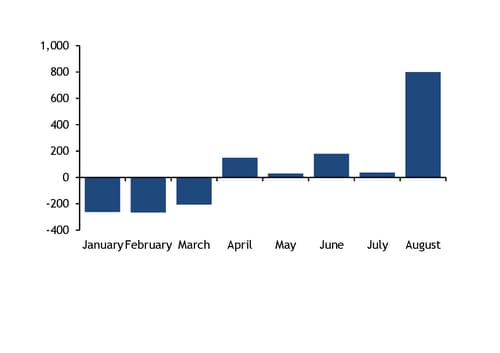
Average monthly net electricity exports from Czechia to Germany in 2023 in MW (data for the first half of August). Source: Argus
Since the beginning of the year, wind power generation in Germany has traditionally declined, while photovoltaic generation has strengthened. While German wind farms supplied an average of 23.4 GW in January according to Argus data, generation in June, at an average of 8.6 GW, was roughly a third of that level. In July, however, generation rose above the seasonal norm again to an average of 13.5 GW thanks to above-average windy weather. Solar power generation gradually declined from an average of 12.3 GW in June to 10.2 GW in July and, so far, 8.6 GW in August.
Generation from both hard coal- and lignite-fired power plants in Germany has also declined in recent months. These plants face high prices for emissions allowances and, during the summer, competition from strong photovoltaic generation in both the domestic and foreign markets. According to Argus, German coal-fired sources supplied an average of 10 GW in June, followed by 8.2 GW in July and only 7 GW so far during the first half of August.
Translation disclaimer
This article is a machine translation of the Czech original and has not yet been fully reviewed. In case of any doubt, please refer to the Czech version.
Sdílejte článek prostřednictvím:
You might also like
22 September 2026, 12:50
22 September 2026, 06:09
21 September 2026, 15:25