25 September 2026, 09:51
Loading...
Czechia: Scandinavia opposes changes to EU ETS 2: will 2026 be a battle over ETS?
Vojtěch Kříž
24 February 2026, 14:46

Sweden, Finland, Denmark and Luxembourg issued a joint statement this week arguing against delaying or making further changes to the EU ETS 2 system. This came a day before a meeting of envoys who were due to discuss the system’s further development. The countries in question primarily argue for the need for a stable investment environment.
The four countries argue that the system, which the EU plans to launch in 2028, should remain unchanged so that companies and households can decide what investments to make. Their statement runs counter to the position of sixteen EU countries, including Czechia, which want to reform the system. These countries issued a similar document last year, before the agreement to delay the system’s introduction by one year from its originally planned 2027 start. It proposed ways of adjusting the system, from increasing the number of allowances and bringing forward the first auctions to extending the operation of the market stability reserve mechanism.
Meanwhile, voices from the domestic political scene, including the governing coalition, are calling for the entire system to be scrapped. Countries such as Hungary would probably also welcome such a move. Other countries want to modify the system because they fear carbon prices will rise to economically devastating levels. Germany, for example, still supports the system’s introduction. However, it would be the most affected of all countries, as it has the highest emissions covered by the system. The question is therefore whether the government led by Friedrich Merz, which has already signalled a willingness to change the system, will adopt a more hardline stance.
Further debate over EU ETS 2 “undermines the system’s credibility and increases uncertainty for investment decisions by companies and households”, according to Reutersin the document circulated by the four countries among other European governments.
Concerns over the impact of EU ETS 2
EU ETS 2 is designed as a tool to support the transition to electric mobility and cleaner heating methods. Like the original EU ETS, it puts a price on CO2 emissions. Member states should invest revenues from allowances in supporting electric mobility and building energy efficiency, particularly in socially disadvantaged regions and among low-income households.
In the first phase, the price is to be capped at 45 euros per tonne of CO2. However, following the initial period, the price could reach around 99 euros per tonne of CO2 in 2030 and as much as 122 euros per tonne of CO2. This could have a significant impact on transport costs. For example, an analysis by Deloittesuggests that in Czechia it would probably increase the price of petrol by around 4 koruna per litre and diesel by 4.58 koruna per litre, costing the average Czech household roughly 3,390 koruna more per year for transport.
Is ETS 1 also on the table?
In recent months, the original EU ETS system, which has been in operation for more than twenty years, has also come under pressure. The European Commissionplans to review it this year. Some governments are likely to see this review as an opportunity to indirectly modify ETS 2 as well, since both systems are to operate under the same legislative framework, albeit with separate markets.
According to Politico, a European taboo was broken in the first half of February: despite long-standing pressure on climate legislation, the EU ETS had until now been largely spared major political criticism. That changed last week. “The carbon price is driving value chains out of Europe,” said Markus Kamieth, CEO of BASF, at a conference in Antwerp. While some politicians defended the system, others joined the criticism, including Chancellor Merz, who later walked back some of his remarks.
Several EU countries also recently described the carbon price as problematic, contributing to market jitters and a drop in allowance prices of around nine euros.
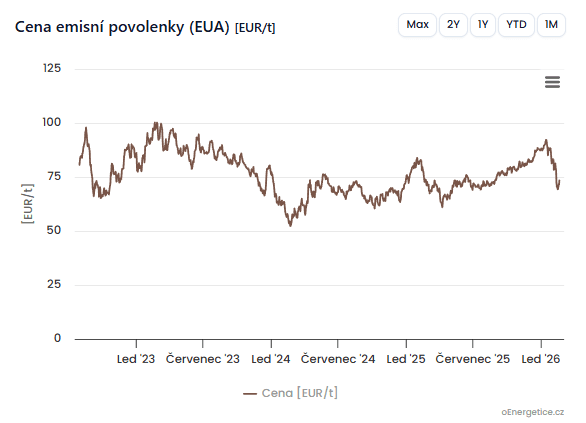
Price development of the contract for delivery of emission allowances in December 2026. Source: Energostat
Although the EU ETS system is often viewed negatively in Czechia, some consider it an important tool. Emissions from sectors covered by the system fell by around 50% over two decades, compared with approximately 20% in sectors outside the ETS. The carbon price in the EU ETS 1 system remains relatively stable.
The problem, however, is that further decarbonisation will be more challenging than the emissions reductions achieved so far. Even the stabilised carbon price is already too high for some countries. In Germany, for example, the significant share of fossil fuels in the energy mix means that the price of emission allowances feeds through into energy prices and the prices of other commodities, frustrating households and weakening industrial competitiveness.
It is no surprise that countries such as Sweden and Finland, whose energy mixes are largely low-emission and this is also reflected in their industries, are among supporters of maintaining both the ETS 1 and ETS 2 systems. Sweden has even extended it. The asymmetry in dependence on fossil fuels is thus bringing the EU to a crossroads.
The year 2026 could be a turning point. Either the system will be strengthened and confirm its role as the main instrument for achieving the 2030–2050 targets, or it will be significantly weakened for the first time in its twenty-year history.
Translation disclaimer
This article is a machine translation of the Czech original and has not yet been fully reviewed. In case of any doubt, please refer to the Czech version.
Sdílejte článek prostřednictvím:
You might also like
24 September 2026, 11:23

24 September 2026, 10:30
24 September 2026, 06:56