
2 October 2026, 21:55
Loading...
From batteries to market: FNA identifies 12 steps without which part of Czech flexibility will remain only on paper

Jakub Malý
15 August 2026, 07:17
The first part showed, that if the ERAA 2025 reference scenario materialises, FNA CZ 2026 does not identify a need to develop flexibility beyond this scenario. For 2035, the model assumes, among other things, 2 031 MW of battery storage, 4 754 MW of gas-fired generation and 190 MW of demand-side response. The second part of the issue is less visible but equally important: how to ensure that the technical potential of flexibility is genuinely available to the market and for power system operation.
The assessment of renewable integration itself provides some indication of the importance of this issue. ČEPS monitors whether planned generation from renewable energy sources (RES) can actually be used, or whether part of it will need to be curtailed. This is one of the four main FNA indicators, alongside residual load, rapid changes in output and short-term flexibility.
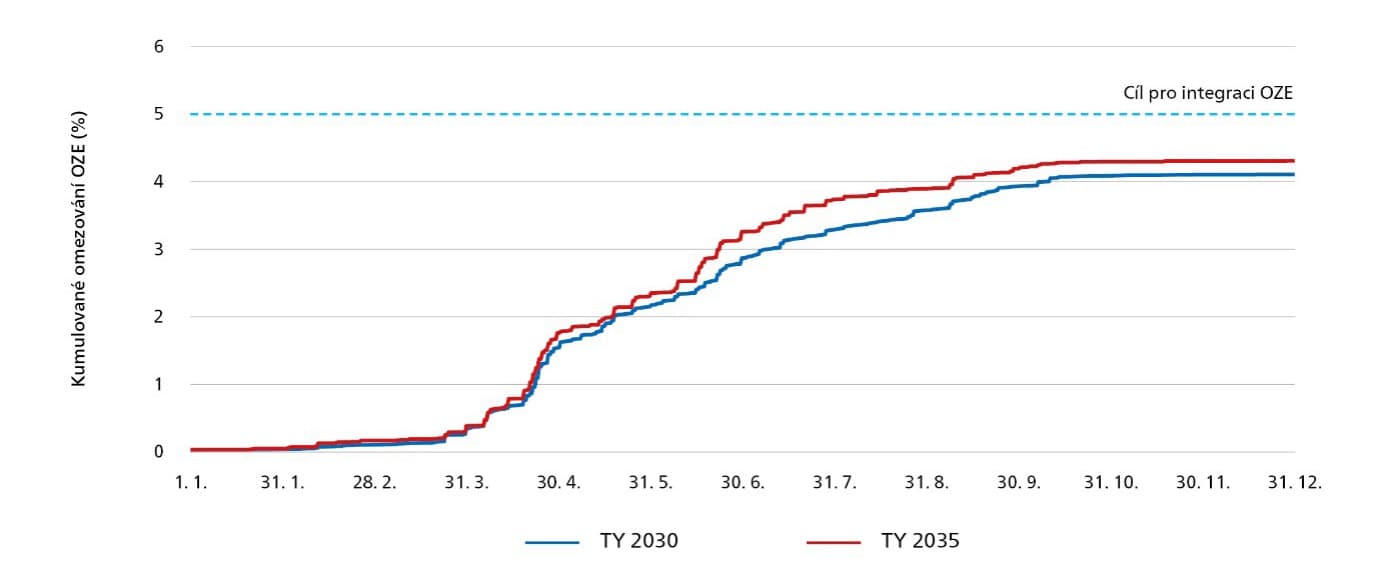
Cumulative curtailment of renewable generation in 2030 and 2035. The dashed line represents the 5% RES integration target. Source: ČEPS
The chart shows cumulative generation curtailment of approximately 4.1% in 2030 and 4.3% in 2035. Both values remain below the 5% target used in the FNA. The gap to this level is approximately 0.9 percentage points in 2030 and 0.7 percentage points in 2035. This is not a power system security margin, but the difference relative to the methodological target for RES integration. ČEPS also explicitly states that further flexibility development may be useful: it can further reduce the amount of unused generation or create conditions for higher RES deployment than assumed in the modelled scenario.
This points to an important distinction between installed capacity and available flexibility. Even a battery with a certain rated capacity may not be able to provide that capacity at all times. This depends, for example, on its state of charge and energy capacity, as well as on the technical and commercial conditions governing its use.
For decentralised assets, the issue of aggregation also arises. The Energy Regulatory Office defines aggregation as the pooling of flexibility from generators, customers or electricity storage operators in order to offer it on the market or manage imbalance. Aggregation is what makes it possible to combine a number of individually small flexible assets into a commercially usable portfolio.
Four areas in which the FNA looks for barriers
The FNA divides potential barriers into the following areas:
- Legislation and regulation – in particular, setting rules that allow individual participants and new forms of flexibility to operate in the market.
- Technical constraints – for example, issues relating to metering, data infrastructure or cybersecurity.
- Economic conditions – meaning the environment that affects the economic incentive to provide and use flexibility.
- Customer behaviour and innovation – the ability to involve consumers and create new products and ways of using flexibility.
ČEPS proposes a total of 12 measures for these areas. Four are expected to be implemented within one year, four within one to three years, and four over more than three years.
The shortest-term measures include completing the reform of the tariff structure at extra-high- and high-voltage levels (EHV and HV), designing measures responding to risks identified in the ČSRES cybersecurity study, assessing options for shortening procedures for the construction of energy infrastructure, and increasing customer awareness of flexibility options.
The tariff structure can significantly affect customers' economic incentive to change their consumption profile. At low voltage, however, the FNA places completion of the reformed tariff structure among measures requiring more than three years. This raises the question of whether price signals for smaller customers will develop as quickly as the technologies enabling flexible consumption itself.
EDC has already been established, but its functionalities are still expanding
Over the medium-term horizon of one to three years, the FNA calls for a more flexible methodology for assessing electricity sharing, a possible update to the metering decree, full implementation of the functionalities of the Electricity Data Centre (EDC), and preparation of a concept for the Czech approach to innovation in flexibility.
Here, the FNA should be supplemented with current developments. The EDC is no longer a future project. Since 1 August 2026, it has expanded its services to include functionalities related to storage and technical flexibility. From 1 September 2026, the Czech market is expected to allow independent aggregators to operate, while the inclusion of commercial flexibility in the EDC's target solution is envisaged from 1 December 2027.
The data layer will be crucial for decentralised flexibility. With the growing number of batteries, generation facilities and active metering points, it is necessary to record and assess which assets provide flexibility and how their activation was carried out. The EDC itself describes its development as the creation of a data environment for market operation, grid management and new energy services.
A further issue is the coordination of individual ways of using flexibility
Among its long-term measures, the FNA includes implementation of the legislative package around the Network Code on Demand Response (NC DR) and the introduction of flexibility markets based on actual need and in a coordinated manner. At the European level, NC DR is intended to establish common rules for the participation of demand-side response, aggregation and other flexible resources in the market and balancing services.
Coordination will be particularly important for assets that can be used in several ways. At different times, battery storage can respond to prices in the short-term market or, if it meets the relevant conditions, provide balancing services. If local flexibility markets are also developed further, use for distribution grid needs may be added. However, it cannot be assumed that the same available capacity can be independently used for several services at the same time. This is precisely why the FNA stresses the coordinated introduction of these markets.
Cybersecurity is also a significant issue. Through aggregation, a large number of smaller assets can become a single coordinated flexibility portfolio, which, alongside operational benefits, also concentrates some control and data risks. The FNA therefore classifies addressing the risks identified by the ČSRES study among measures to be implemented within one year.
The FNA thus shows that the question of flexibility cannot be reduced to building battery storage. The reference scenario for 2035 includes 11 065 MW of photovoltaics, 2 475 MW of wind power, 2 031 MW of batteries and 4 754 MW of gas-fired generation, but the ability to operate this system efficiently will also depend on market rules, metering, data infrastructure and the coordination of individual ways of using flexibility. The key question will therefore not only be the number of installed megawatts, but the share of this capacity that will actually be available and usable at a given time.
Translation disclaimer
This article is a machine translation of the Czech original and has not yet been fully reviewed. In case of any doubt, please refer to the Czech version.
Sdílejte článek prostřednictvím:
You might also like

2 October 2026, 15:14
2 October 2026, 10:06
2 October 2026, 06:14