28 October 2026, 15:10
Loading...
EU electricity markets saw an “explosion” in negative electricity prices in 2023

Jan Budín
5 April 2024, 09:34
2023 was a record year for the occurrence of negative electricity prices in individual markets across European Union countries. A total of 6 470 were recorded, according to an analysis by the European Union Agency for the Cooperation of Energy Regulators (ACER), more than three times the previous record set in 2020.
The occurrence of negative electricity prices, which point to insufficient flexibility in the system or in the facilities connected to it, grew at an unprecedented rate last year. The number increased almost twelvefold year on year and was more than three times higher than in the previous record year of 2020.
According to ACER, last year saw the highest number of hours with negative prices on record in 27 of the EU’s 50 bidding zones. In most Nordic bidding zones, there were more than 380 such hours.
“Negative electricity prices are a consequence of the growing share of renewable energy sources and call for continued market integration and access to flexibility resources, such as demand response,” ACER said.
The agency added that other factors may also have contributed to the sharp increase in negative prices, and that it will examine the issue more closely in forthcoming reports on cross-border capacity (June) and market integration (October).
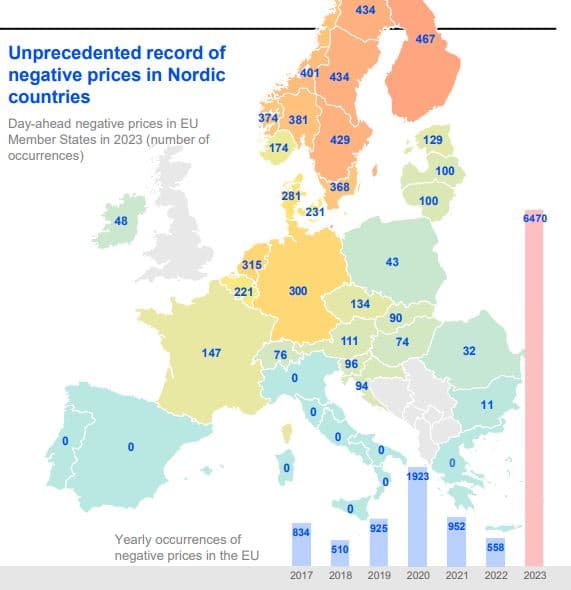
Number of hours with negative electricity prices in individual bidding zones in EU countries. Source: ACER
Negative electricity prices returned to the Czech Republic
In the Czech Republic, as in the EU as a whole, the highest number of negative electricity prices until last year was recorded in 2020, at 119. During the crisis years of 2021 and 2022, electricity prices traded in negative territory for just 33 and 8 hours, respectively. In 2023, however, negative prices returned to an upward trend, with 134 such hours over the year.
Electricity prices in the Czech Republic fell to their lowest level on Sunday, 28 May, reaching -68,54 EUR/MWh. Electricity was “free” on the market that day from 10 a.m. to 5 p.m.
The Netherlands expects up to 1,000 hours of negative prices this year due to solar
The Netherlands was one of the countries where negative electricity prices exceeded 300 hours last year. This year, the number of such hours is also expected to rise sharply following the Senate’s decision to vote against abolishing so-called net metering. According to EnAppSys CEO Jean-Paul Harreman, there could be between 400 and 1,000.
“Installed capacity of solar power plants stands at 26 GW, significantly exceeding peak electricity demand of 16 GW,” Harreman said. It should be noted that peak electricity demand usually occurs in the winter months, when electricity generation from solar power plants is nowhere near their installed capacity. In summer, when solar power generation is highest, electricity demand falls.
To encourage Dutch solar power plant owners to limit generation when there is a surplus of electricity, the government proposed abolishing so-called net metering and introducing a system of payments for electricity fed into the grid. The government reform narrowly passed the lower house of parliament, but ran into opposition in the Senate.
Translation disclaimer
This article is a machine translation of the Czech original and has not yet been fully reviewed. In case of any doubt, please refer to the Czech version.
Sdílejte článek prostřednictvím:
You might also like

28 October 2026, 13:08
28 October 2026, 11:10
28 October 2026, 09:08