23 October 2026, 14:38
Loading...
Power sales hedging horizon is shortening; Uniper had not sold even 1% two years ahead

Martin Voříšek
29 April 2019, 07:12
European energy companies are changing their power sales hedging strategies. Much more trading is being done only for the following year, or at most two years ahead. For example, Uniper had not hedged any power sales for 2021 as of the end of last year.
Changing conditions on the European electricity market are gradually forcing the largest producers to alter their sales hedging strategies. A number of German generators had hedged sales of a larger share of their output well in advance at relatively low prices (compared with current prices on wholesale futures markets).
For example, Germany’s RWE has already hedged the sale of around 90% of its electricity output from nuclear and coal-fired sources for 2020 at a price of around EUR 31/MWh. The current price on the German market is around EUR 50/MWh.
RWE has also largely hedged sales for 2021, having sold a total of 80% of its output at a price of around EUR 37/MWh. At the same time, RWE also hedged the CO2 allowances needed for its generation at EUR 5/t CO2, or EUR 7/t CO2 for 2021.
Uniper has also adopted a distinctive sales hedging strategy. In its investor presentation from mid-November last year, the company stated that it had sold only around 15% of its electricity output for 2020 at an approximate price of around EUR 30/MWh (as of September 2018). By the end of the year, i.e. over the following three months, the company had already fixed more than 80% of its output at a price of around EUR 36/MWh.
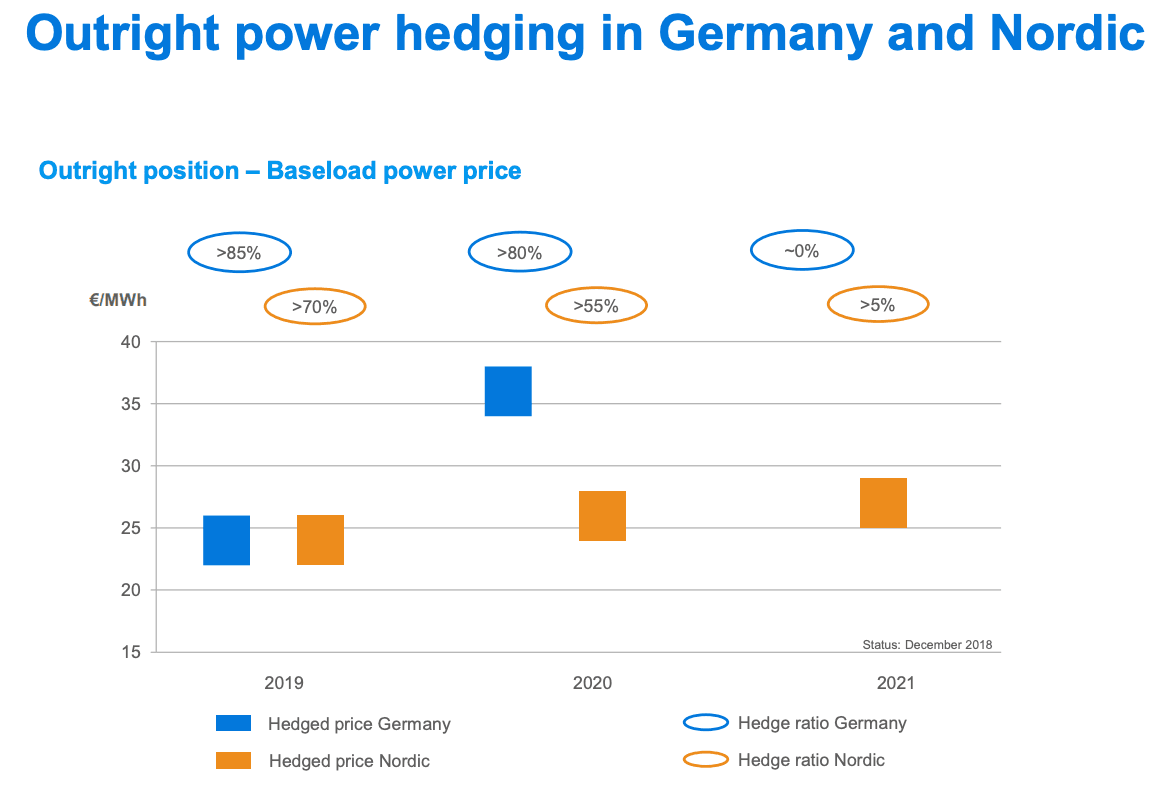
Uniper thus took advantage of the relatively high prices at the end of last year and hedged its sales – only over the coming years will it become clear whether hedging at these prices proved worthwhile for the companies. The main factor will be the price of emission allowances, which is highly prone to fluctuations and has strengthened from around EUR 20/t CO2 to its current level just below EUR 27/t CO2 in recent months, particularly in response to the further delay to Brexit.
However, the low liquidity of contracts for more distant delivery periods is the clearest indication of the current uncertainty on the market. Companies are hedging their sales for shorter periods and relying on prices rising in the coming months (or years). One example is the aforementioned Uniper, which stated at the end of last year that it had not sold even 1% of its electricity for 2021. Similar information concerning RWE’s advance sales for 2021 had emerged earlier.
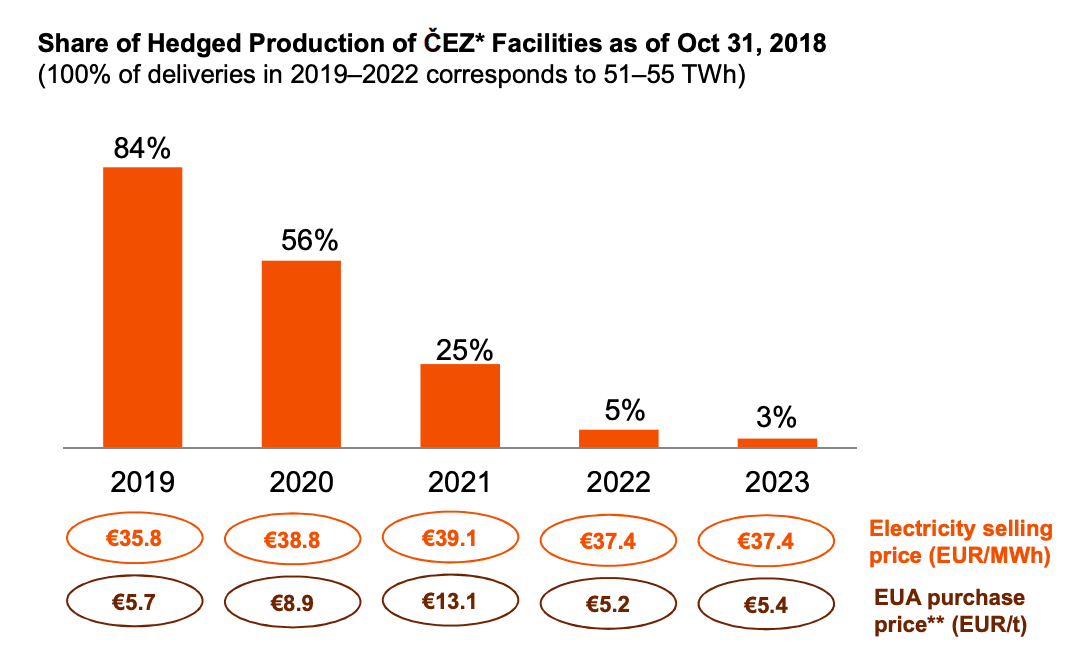
Among its regional competitors, Czech utility ČEZ is one of the more successful in hedging electricity prices, having already sold 64% of its electricity for 2020 at a price of EUR 41/MWh (as of the end of February 2019). It should nevertheless be noted that, compared with RWE for example, it has hedged a CO2 allowance price that is twice as high; allowances are usually hedged at the same time as electricity sales.
Translation disclaimer
This article is a machine translation of the Czech original and has not yet been fully reviewed. In case of any doubt, please refer to the Czech version.
Sdílejte článek prostřednictvím:
You might also like
23 October 2026, 11:01

23 October 2026, 06:34