
23 October 2026, 14:38
Loading...
Investment in electricity transmission and distribution is accelerating; Czechia is no exception

Lukáš Lepič
13 November 2024, 06:58
According to the European Union, investment in electricity infrastructure will exceed EUR 550 billion by 2030. Analyses show that the development of transmission and distribution systems is a long-term trend in Europe and globally, one that is only gaining momentum alongside increased electrification, efforts to reduce emissions and transform the energy sector. Europe is investing billions of euros in modernising and digitalising existing infrastructure. Meanwhile, millions of kilometres of new grids are being built in China, India and Brazil. The Czech Republic is no exception, with a relatively dramatic increase in investment in both electricity distribution and transmission awaiting it in the coming years.
According to many experts and institutions, it is now clear that the energy transition cannot happen without investment in energy infrastructure. Rising electricity consumption, the construction of new renewable energy sources and the growth of electric mobility are simply placing such high demands on the modernisation, reinforcement and expansion of grids at all voltage levels that investment will require multi-billion-euro budgets and greater attention from public institutions and companies in the coming years.
The International Energy Agency (IEA) and Eurelectric, the federation of the European electricity industry, have been highlighting the situation in their analyses for some time. According to these institutions, infrastructure is becoming a bottleneck amid growing efforts to transition to clean energy and reduce emissions.
European countries and institutions have reached the same conclusion, drawing up the European Commission's Grid Action Plan in 2023. According to the plan published in 2023, EUR 584 billion in investment will be needed by 2030. To put this into perspective, such a sum could cover almost half of the EU's seven-year budget (EUR 1.2 trillion) and is equivalent to the annual GDP of countries such as Austria or Ireland.
The enormous volume of investment may seem rather ambitious, but it could be said to be merely an intensification of a long-running trend. According to an IEA analysis, the electricity grid at all voltage levels has expanded continuously over the past five decades, at a rate of roughly 1 million kilometres per year. Assuming that the construction of overhead high-voltage networks (e.g. 110 kV and above) costs around EUR 300,000 to EUR 1 million per kilometre, this represents annual investment running into trillions of euros.
Electricity infrastructure at a glance
The figures show that investment is still needed at all levels
In addition to showing the overall development of infrastructure over recent decades, the IEA analysis breaks these figures down into a more detailed picture. Electricity infrastructure is a broad term. It includes transmission networks running across countries from large generation sources and across national borders, as well as low-voltage distribution networks ending at individual consumers.
According to figures for recent decades, distribution networks have seen the greatest expansion. Globally, they accounted for as much as 93% of the new capacity out of roughly 80 million kilometres of newly built infrastructure (calculated for 1971–2021).
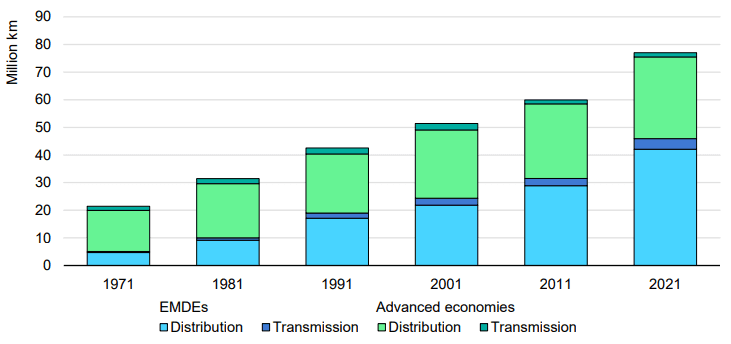
Development of distribution and transmission systems in km. Source: International Energy Agency (IEA)
High investment in the distribution system is unlikely to slow. If dozens, hundreds or thousands of new renewable energy sources, heat pumps or electric vehicle charging stations continue to be added in cities and rural areas, extensive construction, reinforcement and modernisation will still be needed. Only in this way will it be possible to integrate new decentralised generation and appliances.
At the same time, investment in the transmission system can also be expected to grow. In Europe, this is being accelerated not only by rising consumption but also by efforts to increase interconnection between individual countries. According to the aforementioned IEA analysis, investment in this level of the grid represented only 7% of newly built capacity. However, this does not mean that the volume of investment should be negligible or decline in the coming years.
The EU has set an interconnection target of at least 15% by 2030. This means that a 15% ratio of cross-border capacity corresponds to import capacity relative to the installed generation capacity of EU countries. Cross-border capacities currently stand at around 10–13%. Most member states have not yet met the requirement. Estimates state that the total cost of developing Europe's transmission system to achieve the target will exceed EUR 30 billion.
New kilometres are being added in Asia, while Europe and the US reinforce and modernise
In recent decades, expansion has occurred primarily in emerging economies such as India, China and Brazil – at least when looking at newly built kilometres. Over the past decade, developing countries added roughly 15 million kilometres of distribution networks and 1.17 million kilometres of transmission networks. This represents roughly a doubling of the total length of power lines.
By contrast, Europe built 750,000 km of distribution networks over the same period and increased the size of its transmission network by 12%. Given the differing land areas and infrastructure already in place from previous periods, the different development across regions is logical.
However, in terms of total investment in infrastructure, Europe and the United States are not lagging behind China. In 2022, China invested roughly half of what the US and European countries invested combined. The difference lies in where the investment is directed. Over the past decade, China built roughly 2.7 million kilometres of distribution and transmission networks. In Europe, by contrast, investment was directed primarily towards improving the reliability of existing networks, modernisation and digitalisation. Such investment includes not only reinforcing physical infrastructure, but also IT systems, smart metering and resilience against cyber threats.
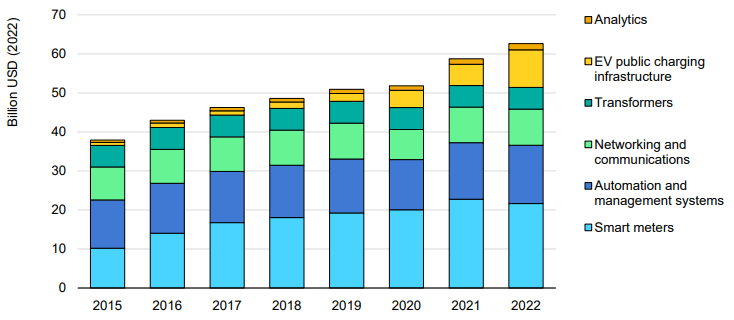
Investment in digital technologies for infrastructure between 2015 and 2022. Source: International Energy Agency (IEA)
The International Energy Agency's figures therefore indicate that massive investment in grids is taking place globally. The difference, however, lies in where the investment costs are directed. While physical infrastructure is being built at a rapid pace in Asia and Latin America, Europe is investing significant resources primarily in the reliability and replacement of power lines and pylons built in the past.
The Czech Republic is not exempt from global trends
The global and European trend of rising investment in electricity infrastructure is not bypassing the Czech Republic either. According to the Czech Association of Regulated Electricity Companies (ČSRES), the rise of green energy will require a dramatic change in the operation of transmission and distribution networks.
ČSRES members – transmission system operator ČEPS and distribution operators – expect their annual investment to increase by 38% in the coming years compared with the 2010–2023 period. On average, they should therefore spend almost CZK 40 billion annually on transforming and modernising grids, and invest CZK 132 billion more by 2035 alone than in the previous period.
As in other European Union countries, the same factors are behind this growth: rising electricity consumption, the construction of decentralised renewable energy sources, and growing requirements for digitalisation and cybersecurity. One example is the growing number of solar power plants and applications for their connection to the grid.
An example of such development in practice is a 2020 plan by ČEZ Distribuce, one of the Czech Republic's three regional distribution operators. By 2025 alone, it plans to invest more than CZK 83 billion in grid reinforcement, modernisation and the integration of smart technologies. A total of CZK 23 billion is to go towards digitalisation and, given for example the plan for the rollout of smart metering, this sum is very likely to be even higher after 2025.
Translation disclaimer
This article is a machine translation of the Czech original and has not yet been fully reviewed. In case of any doubt, please refer to the Czech version.
Sdílejte článek prostřednictvím:
You might also like
23 October 2026, 11:01

23 October 2026, 06:34