23 October 2026, 14:38
Loading...
What are the current developments and trends in Czech nuclear energy?
Martin Ševeček
7 October 2015, 15:56
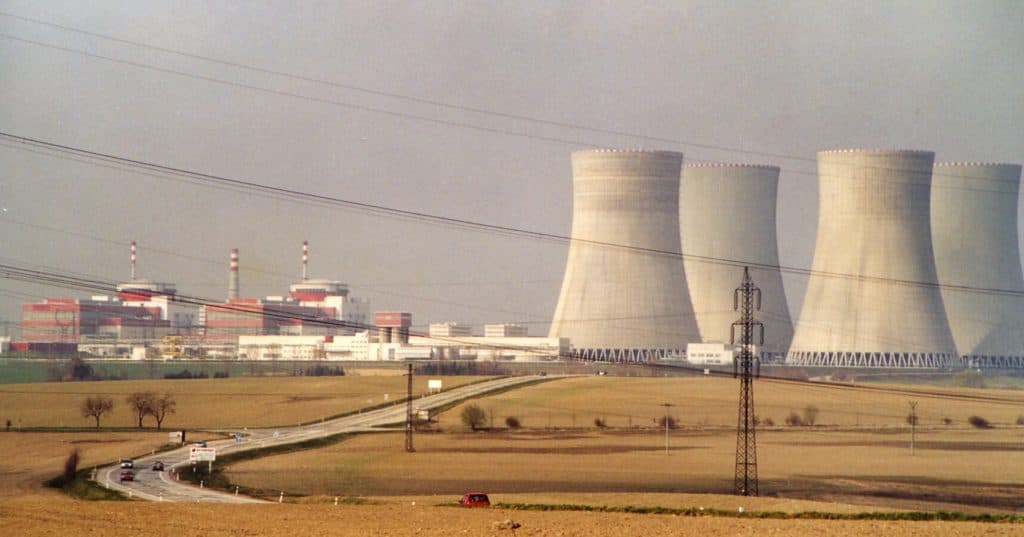
Nuclear sources have held an indispensable place in the Czech Republic's energy mix for many years. According to the update to the State Energy Policy (SEK), nuclear energy will remain one of the main components of the Czech energy mix in the future. This update to the State Energy Policy was approved at the government's May meeting.
Following the approval of the State Energy Policy, the Ministry of Industry and Trade was tasked with preparing a nuclear energy development plan. The document entitled the National Action Plan for Nuclear Energy (NAPJE), approved by the government on 3 June, proposes several options for financing new nuclear units, which is the Achilles' heel of all new or ongoing nuclear power plant construction projects.
Dukovany will most likely be first in line
So what are the real consequences of approving these two key documents for the development of nuclear energy? They naturally have the greatest impact on ČEZ a.s. The Czech government is ČEZ's majority owner through the Ministry of Finance, which holds almost 70 % of the company's shares. The SEK and NAPJE should therefore be binding on it.
However, the remaining 30 % of shares in ČEZ are held by minority shareholders, whose interests the company's management must also defend (or at least not harm), and it must not embark on risky projects such as building two new units at Temelín without a state guarantee of the electricity price.
As is well known, ČEZ cancelled the tender to select a supplier for two new nuclear units at the Temelín site in spring last year. However, this does not mean that all the work ČEZ has done since preparations began has gone to waste. The NAPJE still envisages at least one unit at the Temelín site. Due to political pressures and other reasons (maintaining two nuclear sites, preserving employment and others), priorities have been reassessed and new units at Dukovany are now being considered as the first project. The original Temelín 3,4 project should not be put on hold and should continue in parallel with the Dukovany project.
Several options are available for financing potential construction
According to the latest information, ČEZ will establish two subsidiaries so that it can easily handle them later. The Dukovany project will be led by the Dukovany II subsidiary and the Temelín project by Temelín II. The reasons for creating these companies lie precisely in the NAPJE. The action plan defines three possible options feasible in the Czech environment, but none of them is clearly preferred.
By creating subsidiaries, ČEZ is keeping its options open. A strategic partner can easily enter the new company, the state or a foreign investor can buy it outright, and its owners can even change several times (as in the case of the Hinkley Point C project), etc. This step effectively postpones the decision on financing and the form of project implementation. The three possible options for financing and implementing new nuclear power plant projects presented in the NAPJE are:
- ČEZ investment
- investment through a private investor
- direct construction by the state.
Establishing separate subsidiaries still allows proceeding under any of the above options. The problem with establishing the new Temelín II company is that a number of licences and permits (environmental impact assessment, permits for locating new units, etc.) that have already been issued are tied directly to ČEZ a.s. and are non-transferable. The new subsidiary will therefore have to apply for some permits again.
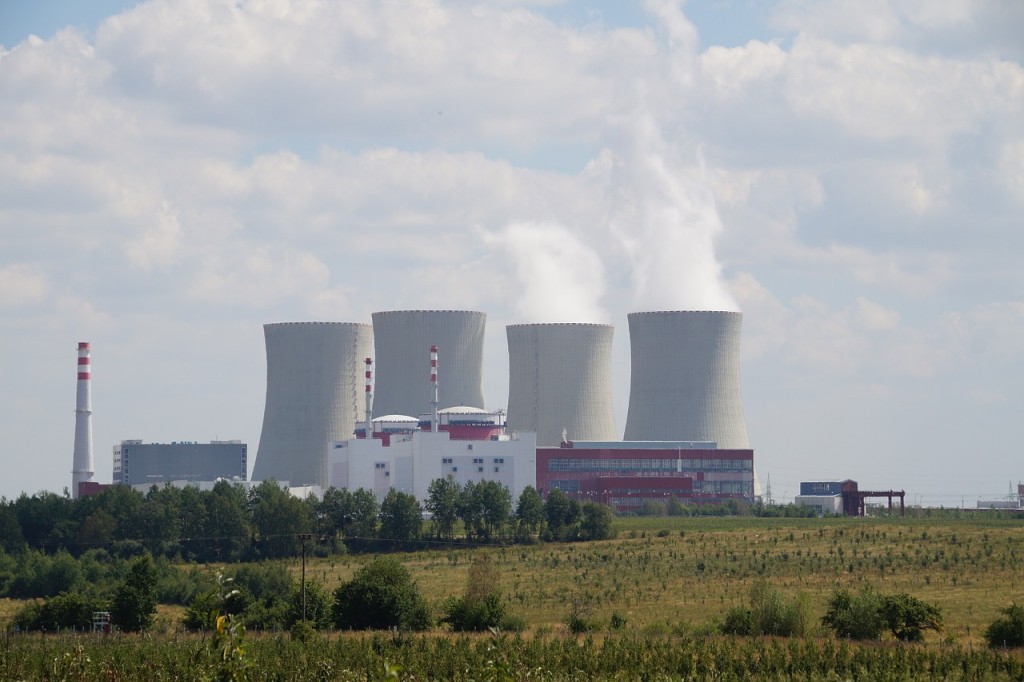
As mentioned, completing Dukovany is the priority. The new Dukovany II subsidiary should submit an application for an environmental impact assessment (EIA) for two units at Dukovany as early as autumn.
Several problems that ČEZ faces in preparing the projects were highlighted at the discussion meeting „60 years of nuclear energy in the Czech Republic: What next?“ Most of them concern Czech legislation, excessive bureaucracy or potential court proceedings. A recent example is the launch of the EIA process for Dukovany.
To start this process, an opinion from the relevant building authority is required (which may also be negative); however, Czech building authorities cannot agree on which one is responsible for Dukovany. The EIA process therefore cannot yet be launched. It may come as a surprise that the application will be submitted for two units. Until now, public discussion has generally focused on one new unit at Dukovany.
Economically, however, it makes sense to build two units at once. For example, US company Westinghouse cites up to a 60 % reduction in costs for the second unit when two units are built at one site compared with two projects at different sites. Another reason is certainly the outlook for the future. Both units do not have to be built now; the prepared site can be used only decades later.
Water shortage could also threaten completion
However, there is one major technological problem at the Dukovany site: a lack of cooling water. The Dukovany nuclear power plant draws cooling water from the Jihlava River, which is a very small river compared, for example, with the Vltava, which supplies water to the Temelín plant. Four units are currently in operation, and if one additional large unit were built, there would be a real risk of water shortage during droughts and the plant would have to be shut down.
If the old Dukovany units are shut down around 2030-2035, there will be enough water for one new unit. But will there also be enough for two large units? It depends on how large they are. The planned EIA application assumes the construction of two large units with output of up to 1700 MWe (the French EPR). It is the largest reactor offered on the market, and any other design has lower output, so its environmental impact (what the EIA assesses) is also expected to be lower. In the case of two large 1700 MWe units being built, there will not be enough water, and the EIA being submitted will therefore consider units operating in parallel.

Another problem is the tender itself for selecting a supplier. As the Temelín tender showed, even selecting a supplier can cause delays, cost increases and problems before construction even begins. A possible and genuinely considered approach was discussed by Jan Žižka in the article: The government is inspired by „the Hungarian atom“.
The government and ČEZ management are considering the possibility of concluding an agreement directly with a supplier under a bilateral intergovernmental agreement, following Hungary's example. Hungarian Prime Minister Orbán signed a direct agreement with Russian President Putin for the construction of a new unit at the Paks site without launching a tender or lengthy negotiations with other interested parties.

While this approach would simplify supplier selection, it would have to be approved by the European Commission. The contract also cannot be concluded within the EU, which would exclude French company AREVA (or EdF). US company Westinghouse is privately owned, with Japan's Toshiba holding a majority stake, and it is questionable whether a similar agreement between the Czech Republic and the US (or Japan?) would pass at all.
This leaves only Russia's Rosatom, one of the state-owned Chinese nuclear consortia, or South Korea's KEPCO. Signing a bilateral agreement with Russia or China would probably be politically unfeasible, while South Korea's KEPCO offers or is building its APR1000 reactors around the world, including in the United Arab Emirates, which do not meet certain stringent safety requirements for Generation III+ reactors (e.g. EUR requirements).

Only time will show what further developments will bring. The chair of the State Office for Nuclear Safety is optimistic and predicts that new nuclear units will be built at both Czech nuclear sites.
Translation disclaimer
This article is a machine translation of the Czech original and has not yet been fully reviewed. In case of any doubt, please refer to the Czech version.
Sdílejte článek prostřednictvím:
You might also like
23 October 2026, 11:01
23 October 2026, 06:34