Electricity generation in the EU has never been so emissions-free

Electricity generation from emissions-free sources reached record levels in the EU in the first half of 2024, as reported by Eurelectric, the association of European electricity producers. This organization collects data from transmission system operators and official EU statistics, and brings together more than 33 associations; in Czechia, this is the Czech Employers' Association in the Energy Sector.
In the first half of 2024, renewables generated more than 50% (around 696 TWh) of all electricity produced in Europe. Nuclear power accounted for around 24%, or 325 TWh. Electricity from fossil fuels accounted for more than 26%, with around 361 TWh generated. Electricity demand remains low due to slower economic growth and partial deindustrialization.
Stimulating electricity demand will be essential to ensure continued investment in emissions-free electricity sources. However, in the context of decarbonization, the question also arises: is the best electricity the kind that does not need to be generated at all and has no emissions footprint?
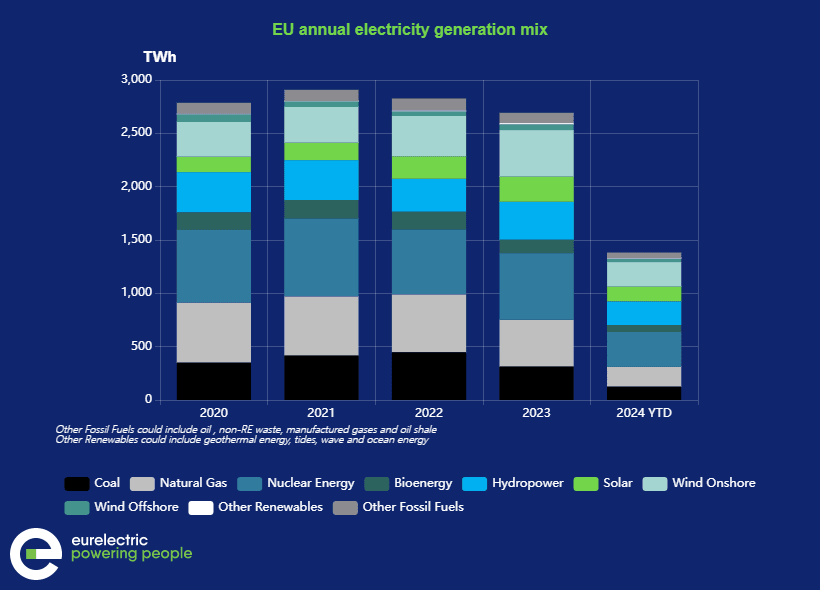
Decarbonization of European electricity generation is accelerating nonetheless. More than 74% of the electricity generated in the EU in the first half of 2024 came from renewable and low-emissions energy sources. This is a significant increase from the 68% share in 2023. The main reasons for this result were further expansion of renewable energy capacity and the stabilization of nuclear power generation, particularly in France.
“The pace of change is astonishing. These figures show that electricity companies' decarbonization efforts are several years ahead of those in any other sector,” said Eurelectric Secretary General Eurelectric, Kristian Ruby.
It should also be noted that electricity demand is lagging. If electricity consumption were to grow as well, the likely shares of the various generation sources would be different.
In the first half of 2023, electricity demand in the EU fell by 5.1% compared with the same period in 2022. Compared with 2022, demand in 2024 remains lower by 4.8%. This trend is due to several factors, including energy savings, milder weather and partial deindustrialization.
For comparison we can also look at data on electricity consumption in China, where year-on-year consumption rose by 7.4% between March 2023 and March 2024, reaching 794 TWh. Interestingly, electricity consumption grew not only in the primary, or manufacturing, sector but also in the services sector, in line with the overall growth of the Chinese economy.
Translation disclaimer
This article is a machine translation of the Czech original and has not yet been fully reviewed. In case of any doubt, please refer to the Czech version.