23 October 2026, 14:38
Loading...
Will natural gas dominate? It will generate as much electricity as coal in OECD countries

Martin Voříšek
30 August 2017, 14:09
In OECD countries, electricity generation from natural gas matched the volume of coal-fired generation for the first time last year. While the trend for coal generation in OECD countries is clearly declining, the situation is exactly the opposite for natural gas. Hydropower and nuclear power plants have maintained a stable share of generation in recent years.
If current trends in the power sector continue at the same pace, renewable sources and natural gas will increasingly dominate electricity generation in the years ahead. At least, this is what the latest data compiled by the International Energy Agency (IEA) for OECD countries suggest.
At the expense of these sources, the most emissions-intensive methods of electricity generation have seen the largest decline in their share of generation, as a result of efforts to reduce emissions in the power sector.
The declining share therefore primarily concerns coal generation, whose share currently stands at around 27 %, alongside natural gas, and electricity generation from petroleum products. The share of petroleum products is currently only in the low single digits.
Electricity generation at nuclear power plants declined slightly, particularly after 2010, but its share has remained relatively stable in recent years.
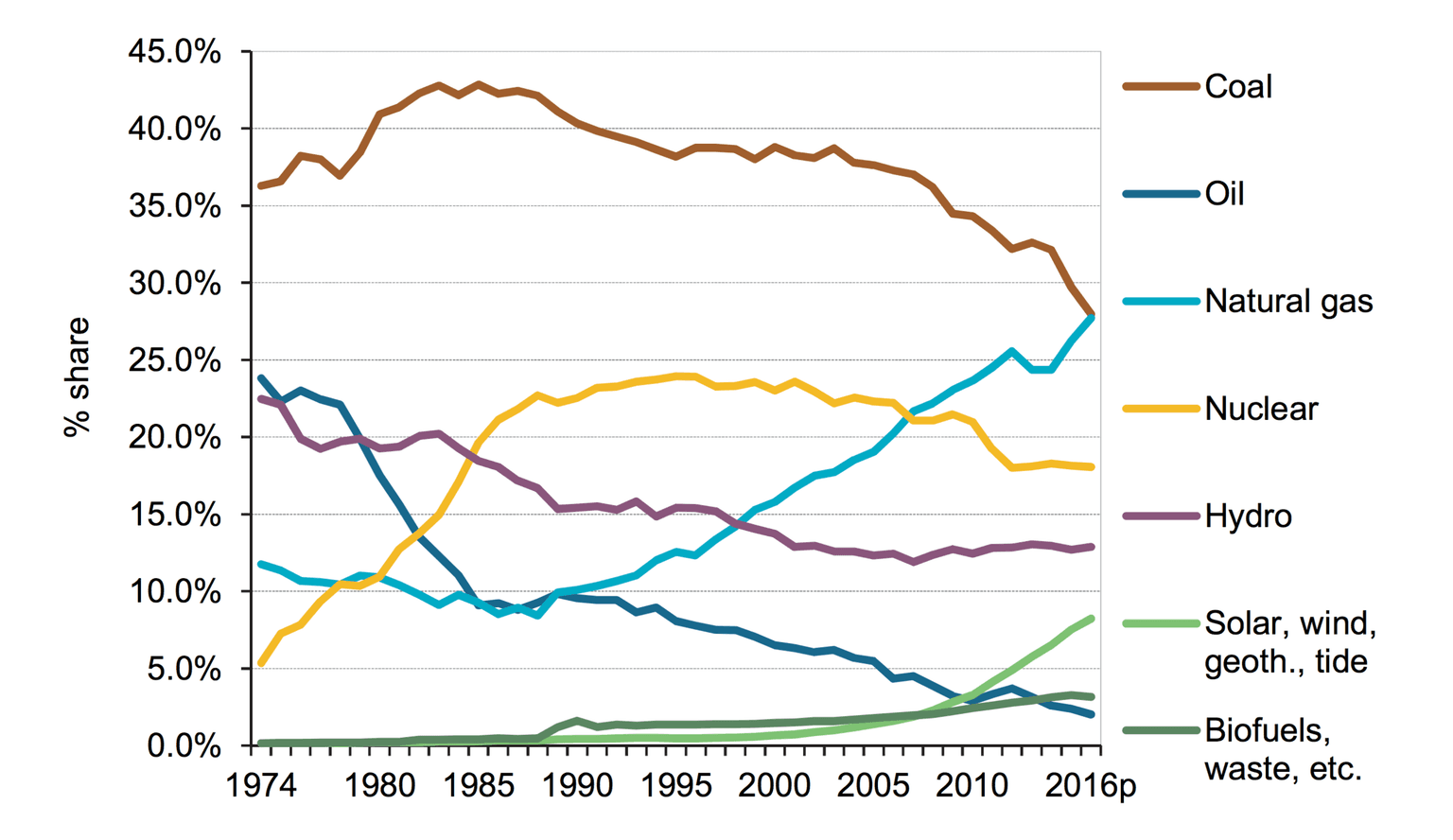
As expected, renewable energy sources have developed in particular in recent years. Generation from wind, solar, tidal and geothermal power plants reached around 8,5 %.
Will natural gas be the dominant fuel in the years ahead?
If trends in electricity generation remain the same for several more years, natural gas can be expected to become an increasingly important part of energy mixes, with its share continuing to grow. This makes sense primarily from the perspective of reducing emissions, which are half as high for natural gas as for coal. This shift is also supported by increasingly frequent and higher taxation of emissions.
{„country“:“GB“,“type“:“AREA“,“from“:“2017-08-01″,“to“:“2017-08-15″,“caption“:“Electricity generation in Great Britain has shifted in recent years from dependence on coal to natural gas.“,“url“:“https://energodock.cz/energodock/get_online_generation_data.php“,“source“:“shortcode“,“start_date“:“2017-08-01″,“end_date“:“2017-08-15″}
A clear example of this development is the UK power sector, which was among the main drivers of the decline in coal-fired electricity generation among OECD countries. This decline is primarily due to the carbon tax, which favours electricity generation from less emissions-intensive natural gas in the UK market. A similar increase in the price of emissions is also expected in European Union countries, which make up a significant part of the OECD.
Equally important, however, will be consumption in the US and China, which, given their installed capacity in coal- and gas-fired power plants, can significantly alter the overall generation shares of individual sources.
Translation disclaimer
This article is a machine translation of the Czech original and has not yet been fully reviewed. In case of any doubt, please refer to the Czech version.
Sdílejte článek prostřednictvím:
You might also like


23 October 2026, 11:01

23 October 2026, 06:34