28 October 2026, 15:10
Loading...
Polish farmers push for Green Deal exemptions, government talks to Commission
Klára Čeperová
7 March 2024, 06:52
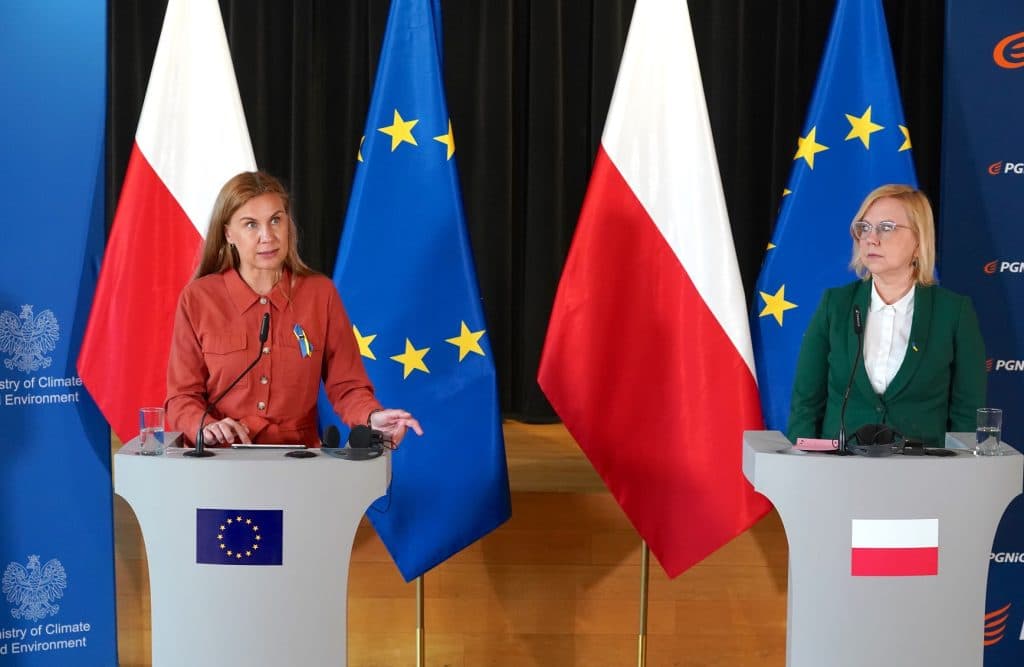
The Polish government is negotiating with European Commission President Ursula von der Leyen to exempt the country from some provisions of the European Green Deal. One of the government ministers confirmed this to the media, according to Euractiv.
Polish farmers are continuing their protests against the European Green Deal and the liberalisation of trade with Ukraine, which has caused them huge losses. Their blockade of the border has drawn condemnation from Ukrainian officials, who have called on their Polish counterparts to take steps to maintain cross-border movement.
This week, Prime Minister Donald Tusk suggested that his government was discussing closing the border and temporarily halting trade between Poland and Ukraine, which Kyiv later denied. Tusk’s cabinet subsequently said that such a move was not currently under consideration.
The situation in the agricultural sector is therefore the main argument for a potential exemption.
Reluctance to decarbonise
Poland made it clear that climate neutrality by 2050 was problematic for the country as early as the discussions on the Green Deal in 2019.
Then-Polish Prime Minister Mateusz Morawiecki told reporters that he had secured an exemption for Poland from the 2050 target, which is to become the legally binding centrepiece of the “European Green Deal”, a plan to transform the European economy. Poland did receive an exemption, with the understanding that the negotiations would be reopened later.
A country that relies on coal for 80% of its electricity generation sought more precise and generous EU commitments on moving away from fossil fuels. “Poland will achieve climate neutrality at its own pace,” Morawiecki said.
Poland eventually agreed to follow the EU’s trajectory, as indicated by a statement from the deputy climate minister.
“Climate neutrality is something we have committed to,” Adam Guibourgé-Czetwertynski said, signalling that Warsaw was now ready to formally support the EU’s climate target for 2050.
New government, new approach
The current government, however, appears to support accelerating decarbonisation. In January 2024, it announced that it would urge the European Union to “adopt” a plan to cut the bloc’s greenhouse gas emissions by 90% by 2040. This appeared to reflect a major shift in the country’s climate policy.
Urszula Zielińska, Secretary of State at Poland’s Ministry of Climate and Environment, also stressed that under Donald Tusk’s new government, Poland would no longer block EU climate measures.
Now, however, it seems that what the energy sector failed to achieve, the agricultural sector may.
Since mid-2022, when the Commission suspended trade barriers with Kyiv under the so-called solidarity corridors, Polish farmers have faced lower demand and prices for their produce as a result of increased inflows of Ukrainian agri-food products. They are therefore pushing for change.
The exemption would cover some areas of the Green Deal, as well as the inflow of imported products that could cause lasting market disruption in one or more countries. Deputy Foreign Minister Andrzej Szejna (New Left, S&D) told private radio station ZET.
“If we manage to negotiate Poland’s demands (...), it will be a common EU position,” he said, adding that if talks with the Commission took too long, Poland would consider measures such as border blockades and unilateral tariffs.
Consultations between the Polish and Ukrainian governments are scheduled for 28 March. Szejna expressed confidence that the problem of Ukrainian food products flooding the Polish market would be resolved by then.
At the agricultural summit convened by Tusk last Thursday, however, most of the farmers present remained dissatisfied with the government’s position on the agricultural sector’s demands. The farmers say they will not stop protesting.
Translation disclaimer
This article is a machine translation of the Czech original and has not yet been fully reviewed. In case of any doubt, please refer to the Czech version.
Sdílejte článek prostřednictvím:
You might also like

28 October 2026, 13:08

28 October 2026, 11:10
28 October 2026, 09:08