Energy conference in Brno, Czechia, highlights new challenges in the energy sector
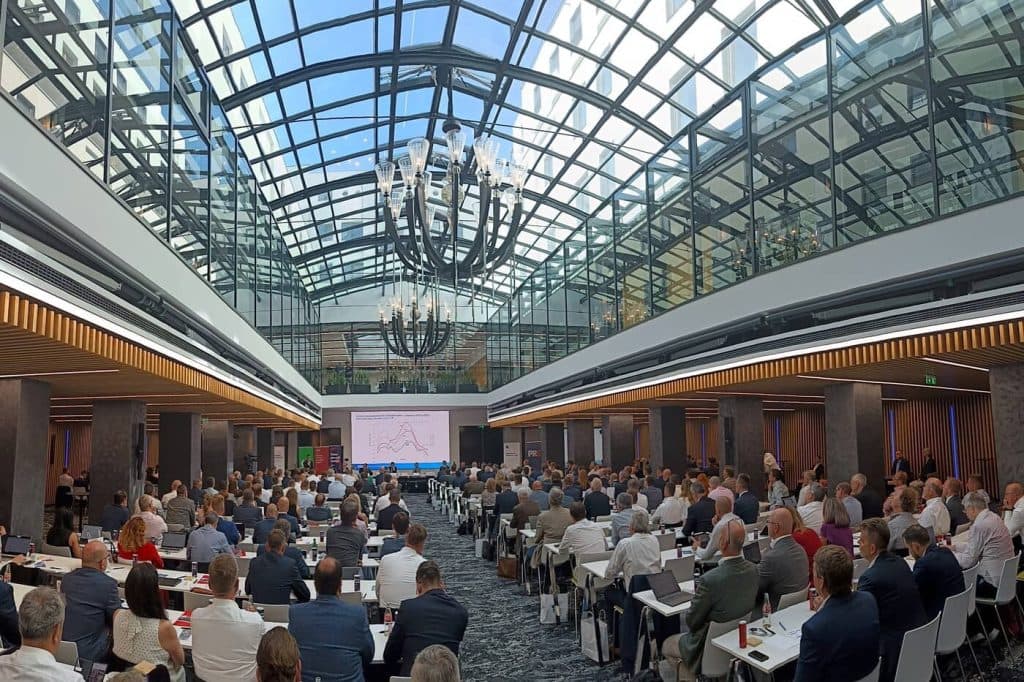
- The Energy 2023 conference provided a forum for sharing thought-provoking views and information from the energy sector
- Experts agreed that the energy sector needs to be decarbonized, but at a pace that primarily ensures security of energy supply
- Long permitting processes and legislative shortcomings were cited as the main obstacles
- The next edition will take place on 18–19 September 2024
Finding the right pace for the energy transition, the future role of individual gaseous fuels in the energy mix, and the challenges involved in the expected decarbonization process. These were the main topics addressed at the Energy 2023 conference, organized by consultancy EGÚ Brno in Brno on 20–21 September 2023.
The two-day meeting of energy experts opened with introductory speeches by Zdeněk Vala, member of the Board and director of EGÚ Brno, and Petr Třešňák, Deputy Minister at the Ministry of Industry and Trade.
The pace of the energy transition
Michal Macenauer, Director of Strategy at EGÚ Brno, addressed decarbonization in his presentation during the first session. He noted, among other things, that willingness to invest in green solutions is growing, but so are concerns about feasibility and cost. “The consequence of rushed decarbonization in the European Union could be the relocation of industrial production outside Europe, for example to China. Decarbonization must be synchronized globally. One hundred per cent decarbonization of the European Union is equivalent to decarbonizing the rest of the world by just eight per cent,” M. Macenauer stressed.
Jiří Feist, a member of the Board of EP Power Europe, said that the pace of decarbonization depends on the conditions of the energy market as a whole. As for the transformation of the district heating sector, he said the state lacks any plan. The same applies to hydrogen projects. In his view, Czechia is now facing its last opportunity to start building new nuclear units.
According to Svatopluk Vnouček, Vice-Chairman of the Board of ČEPS, the Czech transmission system is robust and has sufficient capacity. Significant financial resources are being invested in its renewal and development. Even greater investment will be needed in the future to meet decarbonization commitments, given the increasingly intensive use of renewable energy sources (RES).
As Pavel Čada, Vice-Chairman of the Board of EG.D, noted, the company will invest CZK 8.5 billion in integrating RES into the grid by 2030. “Successful integration of RES requires systemic changes and massive investment in the grid, both in the short and long term,” P. Čada said.
Zdeněk Zajíček, President of the Czech Chamber of Commerce, presented the Czechia at a Crossroads initiative. He said that investment in energy, transport, data and other technical infrastructure is essential. “According to a survey of companies, strategic investment is most threatened by long permitting processes, the lack of a state vision and complex legislation that is not aligned with strategic documents,” Z. Zajíček said. In his view, decarbonization cannot happen without nuclear power, which must be complemented by RES and, during the transition, by gas.
Natural gas, hydrogen and other fuels
During the second session, Thomas Merker, CFO of GasNet, discussed the decarbonization of the gas sector. He said greater use of gaseous fuels can be expected in the future, with natural gas gradually replaced by biomethane and hydrogen. “In the future, gaseous fuels will need to cover seasonal demand for electricity and heat of up to 25 gigawatts. Hydrogen will become competitive after 2030, and transport will be one of the first sectors to use it,” T. Merker said.
As Radek Jirků, a member of the Supervisory Board of Teplárny Zlín, noted, coal must gradually be replaced by other sources of electricity generation, such as RES.
“Coal-fired power plants must be replaced by the construction of other stable sources before they are shut down. The best solution appears to be medium-sized nuclear power plants supported by RES and pumped-storage power plants. It is essential to keep coal-fired power plants running until replacements are available,” R. Jirků said, adding that they cannot be shut down without replacement capacity.
Jiří Novák, Business Development Manager at Gentec CHP, presented the potential of gaseous fuel sources in today’s energy sector. In his view, these fuels cannot be effectively replaced in the energy sector, and their future role will primarily be to provide flexibility. He also highlighted the favorable lead time for building a combined heat and power unit. A medium-sized boiler house with a CHP unit of up to 3 MWe takes 12 months to complete, while a large boiler house with a CHP unit above 3 MWe takes 18 months.
Martin Růžička, Director of Decarbonization at Orlen Unipetrol RPA, discussed fuels with future potential. He noted that current European regulation is bringing major changes to this segment and creating many challenges that need to be addressed. “Energy consumption in transport in Czechia will stagnate until 2030, but regulation will increase the share of alternative fuels,” M. Růžička said, adding that the company plans to invest CZK 35 billion in sustainable development by 2030, including in biofuel production. Orlen Unipetrol is the largest producer of grey hydrogen in Czechia. The company also plans to bring a total of 28 hydrogen filling stations into operation.
Energy flows
In the third session, Pavel Šolc, a member of the Board of ČEPS, shared his views on the energy transition. He said the changes must be compatible with energy security. This also depends on the condition and development of network and information infrastructure, while weather will have a significant impact as the use of RES continues to grow. Broadly speaking, electricity surpluses can be expected in spring and summer, and deficits in winter. In his view, decarbonization and changes to the energy mix will put pressure on the power system and balancing services.
René Neděla, Deputy Director General of the Energy and Nuclear Resources Section at the Ministry of Industry and Trade, outlined changes in gas and oil flows following the halt in supplies from Russia. He considers district heating to be the most problematic sector in terms of decarbonization.
According to Jan Fousek, Executive Director of the Czech Association for Energy Storage AKU-BAT CZ, Czechia needs to start using energy storage technologies as soon as possible. He also highlighted delays in legislation that would enable the development of modern energy, including the sharing of electricity from clean sources within communities and the construction of large battery storage facilities that could be used to balance the national energy system.
“The development of RES, storage, aggregation and other forms of modern energy must not mean the hasty and premature disconnection of rotating generation sources. New gas-fired sources must be built to cover peak demand, while existing nuclear sources should be kept running for as long as possible and new ones built,” J. Fousek said.
Radim Černý, Vice-Chairman of the Board and Director of the Distribution System Management Division at ČEZ Distribuce, focused in his presentation on the impact of the energy transition on distribution system operators. He said that changes to the generation mix are increasing the need for regulation by distribution system operators. The level of reserved capacity is also trending upwards. “Entire areas are not yet being closed to new connections, but the number of areas with limited distribution capacity is rising significantly. However, individual substations are being closed to new connections because their capacity has been exhausted,” R. Černý stressed, adding that the development of decentralized sources makes cooperation between the transmission system operator and individual distribution system operators increasingly important.
David Šafář, a member of the Board of EG.D, said that energy decentralization requires investment not only in strengthening the backbone distribution grid, but also in smart devices such as smart meters. He also warned that photovoltaic generation is increasing voltage in low-voltage networks and could overload the grid in specific areas. He therefore considers the establishment of an Energy Data Centre essential; it will monitor data on electricity generation and consumption in the Czech power system. It should be fully operational by the end of 2026 at the latest.
According to Stanislav Votruba, Head of the Network Planning Section at PREdistribuce, new networks will need to be built at all voltage levels as generation is decarbonized and decentralized. He also considers it essential to ensure the network can operate at all times and to increase flexibility on both the generation and consumption sides. This also requires greater customer engagement and awareness.
Will the new energy sector be market-based?
The fourth session was opened by Michal Puchel, Chairman of the Board of OTE, who outlined factors influencing electricity prices. These include political decisions concerning, for example, decarbonization and the composition of the energy mix; geopolitical factors such as conflicts and the resulting availability of resources; as well as weather, technical conditions and the economic situation in individual countries.
Jaromír Čermák, Vice-Chairman of the Board of the Czech-Moravian Commodity Exchange Kladno, stressed that the market must work in the customer’s interest. “The liberalization of the energy market was intended to create a competitive environment and ensure reliable energy supplies,” J. Čermák said, adding that state intervention in the form of regulation should be limited to the absolute minimum.
Luděk Horn, Director of Trading at ČEZ, presented the company’s experience importing liquefied natural gas (LNG) into Europe. He said ČEZ is continuing to look for new natural gas suppliers in order to replace Russian supplies. The lease of regasification capacity at the floating terminal in Eemshaven, the Netherlands, runs until 2027. ČEZ has already handled more than 20 ships at the terminal and has signed framework LNG trading agreements with more than 25 counterparties. Talks are also under way to secure subsequent regasification capacity at planned terminals in Germany and Poland.
Peter Gyurovszky, Senior Legal Counsel at EP Commodities, presented the AggregateEU platform, which was created in response to the disruption of the global gas market.
“EU countries must aggregate gas demand through the platform equivalent to 15% of their commitments to fill storage, representing approximately 13.5 billion cubic metres of gas a year,” P. Gyurovszky explained.
Jan Troják, Director of Project Finance at ČSOB, discussed market risk in connection with financing new photovoltaic plants. In addition to risks that have long been familiar, such as technological, implementation and operational risks, as well as risks related to a project’s location, new risks have emerged—specifically, the risk of insufficient offtake and the risk of a low electricity sale price.
Conflicting interests in decarbonization
The closing panel discussion on the need for decarbonization and the challenges it entails featured Martin Slabý, Chairman of the Board of the Czech Gas Association and Chairman of the Board of Pražská plynárenská Distribuce; Vladimír Hlavinka, CEO of Tedom and Vice-Chairman of the Modern Energy Union; Martin Hájek, Director of the Czech District Heating Association; Jan Pačes, Vice-Chairman of the Board of 2JCP; Pavel Řežábek, Chief Economist at ČEZ; and Martin Ludvík, CEO of Sev.en Industry Supply.
The discussion highlighted, among other things, that decarbonization is necessary, but there is not yet an adequate replacement for electricity generated from coal. Natural gas is important in this context, particularly during the winter. Long-term planning by the state is ineffective, and important steps need to be taken in the near future. Market mechanisms should also be preserved.

Translation disclaimer
This article is a machine translation of the Czech original and has not yet been fully reviewed. In case of any doubt, please refer to the Czech version.




