Czechia to have capacity at German LNG terminal, covering a quarter of gas consumption

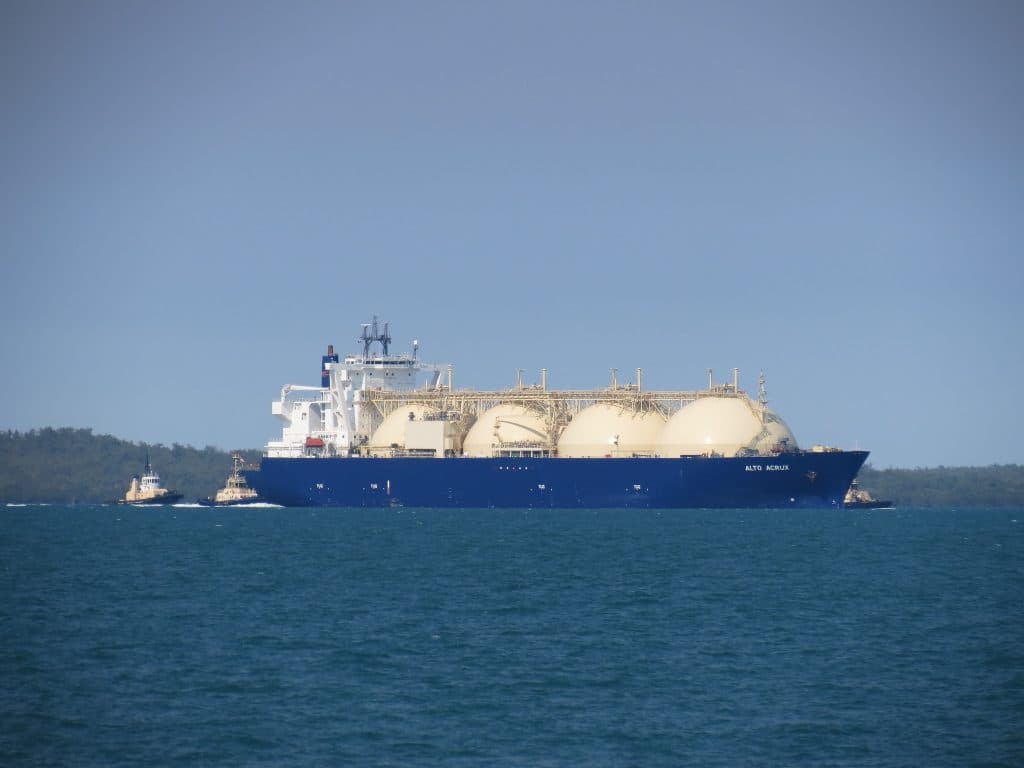
The Czech Republic, working with energy group ČEZ, has secured capacity at an onshore terminal for liquefied natural gas (LNG) under construction in Germany. From 2027, it will have access to two billion cubic meters of gas a year at the Stade terminal near Hamburg, more than a quarter of current domestic consumption. The company has signed a 15-year contract with the operator, with an option to extend it. Prime Minister Petr Fiala (ODS) announced the news at a press conference today. The Czech Republic currently has capacity leased at an LNG terminal in the Netherlands until 2027, with access to around three billion cubic meters of gas a year.
The Stade terminal will enable imports and regasification of liquefied natural gas. According to ČEZ, the terminal could later be converted to import and process climate-neutral ammonia, which can be used to produce green hydrogen. ČEZ has initially leased capacity at the terminal for 15 years, with an option to extend the contract to up to 25 years in connection with the future use of green hydrogen. The terminal is being built by Germany’s Hanseatic Energy Hub.
The prime minister stressed the importance of the investment in the terminal for strengthening the country’s energy security. „We have already taken a number of concrete steps, and now we are adding another important piece to the puzzle. Together with the purchase of gas storage facilities and gas pipelines, this significantly increases our ability to transport and store natural gas from reliable suppliers,“ Fiala said.
The Ministry of Industry and Trade (MPO) has signed a similar capacity-reservation agreement with ČEZ as the one in place for the terminal in Eemshaven in the Netherlands. „Having a stake in the terminal in Stade near Hamburg also has the advantage of being closer than the terminal in the Netherlands. The gas supplied will therefore cross fewer borders, reducing the charges for transporting it to the Czech Republic,“ said Industry and Trade Minister Jozef Síkela (STAN).
Unlike the terminal in the Netherlands, which is floating, the German terminal will be onshore. It is expected to offer greater capacity and faster unloading and regasification. „Onshore terminals will gradually replace temporary floating ones, so from the outset we sought to secure long-term capacity at one of the planned onshore terminals as well. Until recently, we had no presence in the LNG market, but over the past year and a half we have gained considerable experience that we can now build on,“ said ČEZ CEO Daniel Beneš. He noted that ČEZ has leased capacity at the Eemshaven terminal until September 2027, and that securing capacity in Germany will allow LNG deliveries to continue seamlessly after that.
ČEZ will be able to draw on two billion cubic meters of annual capacity at the German terminal for the Czech Republic. This currently represents more than a quarter of domestic annual consumption, which fell from 9.4 billion cubic meters two years ago to 7.5 billion cubic meters in 2022. So far this year, consumption has fallen by a further ten percent compared with last year. In the future, however, gas consumption is expected to rise, as the state plans to use gas for heating and electricity generation as it prepares to replace coal. Current estimates project an increase in consumption of two to four billion cubic meters a year.
The Stade terminal, which will be built on the site of the current floating terminal, will also include LNG storage tanks. Other companies leasing capacity at the facility are Germany’s EnBW and SEFE. The terminal’s total capacity is 13.3 billion cubic meters of gas a year.
The Czech Republic currently has access to LNG capacity at Eemshaven in the Netherlands, where it has around three billion cubic meters of gas a year until 2027. According to the government, this capacity has helped significantly reduce the country’s dependence on gas supplies from Russia. According to MPO data, that dependence fell to zero this year. ČEZ also recently postponed plans to secure capacity at an LNG terminal in Poland, as the company was unhappy with the terms on offer.
Translation disclaimer
This article is a machine translation of the Czech original and has not yet been fully reviewed. In case of any doubt, please refer to the Czech version.




