6 November 2026, 14:13
Loading...
Germany to end energy price controls early; Scholz says they are no longer needed

oEnergetice.cz, ČTK
28 November 2023, 14:48
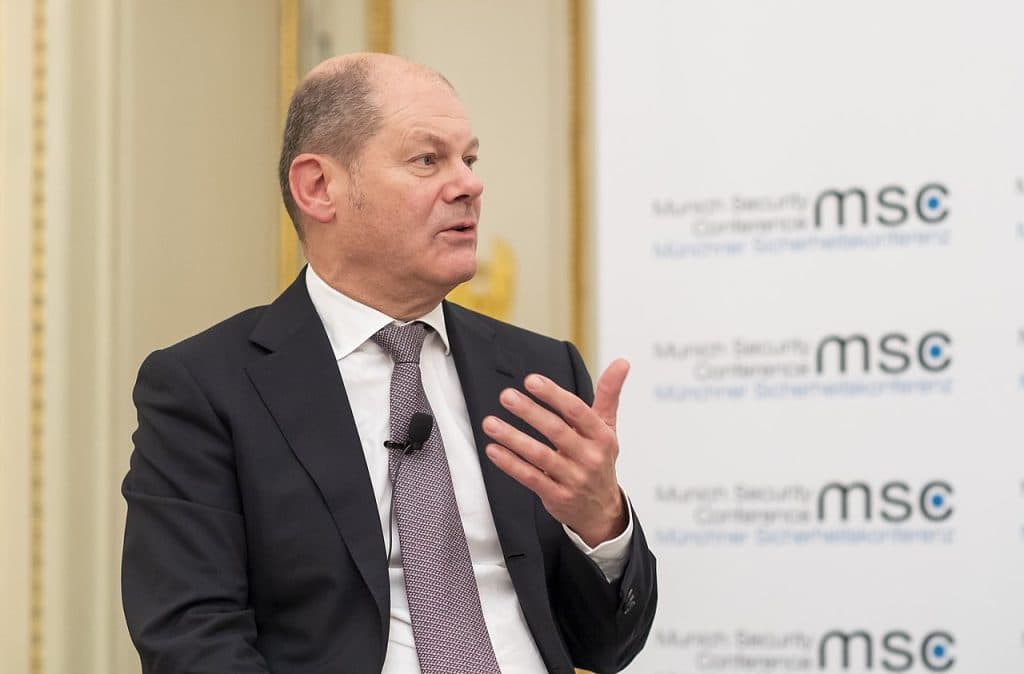
Berlin, Nov. 28 (CTK correspondent) – Germany will end its price controls for electricity, gas and district heating early because of the budget crisis, despite originally planning to subsidise them until March 2024. Chancellor Olaf Scholz said in the Bundestag today that the so-called energy price brake was no longer needed. He also promised that the government would step in if prices rose sharply. The chancellor also assured the public that the budget crisis would have no impact on the state’s day-to-day spending. This means, among other things, that pensioners will continue to receive their pensions and the state will continue to pay housing benefits.
Friedrich Merz, leader of the opposition conservative Christian Democratic Union (CDU), criticised the government in parliament for bringing about the current crisis through its own actions, as it had tried to circumvent budget rules. „The house of cards has collapsed,“ he said. He added that Scholz had started circumventing the rules when he was finance minister in Chancellor Angela Merkel’s (CDU) government.
Federal Finance Minister Christian Lindner spoke a week ago about ending energy price subsidies at the end of this year. Scholz confirmed the plan today. He said the controls would no longer be needed from the new year because gas and electricity prices were affordable again.
„Our storage facilities are full, so we do not need to worry about a sudden spike in prices. But of course, if energy prices rise unexpectedly and dramatically, we are ready to act immediately,“ Scholz said.
According to the media, the cap is currently irrelevant for most households due to the general decline in market energy prices, but it served as a safeguard against possible further fluctuations.
Germany entered a budget crisis in mid-November, when the Constitutional Court ruled that the government could not use the 60 billion euros (CZK 1.47 trillion) transferred to the Climate and Transformation Fund (KTF). It also stated that commitments already approved from this sum would have to be funded another way. The ruling also raised questions about the financing of other off-budget funds, such as the Economic Stabilisation Fund (WSF), into which Germany had put 200 billion euros (CZK 4.9 trillion), among other things, to regulate energy prices.
Because of the Constitutional Court ruling, the government must revise next year’s budget. It is uncertain whether it will be approved this year, but Scholz said the cabinet and parliament were working hard on the changes. Scholz noted that the 2024 budget under preparation would include cuts. The government has decided to amend this year’s budget through a supplementary bill. It aims to provide legal backing for loans worth 43.2 billion euros (CZK 1 trillion) for regulating energy prices and 1.6 billion euros (CZK 39 billion) to help rebuild after the 2021 floods in the Ahr Valley (Ahrtal).
At the start of his speech to MPs, Scholz explained that his government took office in December 2021 amid a severe pandemic and that Russian troops invaded Ukraine shortly afterwards, in February 2022. „Germany has faced severe crises in recent years. The Federal Republic has never before experienced crises of such frequency and severity,“ the chancellor said. He said the government had been right to respond by setting up off-budget funds.
The court’s decision, which Scholz said he accepted, nevertheless means a new financial reality and complications. „Not only for the current government, but also for past and future governments at federal and state level,“ Scholz said of the ruling’s impact.
According to Scholz, the Constitutional Court clarified how the debt brake should be applied. „That had not been clear until now,“ he said. The remark drew jeers from the conservative opposition CDU/CSU alliance. Opposition MPs also burst out laughing when Scholz said that if his government had known this in the winter of 2021, it would have taken a different path. The chancellor was also met with laughter when he used the English phrase ‚You will never walk alone‘, which he has repeatedly used in the past to promise that the government would not abandon anyone. Scholz responded to the jeers by saying he did not understand what was funny. „Perhaps you mean ‚you will never walk with the Christian Democratic Union‘,“ he said, alluding to the opposition CDU.
Despite the current crisis, Scholz said Germany would continue to support Ukraine, including with arms supplies, for as long as necessary. „It is support of existential importance. For Ukraine, clearly, but ultimately for us and for Europe too, if (Russian President Vladimir) Putin were to win,“ he said. According to Scholz, the government will also continue to modernise the country and transform the economy to achieve net-zero carbon emissions.
Translation disclaimer
This article is a machine translation of the Czech original and has not yet been fully reviewed. In case of any doubt, please refer to the Czech version.
Sdílejte článek prostřednictvím:
You might also like
6 November 2026, 10:25