Will Germany see a blanket cut in electricity tax? Merz revives promise after election debacle

German Chancellor Friedrich Merz has pledged to cut electricity tax to the minimum set by European Union regulations. After a series of CDU defeats in state elections, he has revived the party’s pledge. German public broadcaster ZDF reported. A tax break currently reserved for selected sectors would now also apply to households. He wants to fund it based on economic growth forecasts, but the finance minister is sceptical.
Last month, Germany experienced decisive moments for the future of several federal states. Two state elections were held in the eastern part of the country, where energy was among the most prominent campaign issues. The controversial Alternative for Germany (AfD) focused on criticism of the Energiewende and high electricity prices. Elections were also held for the state parliament in the capital, and, as in the previous two contests, the traditional Christian Democratic Union (CDU) suffered a defeat.
In Saxony-Anhalt, where it had previously led the state coalition government, the CDU won just 17.2% of the vote. It thus lost more than half its support compared with the previous election and was soundly defeated by the Alternative for Germany (AfD), which won 43.8%. Two weeks later, it fared even worse in Mecklenburg-Western Pomerania. With 4.9% of the vote, it failed for the first time in its history to clear the 5% threshold required to enter the state parliament. The AfD also won there, with 38.2%, this time with a narrower lead over the Social Democratic Party of Germany (SPD), which received 35.5%. In Berlin, the CDU lost its lead to the left-wing Die Linke, which won 25.7%. The CDU won 18.8%, followed closely by the AfD with 16.3%.
The string of setbacks intensified pressure on Friedrich Merz himself, who has been chancellor for just 16 months. In Germany, the BBC reported, speculation about his possible replacement was openly discussed during September. Eight state premiers from the CDU publicly backed him, but that did not avert a leadership crisis in the party. Among other things, Merz responded by pledging to cut electricity tax for all consumers as much as possible.
Reduced rate to apply to households too
The CDU included this pledge in its so-called immediate programme for prosperity and security, adopted at the party convention in February 2025. It later reaffirmed it in the federal coalition agreement with the SPD and CSU. Under European legislation, the minimum electricity tax rate is 0.1 cents per kWh for households and 0.05 cents for business use.
The Clean Energy Wire website, for example, noted that German households currently pay 2.05 cents per kWh. Last year, citing a tight budget, the government decided that the reduced rate would apply from this January only to companies in manufacturing, agriculture and forestry. Households, trade and services remained subject to the full rate, prompting a wave of criticism from consumer organisations and business associations. As for the savings, Clean Energy Wire cites the comparison website Verivox. According to its estimate, a tax cut would save an average three-person household around 93 euros (CZK 2,239) a year, or about 7% of its electricity bill.
Among the highest prices in the European Union
Public broadcaster ZDF recently also focused on high electricity prices. Citing Eurostat, it said German consumers pay some of the highest prices in the European Union. In the second half of 2025, a kilowatt-hour cost households an average of around 39 cents (CZK 9.60 at the current exchange rate). Ireland fared worst in the statistics, while the Czech Republic came sixth among the EU’s 27 member states, at 32 cents/kWh (CZK 7.80).
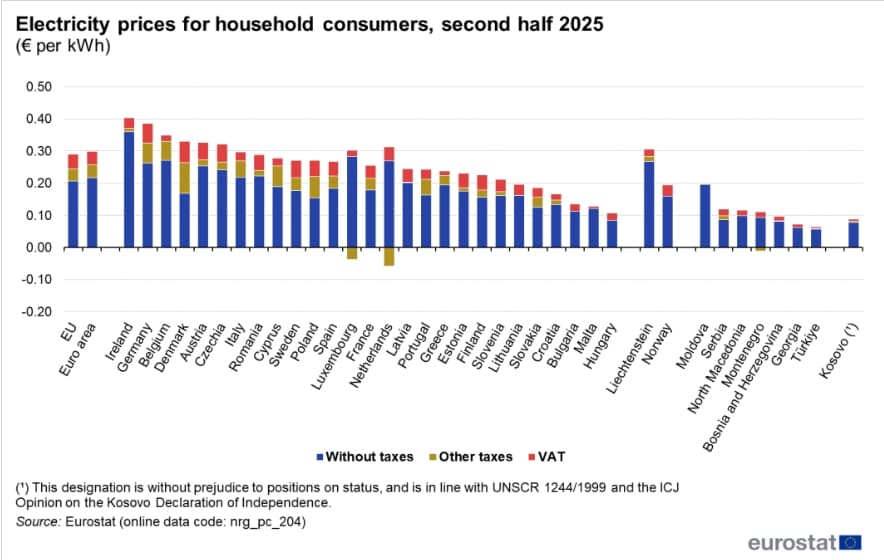
Households pay around 40% for electricity itself—that is, wholesale purchases and suppliers’ margins. Around a quarter of the bill consists of transmission and distribution network charges. These have risen in recent years because of extensive investment in the grid, particularly in power lines intended to bring electricity from the windy north to the industrial south, as well as the costs of managing an overloaded system.
Taxes, levies and charges set by the state account for almost a third of the price. Electricity tax is the only one of these components that the government can cut without complex regulatory changes. Germany is not the only country to have opted for electricity tax relief. Outside the EU, the UK government decided to abolish value-added tax on electricity entirely. For now, this is a temporary measure running from 1 October this year to 31 March 2027.
Will the expected economic recovery cover the costs?
To cover the cost of the tax cut, Merz points to forecasts for growth in the German economy and the additional revenue it would bring. The forecast for this year has been raised from 0.5% to 1.3%, while growth of 1.1% is expected next year. According to Merz, each percentage point of growth would generate around 10 billion euros (CZK 244 billion) in additional revenue from selected taxes, about half of which would go to the federal budget. Finance Minister Lars Klingbeil (SPD), however, does not share this optimism.
“We are pleased to see economic growth return, but I cannot confirm the assumption that it could sustainably fund a cut in electricity tax,” Klingbeil said at a separate press conference on fiscal policy, as reported by Reuters.
Translation disclaimer
This article is a machine translation of the Czech original and has not yet been fully reviewed. In case of any doubt, please refer to the Czech version.