
23 October 2026, 14:38
Loading...
Hydrogen players meet in Prague to discuss Czech hydrogen backbone network
Klára Čeperová
17 November 2024, 10:01
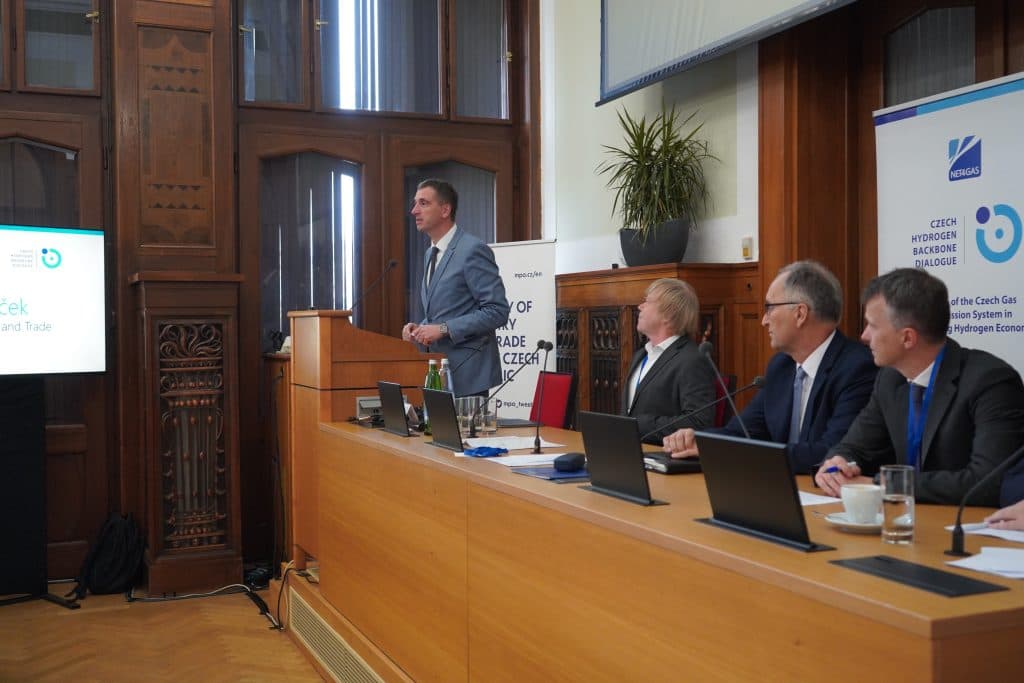
Prague hosted companies from across the hydrogen supply chain, from production and transport to consumption. The conference was organized by NET4GAS together with the Ministry of Industry and Trade.
The gas transmission system operator NET4GAS is involved in four hydrogen partnerships (www.CEHC.eu, www.CGHI.eu, www.SEEHyC.eu, www.SunsHyneCorridor.eu), most recently SEEHyC, which aim to develop capacity to transport affordable renewable and low-emissions hydrogen.
All the partners—operators of European gas transmission systems working with the TSO to develop the corridors—had the opportunity in November to meet with other Czech and European energy and industry representatives at the Czech Hydrogen Backbone Dialogue, where they confirmed their plans to build backbone hydrogen infrastructure in short presentations.
“When planning the hydrogen backbone network, we identified hydrogen production and consumption locations and found the main corridors connecting them. One of these also runs through the Czech Republic. By starting with network planning, we gave producers and consumers confidence that there would be a way to transfer hydrogen between them,” Erik Kolstø, head of Business Development – Hydrogen and Carbon Infrastructure at OGE, explained at the conference.
The approach of using infrastructure as a driver of transformation is supported in her research by systems analyst Donella Meadows. Put simply, it means providing an assurance that can then accelerate the development of a particular sector.
An opportunity for Czechia
This is also an opportunity for the Czech Republic. A look at the map of the future European hydrogen transmission system shows that the country’s hydrogen gas infrastructure could connect future sources of renewable hydrogen in the North and Baltic seas, Ukraine, southern Europe, Greece and North Africa with the relevant end users across Europe. Regional projects will help make this possible; participants at the meeting included future producers, transporters and buyers from the Czech Republic and other countries.
At the conference organized by NET4GAS under the auspices of the Ministry of Industry and Trade, representatives of the operator of the Czech gas transmission system—which will also become a hydrogen network in the future—highlighted the potential of the Czech Hydrogen Backbone Network in line with the national hydrogen strategy. It will connect the main hydrogen production areas with demand centers, both in the Czech Republic and across Europe. The participation of international players points to the growing importance of the Czech Hydrogen Backbone Network in connecting European hydrogen initiatives and to the strategic importance of NET4GAS.
“Thanks to its robust gas transmission infrastructure and its location in the heart of Europe, Czechia has a unique competitive advantage. Our goal is to make the most of this opportunity, which is why we are now working flat out to build a backbone network for hydrogen transport and create European hydrogen corridors,”Industry and Trade Minister Lukáš Vlček said at the conference, adding that hydrogen could also make a significant contribution to achieving Europe’s decarbonization goals.
The time is now
Those goals are drawing closer, with the first milestone coming in 2030, when legislation requires industry and transport to consume specific quantities of hydrogen. Germany is currently furthest ahead in the process of developing infrastructure.
“It took 15 months from the German TSOs’ presentation of the Core Grid to its approval by the Bundesnetzagentur, including the European Commission’s approval of funding,” Kolstø said.
To accelerate the development of hydrogen corridors, gas transmission system operators such as GASCADE, OGE, Eustream, DESFA, GTSOUA and Bulgartransgaz will apply to the European Commission this year for EU Projects of Common and Mutual Interest (PCI/PMI) status. PCI status will allow projects to be approved more quickly, speeding up the construction of hydrogen infrastructure that will efficiently meet growing demand for hydrogen across Europe. This infrastructure will also help reduce Europe’s dependence on fossil fuels and their imports.
Cost
Czech stakeholders are skeptical about the development of the hydrogen economy, primarily because of the commodity’s price. Pavel Farkač, director of development and transformation projects at Se.ven Energy, noted that although the company plans to produce hydrogen itself, it is difficult to find an end customer. The group is nevertheless continuing to develop hydrogen projects.
“For me, the main question is what we will do over the next ten years, when we will be producing hydrogen at high cost and, without a suitable support scheme, it will be difficult to find a customer willing to pay that price,”Jan Šícha added during Farkač’s panel discussion, director of innovation at ČEZ Group.
Translation disclaimer
This article is a machine translation of the Czech original and has not yet been fully reviewed. In case of any doubt, please refer to the Czech version.
Sdílejte článek prostřednictvím:
You might also like


23 October 2026, 11:01


23 October 2026, 06:34