
28 October 2026, 15:10
Loading...
Austrian government strengthens independence from Russian gas
Veronika Jurcová
9 March 2024, 12:54
The Austrian government has agreed to provide the 200 million euros needed to build a gas pipeline that will strengthen the country's ability to import natural gas via Germany. Construction of the key 40km pipeline linking Austria with Germany had been on hold for years, but amid growing political pressure to reduce dependence on Russia, Vienna has now pledged funding, reports Euractiv.
The West Austria Gas Pipeline (WAG), commissioned in 1980, runs for 245 km between the Baumgarten gas hub on the border with Slovakia and Oberkappel on the border with Germany. It was originally designed and technically optimised to transport gas from east to west, with a capacity of approximately 90 TWh/year. In recent years, however, demand for transportation in the opposite direction—from west to east—has continued to grow. The WAG can therefore now operate in reverse flow and supply gas to Austria.
The Austrian government has now approved financial support for expanding the pipeline with a 40-kilometre section from Oberkappel to Bad Leonfelden, which will be supplemented by a parallel line. The so-called WAG Loop 1 will increase Austria's capacity to import gas from Germany by 2.5 billion cubic metres a year (27 TWh per year), or approximately one-third of its total annual capacity. The pipeline could be completed by the end of 2027, just in time to meet the EU deadline for ending Russian gas supplies. This would allow Austria to import all the gas it needs from LNG terminals along the European coast via German territory.
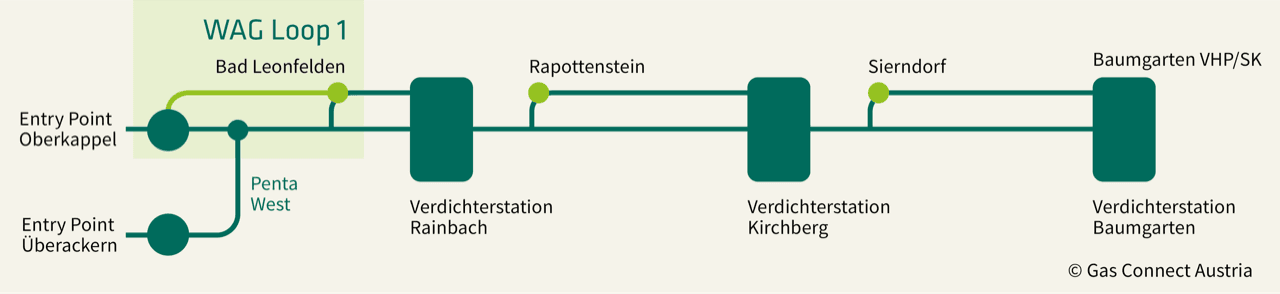
Source: Gas Connect Austria: WAG Loop schematic
The increased capacity will also provide greater flexibility for injecting gas into and withdrawing it from the Haidach and Seven Fields gas storage facilities in Upper Austria. The pipeline is also designed to transport hydrogen in the future, with potential customers including industry in Linz.
From the Czech Republic's perspective, it will provide a competing route for gas transit from Germany, which currently has to pass through the Czech Republic to Slovakia and then to Baumgarten in Austria.
Funding is not the only problem
Funding is not the only obstacle to the project. Another issue is the long-term contract between Austrian company OMV and Russian state-owned company Gazprom, which runs until 2040, reports Euractiv.
When Austria was forced to admit in mid-February that Russian gas accounted for 98% of its recent gas supplies, two years after Russia invaded Ukraine, political pressure to cancel the gas supply contract with Gazprom intensified. The approaching parliamentary elections in September 2024 are also adding to the pressure.
Austria's government, made up of the centre-right ÖVP and the Greens, agrees that the country needs to reduce its dependence on Russia. Green Party Energy Minister Leonore Gewessler has repeatedly stressed that continued Austrian imports help the Kremlin pay for its war against Ukraine, adding a moral obligation—beyond the established economic security reasons—to sever gas ties with Russia.
"We must end gas supplies from Russia; we must get rid of the risk of blackmail," Minister Gewessler said on public broadcaster ORF on Sunday (25 February).
The move is also supported by the liberal opposition party NEOS, Brussels and Austria's energy regulator, E-Control.
Ending the contract with Gazprom
There is no clear political consensus, however, on how to terminate the contract—or whether to do so at all. ÖVP Chancellor Karl Nehammer previously ruled out ending it, citing possible economic consequences.
OMV signed the long-term contract in 2018, committing it to purchase 6 billion cubic metres (bcm) a year until 2040—almost all of Austria's gas consumption. The contract is based on a “take-or-pay” principle, meaning OMV must pay Gazprom whether or not it takes delivery of the gas.
But terminating it is not straightforward. One problem is that the contract with Gazprom is secret, even from lawmakers. Apart from its basic terms, no further details are known. Moreover, the best opportunity to terminate the contract has already been missed.
“The opportunity to exit was a year ago, specifically when Russia failed to deliver the energy volumes it had promised and agreed to supply under the contract,” said Othmar Karas, a vice-president of the European Parliament from the European People's Party (EPP).
When OMV did not cancel the contract at the time, citing a breach of trust, it effectively signalled that supply cuts were acceptable to the company. It is still possible to invoke a breach of trust now, but it is unclear whether that argument would succeed in any arbitration.
OMV's ownership structure is also an issue. Although the company is Austria's main energy supplier, the state owns only a 31.5% stake, ADNOC of the UAE holds 24.9%, and the rest is publicly traded. If the government forced OMV to breach the contract by law, Austria could face legal action for interfering in private business.
Another opportunity to terminate the contract could arise in 2025.
“Under the current circumstances, Ukraine will not extend its gas transit contract with Gazprom, which expires at the end of 2024. That means the gas will no longer reach us, and we will have the opportunity to terminate the contract,” Karas said.
It is not yet clear, however, whether the political will to do so will remain until 2025. Austria's elections will be held in September, and the far-right FPÖ, which previously signed a friendship agreement with Vladimir Putin's United Russia party, is comfortably leading the polls with 30% of the vote. The party is certainly not in favour of getting rid of Russian gas.
Translation disclaimer
This article is a machine translation of the Czech original and has not yet been fully reviewed. In case of any doubt, please refer to the Czech version.
Sdílejte článek prostřednictvím:
You might also like

28 October 2026, 13:08

28 October 2026, 11:10

28 October 2026, 09:08
