11 October 2026, 08:24
Loading...
Greenland dispute highlights risks of Europe’s dependence on US LNG

David Vobořil
22 January 2026, 06:58
The European Union has very limited room to maneuver in retaliating against the newly announced US tariffs. Analysts warn that any move to restrict imports of liquefied natural gas (LNG) from the US would be economically and energetically self-destructive for Europe. Dependence on US gas supplies has deepened significantly since the shift away from Russian fossil fuels, and alternatives are limited in the short term.
Europe is unlikely to respond to the threat of US tariffs with countermeasures restricting LNG imports from the US, analysts say. The reason is its high dependence on US gas supplies and the lack of realistic alternatives that could be mobilized quickly.
Experts told Montel this in response to US President Donald Trump’s remarks over the weekend, in which he threatened to impose tariffs on goods from eight European countries until he secures a deal to buy Greenland.
“Europe’s position in energy markets is too weak for it to be used as a primary tool against the US over Greenland,” said Henning Gloystein, director for energy and industry at consultancy Eurasia Group. He said European leaders are instead concerned that the United States could use its dominant position in LNG supplies to exert political pressure on Europe.
Impact on the European market
While the US continues to press Europe to buy more LNG and is unlikely to restrict exports in the short term, the mere possibility of the US limiting LNG exports could affect European markets, said Andreas Goldthau, director of the Willy Brandt School of Public Policy at the University of Erfurt.
The United States became a key gas supplier to Europe after Russia’s invasion of Ukraine. As part of its efforts to break away from Russian fossil fuels, the EU significantly increased its imports of LNG from the US. Any sanctions or restrictions on these flows would drive up procurement costs, increase price volatility and intensify competition with Asia for flexible LNG supplies, analysts say.
“Without a coordinated replacement plan—additional LNG supplies from outside the US, a more significant reduction in consumption or emergency measures involving storage—such a move would be economically counterproductive,” Gloystein warned.
Independent LNG market analyst Thanasis Konstantopoulos made a similar point, saying that restricting US supplies is theoretically possible but very difficult to implement in practice without jeopardizing security of supply.
“Europe’s relative political and economic weakness is being ruthlessly exploited by the major geopolitical players today, especially the United States, Russia and China,” Gloystein added. In this environment, analysts say, the EU is unlikely to risk destabilizing its own energy system in retaliation against the US in a trade dispute.
US gas accounts for 60% of LNG imports, and that share is set to grow
Last year’s import figures also illustrate Europe’s dependence on US LNG. In 2025, Europe imported a record 65.2 million tonnes of LNG from the US, equivalent to around 88.7 billion cubic meters of gas (bcm) and nearly 60% of all LNG imports into the region. This was a year-on-year increase of 58%, according to data from Kpler.

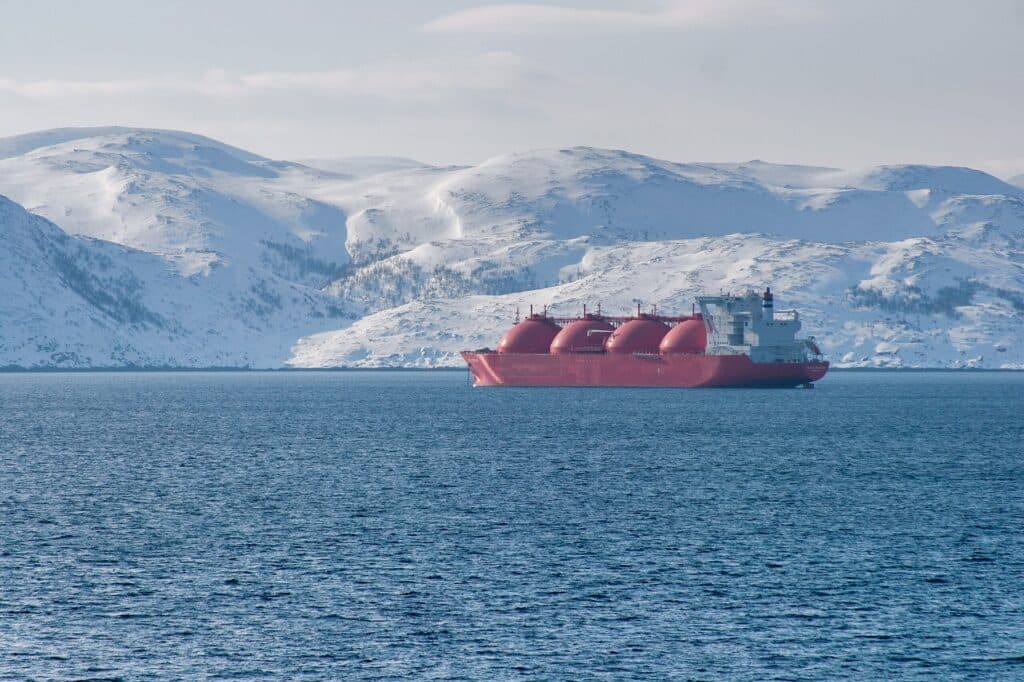
LNG tanker at the LNG terminal in Brunsbüttel, Germany. Source: Press RWE
This dependence could deepen further in the coming years. In mid-2025, the European Union committed to buying up to $750 billion worth of energy commodities from the US by 2028, including LNG, oil and other products.
According to analysts at the Institute for Energy Economics and Financial Analysis (IEEFA), if these agreements are fulfilled and efforts to reduce gas consumption fail, EU imports of US LNG could rise to as much as 115 billion cubic meters a year by 2030. That would mean 75 to 80% of all LNG would come from the US.
Some experts, however, point out that Europe has options to reduce this dependence, at least over the longer term. According to Anne-Sophie Corbeau, a researcher at Columbia University’s Center on Global Energy Policy, the solution lies primarily in investments in energy efficiency, much greater electrification and reducing gas consumption in the residential heating sector. Qatar appears to be the only realistic alternative for LNG supplies.
“The only real option for diversifying supplies away from US LNG is Qatar, the only country with large volumes of LNG that are not tied up in contracts,” Corbeau added.
Mutual dependence
In the short term, the US administration is unlikely to halt LNG exports to Europe, said Anna Lentschig, a researcher at the Dutch think tank Clingendael Institute.
For the US president, halting or restricting exports would amount to “shooting himself in the foot” and would affect the credibility of the US as a supplier, Corbeau said.
Trump could, however, impose tariffs on US LNG supplies to Europe to restrict its gas supplies, Lentschig added. This would hurt the US domestic gas industry, which is already looking for new buyers in Europe and Asia, she said.
“LNG exporters that have already taken final investment decisions and invested money in export capacity would likely turn to the courts if the Trump administration adopted a more restrictive export policy or even revoked permits,” said Andreas Goldthau, director of the Willy Brandt School of Public Policy at the University of Erfurt.“It cannot be ruled out, however, that Trump will first test the waters,” he added.
However, US Trade Representative Jamieson Greer said on Tuesday that the US would continue to supply LNG to Europe, despite current geopolitical tensions.
“The United States will continue to be a significant source of LNG for Europe and the world, and we are glad to work with Europe to find a way to supply it,” Greer told Montel at the World Economic Forum summit in Davos.
Trump could instead put greater pressure on Europe to buy larger quantities of energy commodities from the US.
Translation disclaimer
This article is a machine translation of the Czech original and has not yet been fully reviewed. In case of any doubt, please refer to the Czech version.
Sdílejte článek prostřednictvím:
You might also like


10 October 2026, 13:19

10 October 2026, 07:37
10 October 2026, 07:02