
23 October 2026, 14:38
Loading...
PPK: Czech decarbonization requires abandoning ideological absolutism
Klára Čeperová
26 October 2024, 12:54
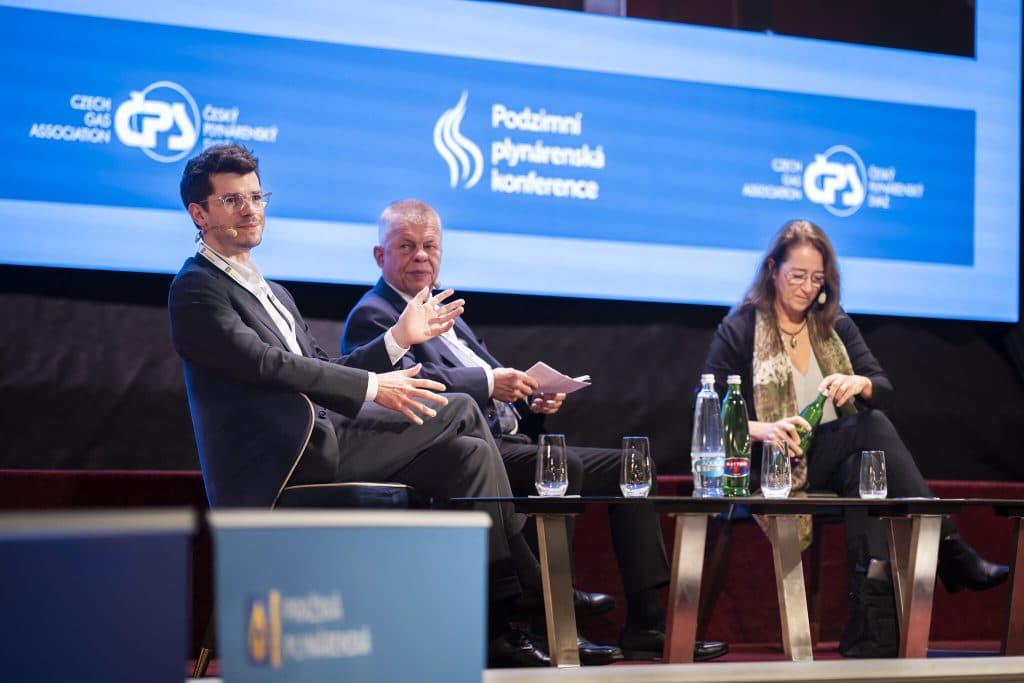
The Autumn Gas Conference featured Barbara Jinksová, Victor Bernabeu, Wolfgang Peters and Patrick Peichert on a panel. They discussed how the EU is currently working to develop renewable and low-carbon gases, such as hydrogen and biomethane, which can help achieve the EU’s climate targets.
Hydrogen distribution networks can provide the essential links between producers and consumers of the commodity. This could lead to a reduction in CO2 emissions of more than 500 million tonnes a year, create a million jobs in Europe and support the decarbonization of European manufacturing, thereby preventing industry from relocating to countries with less stringent requirements for decarbonizing processes.
This is one of the conclusions reached by the Ready4H2 initiative, which brings together 70 distribution and local gas network operators and national associations in 9 European countries. GasNet is its Czech member. Barbara Jinksová, the initiative’s director and one of three women speakers at the PPK, presented it at the Autumn Gas Conference in a panel on the European perspective on the gas industry.
During the discussion, she noted that according to an analysis by IRENA, meeting the goals of the 2015 Paris Agreement on climate change will require the share of electricity in the energy mix to rise from 22 % in 2020 to 51 % in 2050. Jinksová said this leaves plenty of room for the use of gases.
“Europe’s task is not to say that fracking will work and hydrogen will not. We must allow all options: nuclear power, low-emission hydrogen, biomethane, CCU/CCS,” said the director of Ready4H2.
Technological neutrality
All panelists generally agreed on the principle of technological neutrality.
“Legislators have become detached from reality. We have no incentives for biomethane or biomethane targets, and no support for blue or pink hydrogen, for example. We are focusing only on renewable hydrogen, but we lack regulation and the right mix of support for different alternatives,” said Victor Bernabeu, policy director of the Eurogas association.
Last year, the World Biogas Association and 46 other organizations involved in decarbonizing the gas industry in Europe, for example, called for binding targets for biomethane production in the EU. They sent a joint letter to EU policymakers, urging the EU to include a binding target for the expansion of biomethane by 2030 in its hydrogen and gas package.
In addition, the signatories called for a broader binding EU-level target to develop all renewable gases, accompanied by specific measures requiring a reduction in greenhouse gas intensity across the gas mix by 2030.
Security, affordability and sustainability
Bernabeu also pointed out that the EU had focused exclusively on sustainability in all its legislation, leaving out the other two pillars—security of supply and affordability.
According to Wolfgang Peters, owner of “The Gas Value Chain Company GmbH” and a former employee of RWE Transgas, Duke and Mobile, this is one of the mistakes Germany is making.
“Germany is focusing solely on hydrogen and is not thinking about affordability. On top of that, we are banning other options for decarbonization, such as nuclear power. We are going through a coal and nuclear phase-out, banning the use of CCU/CCS and regulating hydrogen production extremely tightly,” Peters said in the discussion.
According to the panelists, hydrogen is part of the solution, but it is not the only solution, and other gases should also be developed with the same level of commitment.
Translation disclaimer
This article is a machine translation of the Czech original and has not yet been fully reviewed. In case of any doubt, please refer to the Czech version.
Sdílejte článek prostřednictvím:
You might also like


23 October 2026, 11:01


23 October 2026, 06:34